
Published: April 23, 2026 | thefinalconvergence.com
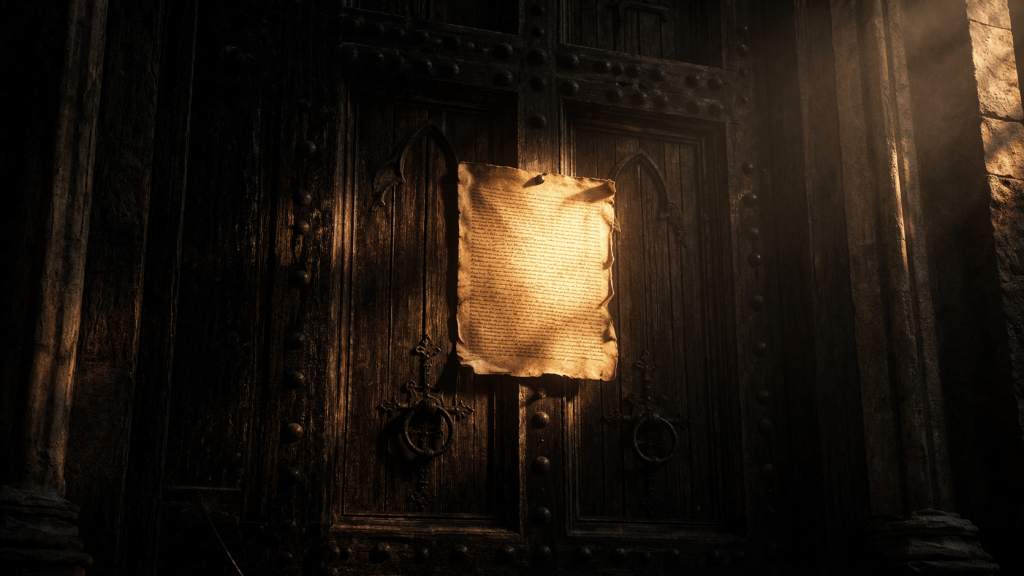
On October 31, 1517, an Augustinian monk named Martin Luther nailed ninety-five theses to the door of the Castle Church in Wittenberg, Germany, and in doing so, ignited the most significant theological controversy in the history of the Western church.
The controversy was not primarily about indulgences, though indulgences were the presenting issue. It was not primarily about papal authority, though that came quickly into focus. At its deepest level, the controversy was about a single question that has never lost its urgency in the five centuries since Luther drove his nail into that church door:
Who has the final say?
Rome’s answer was clear and had been clear for centuries: the Church, meaning the magisterium, the councils, the pope speaking ex cathedra, has the final authority to determine what Christians must believe and how they must live. Scripture is authoritative, but it cannot be properly understood apart from the authoritative teaching of the Church. Tradition stands alongside Scripture as an equal source of divine revelation.
Luther’s answer, the answer that cost him everything and launched the Reformation, was equally clear:
Sola Scriptura.
Scripture alone. The written Word of God, and the written Word of God alone, is the final, sufficient, and authoritative standard for all matters of faith and practice. Not tradition. Not councils. Not popes. Not the accumulated wisdom of the ages. Scripture alone.
That principle is not merely a piece of Reformation history. It is the most urgent theological commitment the church can make in the twenty-first century, because the same pressures that confronted Luther are confronting the church today, wearing different clothes.
What Sola Scriptura Actually Claims
Sola Scriptura is one of the most frequently misunderstood principles in Protestant theology, both by those who oppose it and by those who claim to hold it.
It does not claim that the Bible is the only thing that exists or that should be consulted in the Christian life. It does not claim that church history, creeds, confessions, and the wisdom of godly teachers across the centuries have no value. It does not mean that every Christian is an island, free to interpret Scripture in complete isolation from the community of faith across time.
What Sola Scriptura claims is more specific and more decisive than any of these caricatures:
Scripture is the final authority. Not the only resource, the final authority. When Scripture and tradition conflict, Scripture wins. When the pronouncement of a council contradicts the clear teaching of the Word, the council is wrong. When the claimed revelation of an apostle or prophet adds to or contradicts Scripture, the claimed revelation is rejected, because the Word is the standard against which all other claimed sources of truth are measured.
“All scripture is given by inspiration of God, and is profitable for doctrine, for reproof, for correction, for instruction in righteousness: that the man of God may be perfect, throughly furnished unto all good works” (2 Timothy 3:16-17).
Throughly furnished. Lacking nothing. The Scripture that God has breathed out is sufficient to equip the believer completely for every good work. If the believer is throughly furnished by Scripture alone, lacking nothing, then no additional source of authoritative revelation is necessary.
That is Sola Scriptura. Final authority. Complete sufficiency. The Word above all.
The Five Solas and Their Unity
Sola Scriptura was not the only battle cry of the Reformation. It was one of five, the five solas, each of which expressed a crucial aspect of the Reformation’s recovery of biblical truth.
Sola Scriptura, Scripture alone as the final authority. Sola Gratia, Grace alone as the basis of salvation. Sola Fide, Faith alone as the instrument of justification. Solus Christus, Christ alone as the mediator between God and man. Soli Deo Gloria, To God alone be the glory.
These five are not independent theological preferences that can be held in isolation from each other. They are an integrated system, and Sola Scriptura is the epistemological foundation on which all the others rest.
Without Sola Scriptura, you have no reliable basis for Sola Gratia, because if tradition can supplement Scripture, the traditions of merit, penance, and purgatory can qualify grace in ways the Word does not authorize. Without Sola Scriptura, you have no reliable basis for Sola Fide, because the councils can declare faith alone to be anathema, as Trent did in 1547, and if councils share authority with Scripture, that declaration carries weight. Without Sola Scriptura, Solus Christus can be qualified by mediators, Mary, the saints, the pope, whose authority comes not from the Word but from tradition.
Every corruption of the gospel ultimately traces back to a departure from Sola Scriptura. When another source of authority is allowed to stand beside or above the Word, the Word is always diminished, and the gospel always suffers.
Sola Scriptura vs. Solo Scriptura
One of the most important distinctions in this discussion is the difference between Sola Scriptura and what is sometimes called Solo Scriptura, a distinction that is often missed and that leads to significant confusion.
Solo Scriptura, the position that every individual believer interprets Scripture entirely on their own, without reference to the church, to church history, or to the wisdom of godly teachers across the centuries, is not the Reformation position. It is actually a distortion of the Reformation position that leads to theological individualism and ultimately to the very instability the Reformers sought to correct.
The Reformers did not dismiss the creeds, the councils, or the insights of the church fathers. They used them, extensively. What they insisted was that these things served Scripture rather than standing alongside it as equal authorities. The Nicene Creed is valuable because it accurately summarizes what Scripture teaches about the nature of Christ. The moment a creed departs from Scripture, the creed must be corrected, not Scripture.
This distinction matters practically because the legitimate use of church history, biblical scholarship, and theological tradition is not a concession to Rome’s position. It is the Reformation position, properly understood. The believer who studies the early church fathers to better understand how the apostolic church read Scripture is not abandoning Sola Scriptura. The believer who submits the fathers’ conclusions to the bar of Scripture, ready to correct them where they depart from the Word, that is Sola Scriptura in action.
The Berean Test Applied to Tradition
The clearest practical expression of Sola Scriptura is the Berean test, applied not just to contemporary teachers but to the entire accumulated tradition of the church.
“These were more noble than those in Thessalonica, in that they received the word with all readiness of mind, and searched the scriptures daily, whether those things were so” (Acts 17:11).
Whether those things were so. The Bereans did not ask whether Paul’s teaching was consistent with the tradition of the synagogue. They did not ask whether it had been approved by recognized authorities. They searched the scriptures to determine whether it was true.
That same test applies to every tradition, every creed, every confessional statement, every catechism, every papal encyclical, every prophetic declaration, every apostolic decree that has ever been produced in the name of the Christian faith.
Does it agree with Scripture? If yes, it can be held with appropriate weight and confidence, as a human expression of divine truth. If no, it must be corrected, regardless of its age, regardless of the authority of its source, regardless of how many generations of believers have held it without question.
This is not arrogance. Luther was accused of arrogance, of placing his individual judgment above the collective wisdom of councils and popes. His answer at the Diet of Worms remains one of the most important statements of the Reformation principle:
“Unless I am convinced by the testimony of the Holy Scriptures or by evident reason, for I do not trust either in the pope or in councils alone, since it is well known that they have often erred and contradicted themselves, I am bound by the Scriptures I have quoted and my conscience is captive to the Word of God. I cannot and will not recant anything, since it is neither safe nor right to go against conscience. Here I stand. I cannot do otherwise. God help me.”
Here I stand.
Not on tradition. Not on councils. On the Word of God.
Why Sola Scriptura Matters Now More Than Ever
The pressures against Sola Scriptura in the twenty-first century come from multiple directions simultaneously, and they are more subtle than the pressure Luther faced, which is precisely what makes them more dangerous.
From Rome, the pressure is ecumenical, the suggestion that the Reformation was a tragic misunderstanding that faithful Christians on both sides are now moving to correct. From the NAR, the pressure is prophetic, the ongoing flow of fresh revelation that supplements and in practice supersedes the written Word. From progressive Christianity, the pressure is hermeneutical, the claim that Scripture must be reread through contemporary cultural lenses that correct the biases and limitations of its human authors. From the seeker-sensitive movement, the pressure is pragmatic, the felt needs of the congregation take priority over the demands of the text.
Every one of these pressures has the same effect: something else gains authority alongside or above the Word. And every time that happens, the gospel suffers.
“For I am not ashamed of the gospel of Christ: for it is the power of God unto salvation to every one that believeth” (Romans 1:16).
The power is in the gospel. The gospel is in the Word. And the Word is protected, its purity, its sufficiency, its final authority, by Sola Scriptura.
The Reformation was not a historical event that has been resolved. It was the recovery of a principle that must be recovered in every generation, because every generation faces the same pressure to let something else stand beside the Word and share its throne.
Here I stand. On the Word of God. Alone.
That is where the church has always found its footing when everything else has shifted.
📖 This post is adapted from What Is Truth? Unshakable Truth in a Post-Truth World. If it helped you, the full book is available on Amazon — or you can support this ministry directly.
This article is part of the What Is Truth? series. View all articles here → What Is Truth? — Articles, Teachings, and Biblical Analysis
Explore more at thefinalconvergence.com | Follow on Instagram, Facebook, X, and YouTube
If you like to be updated on new blogs, sign up to our newsletter!


Leave a comment