
Published: May 17, 2026 | thefinalconvergence.com
It is here. Seven days of questions. Seven days of building toward the center of something. Seven days of naming the problem from every angle — the complication strategy, the additions, the sincere millions trusting the wrong thing, the traditions that have been repositioned from fruit to root, the gospel that does not need help, the open door that has always been there.
Today I open the door.
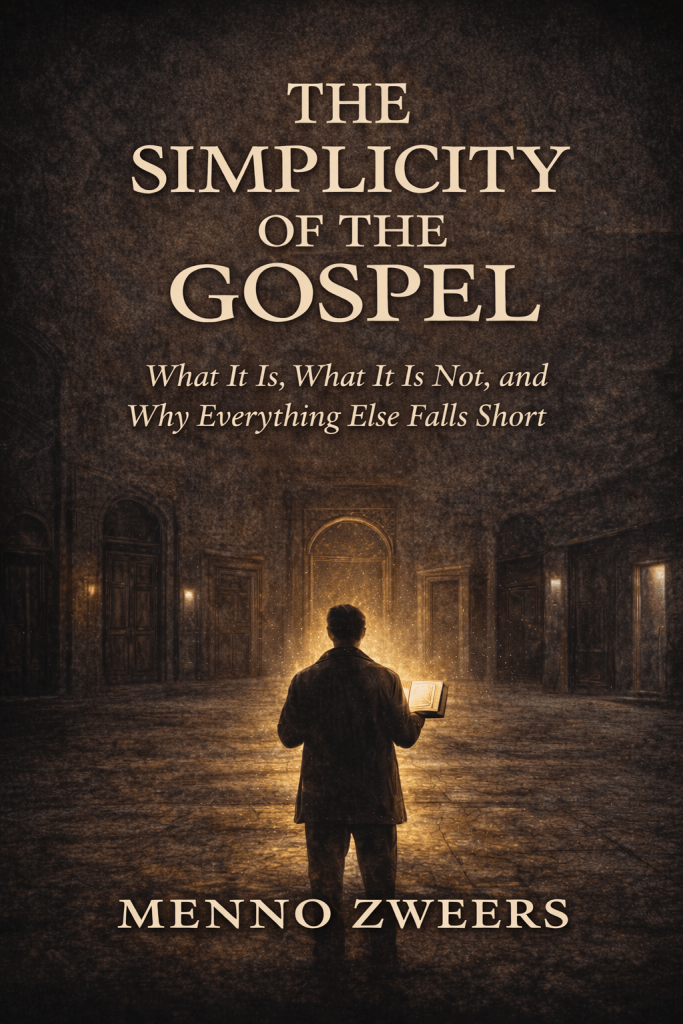
The Book
The Simplicity of the Gospel: What It Is, What It Is Not, and Why Everything Else Falls Short
Book 2 Written by Menno Zweers
This is the second volume in series. If What Is Truth? asked the most fundamental question a believer in the post-truth age can ask, this book answers the most urgent one. Not what is truth in the abstract. What is the gospel specifically, precisely, and sufficiently. And what has been replacing it in the traditions, movements, and systems that millions of sincere people call Christianity today.
Why This Book Exists
Paul wrote to the Corinthians from a place of fear. Not the fear of Rome. Not the fear of persecution, imprisonment, or execution, all of which he had faced and would face again. A deeper fear. A pastoral fear. The fear of a shepherd who sees the wolves not at the gate but inside the fold, dressed in sheep’s clothing, feeding the flock something that looks like the gospel and is not.
“But I fear, lest by any means, as the serpent beguiled Eve through his subtilty, so your minds should be corrupted from the simplicity that is in Christ.” — 2 Corinthians 11:3 KJV That fear is not ancient history. It is the description of right now.
Across the world, tens of thousands of churches gather every week. Millions of sermons are preached. Stadiums are filled. Religious media reaches billions. And in the midst of all that noise, the actual gospel of Jesus Christ, as Paul gave it in four sentences in 1 Corinthians 15, is being heard less and less. Because what is filling the space is not the gospel. It is the gospel complicated. The gospel supplemented. The gospel replaced by something that uses the same language, invokes the same name, claims the same authority, and cannot save.
The Simplicity of the Gospel was written because that situation demands a response. Not an academic response. A pastoral one. Written not from a safe theological distance but from nearly four decades of experience inside the movements this book examines, and from the slow, costly, liberating process of coming out of them and returning to the Word alone.
What the Book Contains
Part One — What the Gospel Is
The book begins not with the counterfeits but with the real. Christ died for our sins according to the scriptures. He was buried. He rose again on the third day according to the scriptures. Four sentences. The whole gospel. Not a starting point that requires expansion, the complete declaration of what God did in Christ for the salvation of every person who will repent and believe.
This section establishes what repentance actually is, not mere sorrow, not emotional remorse, but the metanoia that turns. What faith actually is, not mental assent, not emotional response, but the fiducia that entrusts the whole soul to the finished work of Christ. And what the holiness of God actually demands, because you cannot understand why the gospel is good news until you understand why the bad news is as bad as it is.
Part Two — What the Gospel Is Not
The second section turns toward the counterfeits, not to condemn the people inside them, but to examine each system against the standard Paul gave. Each chapter asks the same diagnostic question: does this present the four sentences as sufficient, or does it require something alongside them as a condition of salvation?
Part Three — Five Systems Examined
This is the heart of the book. Five major systems. Each one historically significant. Each one holding millions of sincere believers. Each one examined from Scripture alone, no ad hominem, no caricature, no dismissal of the genuine devotion within each tradition. Just the Word. And the question the Word demands: what has been added to the four sentences?
The five systems are:
Roman Catholicism — the sacramental system, the Mass as ongoing sacrifice, purgatory, the mediation of Mary and the saints. Each element measured against the finished work declared in Hebrews 10:10-14 and the one mediator declared in 1 Timothy 2:5.
The Charismatic Movement — tongues as required evidence, experiential validation as the standard of spiritual reality, the elevation of feeling above the sufficient Word. Measured against 1 Corinthians 12:29-30 and the sufficient lamp of Psalm 119:105.
The New Apostolic Reformation — restored apostolic and prophetic authority supplementing the closed canon, the Seven Mountain Mandate replacing the Great Commission, ongoing revelation requiring the Word to be held loosely. Measured against Ephesians 2:20, Revelation 22:18, and the Deuteronomy 18:22 prophetic standard.
Legalism — the performance-based gospel that evaluates standing before God by behavioral compliance, that produces the whitewashed tombs of Matthew 23 and the weary bondage of those trying to earn what grace has freely given. Measured against Romans 4:5 and Galatians 5:1.
The Prosperity Gospel and Therapeutic Self-Gospel — health, wealth, and your best life now as the content of the gospel’s promises; the therapeutic gospel that presents Christ as the answer to felt needs without ever naming the actual need. Measured against 2 Timothy 3:12 and 1 Corinthians 15:17.
Part Four — The Return to Simplicity
The book does not end with examination. It ends with invitation. The same invitation that has been extended since the first century and that no complication has ever permanently closed. Come to Christ. Repent and believe the gospel. Trust in the finished work of the Son of God, in His death, His burial, His resurrection, as the complete and sufficient ground of your standing before a holy God. Without supplement. Without condition. Without the mediation of any institution, any sacrament, any experience, any ongoing prophetic voice.
Simply. Completely. By grace. Through faith. In Christ alone.
The Appendices
Six appendices provide additional tools: a comprehensive collection of gospel proclamation Scriptures organized by theme, an examination of the Five Solas and their relationship to the simple gospel, a Gospel Proclamation Checklist for evaluating any message claiming to be the gospel, study questions for each chapter, a glossary of key terms, and a recommended reading list for deeper study.
Who This Book Is For
It is for the Catholic who has never been told that the sacrifice of Christ was finished, tetelestai, it is finished, and that nothing remains to be added by the Mass, earned through purgatory, or mediated through Mary.
It is for the Charismatic who has been chasing fire for years and never found the settled peace that the simple gospel was designed to give, because peace is not found at the next conference or in the next prophetic word but in the finished work of the One who said “It is finished” and meant it completely.
It is for the person in the prosperity pew who has been giving their seed-faith offerings and wondering why the formula is not producing the promised results, because Christ did not die so that your bank account would grow. He died so that your sin would be forgiven and you would stand before a holy God in the righteousness of His Son.
It is for the person inside the NAR who is beginning to sense that something is not right, that the ongoing apostolic declarations and prophetic directions have not produced what they promised, because the Word is sufficient, the canon is closed, and the simple gospel that twelve ordinary men took to the world without a single apostolic network is still — still — the power of God unto salvation.
It is for the legalist who is exhausted from trying to earn what grace freely gives, because “Come unto me, all ye that labour and are heavy laden, and I will give you rest” was addressed precisely to you.
It is for the new believer trying to build a faith in a world that offers a hundred versions of the gospel and no reliable way to test them.
It is for the pastor and teacher who carries the weight of feeding people truth rather than tradition.
It is for everyone who has ever sat in a church and sensed that something was missing, or something was added, without being able to name it.
When and Where
The Simplicity of the Gospel: What It Is, What It Is Not, and Why Everything Else Falls Short is available now on Amazon, paperback and Kindle.
The 30-day blog series begins on launch day, a new post every day for thirty days going deeper into every theme the book raises. Subscribe to thefinalconvergence.com to receive every post. Follow on Instagram, Facebook, X, and YouTube.
A Final Word
Paul wrote with tears when he named the false teachers. Not because he enjoyed confrontation. Because the souls of the people he was writing to were real. Their sincerity was real. And what was at stake was real. This book was written from the same place.
Not anger. Urgency. Not contempt. Concern. Not the cold theological satisfaction of being right. The deep, genuine, pastoral conviction that every person who has been given a complicated gospel deserves to know what the simple one actually is, and that knowing it might be the most important thing that happens to them in this life.
The gospel is simple. It has always been simple. And it is still, after twenty centuries of every complication the serpent has managed to introduce, exactly sufficient. Christ died for our sins according to the scriptures. He was buried. He rose again the third day according to the scriptures.
That is the gospel. It has always been enough.
“For I am not ashamed of the gospel of Christ: for it is the power of God unto salvation to every one that believeth.” — Romans 1:16 KJV
📖 This post is adapted from The Simplicity of the Gospel: What It Is, What It Is Not, and Why Everything Else Falls Short. If it helped you, the full book is available on Amazon — or you can support this ministry directly.
📖 What Is Truth? Unshakable Truth in a Post-Truth World — Book 1 still available. Get Book 1 on Amazon →
thefinalconvergence.com | Follow on Instagram, Facebook, X, and YouTube
If you like to be updated on new blogs, sign up to our newsletter!


Leave a Reply