
Published: May 24, 2026 | thefinalconvergence.com
Yesterday we stood at the cross. We examined what actually happened there, not the symbol, not the demonstration, not the moral example, but the specific judicial transaction in which the Son of God bore in His body the full penal consequence that divine justice demanded against human sin. The great exchange. His righteousness credited to the sinner. The sinner’s debt paid in full. Tetelestai, finished.
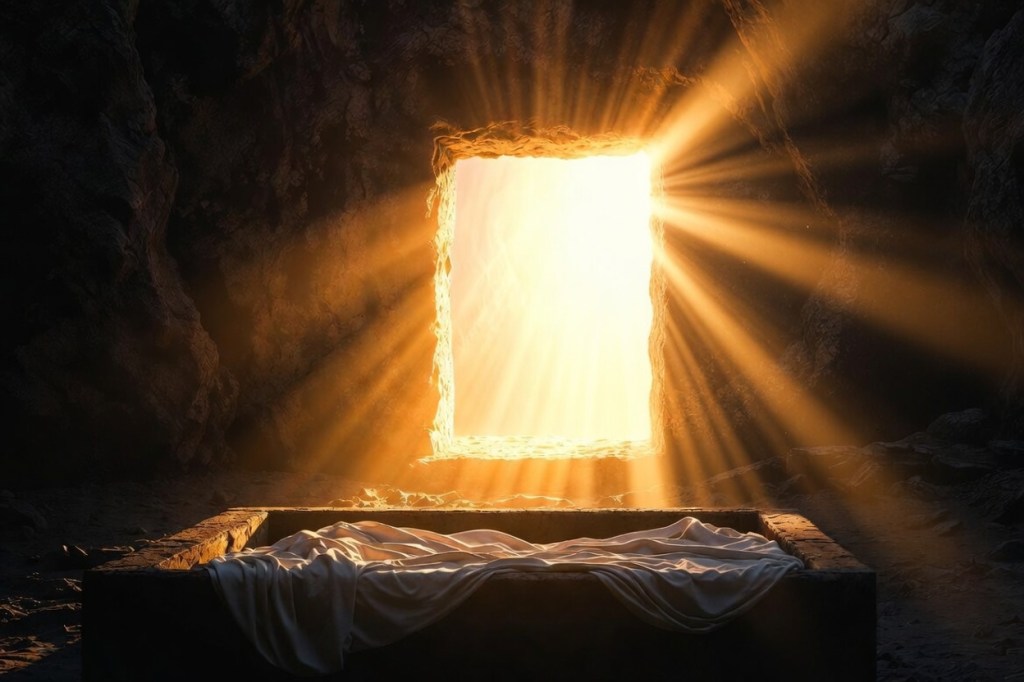
Today we move three days forward. The stone is rolled away. The grave clothes are lying there, collapsed, as if the body simply passed through them. Mary Magdalene stands weeping outside the tomb and hears her name spoken by the one she thought was dead. Two disciples walking to Emmaus encounter a stranger on the road and their hearts burn within them as He opens the Scriptures. Thomas, who refused to believe without seeing, collapses when he sees, “My Lord and my God.”
The resurrection. Not a metaphor for hope. Not a spiritual renewal. Not the ongoing influence of a great teacher living on through His followers. A bodily, historical, physical resurrection, the literal walking out of a sealed tomb by the Son of God in the same body that had been nailed to the cross, buried, and sealed with a Roman guard.
And according to Paul, it is not optional.
What Paul Says About the Resurrection
The most concentrated biblical argument for the necessity of the resurrection is in 1 Corinthians 15, the same chapter where Paul gives us the four sentences of the gospel. He does not move on from the resurrection as a settled matter. He defends it, argues for it, and then presses into its consequences with a precision that leaves no room for a gospel that treats the resurrection as a secondary matter. “And if Christ be not raised, your faith is vain; ye are yet in your sins” (1 Corinthians 15:17). Four consequences Paul draws from a hypothetical resurrection denial, and each one is more devastating than the last.
Your faith is vain. Empty. Worthless. Not imperfect or incomplete, vain. If Christ did not rise, then what the believer has placed their trust in is nothing. The object of faith has not proven itself. The cross, without the resurrection, is simply another execution. The tomb, without the empty tomb, is simply a grave.
Ye are yet in your sins. This is the most devastating consequence and the most direct connection between the resurrection and the atonement. If Christ did not rise, if the Father did not raise Him from the dead, then the sacrifice was not accepted. The debt was not paid. The offering was insufficient. The sinner is still carrying the full weight of their transgression with no resolution in sight.
Then they also which are fallen asleep in Christ are perished. Every believer who has died trusting in Christ, every martyr, every saint, every ordinary person who lived and died in the hope of the resurrection, perished. Their faith was a tragic delusion. Their hope was empty. The comfort that sustained them through suffering was false.
We are of all men most miserable. If the resurrection did not happen and Christianity is built on a lie, then the people who gave up most for it, who suffered most for it, who organized their entire lives around it, are the most pitiable people in history. They traded comfort, security, social acceptance, and in many cases their lives, for a story that was not true.
Paul does not soften these consequences. He presses them to their full logical conclusion, because he is making the argument from the other direction. These consequences are so devastating that they constitute the proof of the resurrection’s necessity. A faith without the resurrection is not merely incomplete. It is worthless, sin-laden, death-doomed, and pitiful. The resurrection is not a bonus feature of the gospel. It is the load-bearing wall.
What the Resurrection Actually Is
The resurrection is the Father’s verdict on the Son’s sacrifice. This is the theological connection that is most consistently missed when the resurrection is treated as a separate miracle rather than as the necessary completion of what the cross accomplished.
At Calvary, the Son bore the sin of His people and paid the penalty divine justice demanded. But justice does not simply receive a payment, it must declare the payment sufficient. The court must render its verdict. The judge must declare the account settled. The resurrection is that declaration.
When God the Father raised the Son from the dead on the third day, He was announcing to the universe that the sacrifice was accepted. The debt was paid in full. The penalty has been satisfied. The offering was sufficient. The verdict of divine justice is: tetelestai, it is finished, and the one who made the payment has been vindicated.
“Who was delivered for our offences, and was raised again for our justification” (Romans 4:25). Raised again for our justification. Not raised as an interesting miracle separate from the atonement. Raised specifically for our justification, the resurrection is the grounds of the judicial declaration that the sinner who trusts in Christ is righteous before God. The empty tomb is the receipt for the payment the cross made.
Without the resurrection, the payment has been made but the receipt has not been issued. The sacrifice has been offered but the Father has not declared it accepted. The cross, without the resurrection, is an incomplete transaction.
The Evidence for the Empty Tomb
Paul does not treat the resurrection as a matter of faith only, as something to be accepted without evidence on purely theological grounds. He presents it as a historical event with historical witnesses. “After that, he was seen of Cephas, then of the twelve: after that, he was seen of above five hundred brethren at once; of whom the greater part remain unto this present, but some are fallen asleep. After that, he was seen of James; then of all the apostles. And last of all he was seen of me also” (1 Corinthians 15:5-8).
Five hundred at once. Of whom the greater part remain at the time Paul is writing, meaning they are alive, available, interrogatable, falsifiable witnesses. Paul is not making an appeal to private spiritual experience or unverifiable mystical encounter. He is pointing to living witnesses who can be questioned about what they saw. The historical case for the resurrection rests on four facts that virtually all critical historians, including those who do not accept the resurrection, acknowledge as established:
Jesus of Nazareth died by crucifixion under Pontius Pilate. His tomb was found empty on the third day, acknowledged even by the religious authorities who tried to explain it by bribing the guards to say the disciples stole the body. The disciples genuinely believed they had seen Him risen from the dead, not as a shared hallucination but as an objective encounter. And the disciples were transformed from terrified, scattered followers into men and women who faced torture and death for their testimony that He was risen.
People do not die for things they know are lies. The disciples gave everything for the testimony of the resurrection, not because they were deluded, but because they had seen with their own eyes the one they had watched die, alive, standing before them, speaking to them, eating with them, inviting Thomas to touch the wounds.
The empty tomb is the most well-attested fact of the first century. The question is not whether the tomb was empty. The question is how it became empty. And the only explanation that accounts for all the evidence without requiring an even more extraordinary alternative is the explanation the disciples gave from the first day: He was raised.
The Resurrection and the False Gospels
One of the most revealing tests of a false gospel is what it does with the resurrection. The prosperity gospel preaches a risen Christ who is primarily the guarantor of earthly blessing. The resurrection is the triumphant proof that God wants His people victorious, healthy, wealthy, and successful. The resurrection becomes the grounds for claiming material prosperity rather than the grounds for justification before a holy God.
The therapeutic gospel presents a risen Christ who is primarily the healer of emotional wounds and the restorer of self-esteem. The resurrection is good news because it means Christ is alive and available to meet felt needs, to provide companionship in loneliness, to give purpose to the purposeless.
The social gospel presents a risen Christ who is primarily the champion of justice and the model of sacrificial service. The resurrection is the ultimate demonstration of God’s commitment to life over death, and the inspiration for believers to fight for justice in the present age.
Each of these presentations has something true about the risen Christ. He is victorious. He does bring healing. He does care about justice. But in each case the resurrection has been repositioned, from the Father’s judicial declaration that the sacrifice was accepted and the sinner is justified, to the grounds for something else the preacher wants to offer. And when the resurrection is repositioned from the completion of the atonement to the grounds for something else, the gospel has been complicated.
Because Paul’s point in 1 Corinthians 15 is not that the resurrection makes Christ victorious, healing, or just. His point is that the resurrection is the only thing standing between the believer and ye are yet in your sins. The resurrection is not good news because of what it enables in this life. It is good news because of what it accomplishes in eternity, the legal vindication of the sacrifice that purchased the believer’s justification before the God they sinned against.
He Is Risen
And yet, for all of the theological weight this post has laid on the resurrection, it is worth pausing at the simplicity of it. An angel. A rolled-away stone. A folded cloth. A garden.
“He is not here: for he is risen, as he said. Come, see the place where the Lord lay” (Matthew 28:6). He is risen as He said. Not as the disciples hoped. Not as the theologians theorized. As He said. The one who declared “I am the resurrection, and the life” (John 11:25), and who demonstrated the truth of that declaration by walking out of the tomb on the third day.
The resurrection is not optional. It is not a theological bonus added to a gospel that was already complete without it. It is the declaration of the Father that the debt is paid, the sacrifice accepted, the sinner justified, the death defeated.
He is risen. That changes everything.
“And if Christ be not raised, your faith is vain; ye are yet in your sins.” — 1 Corinthians 15:17 KJV
📖 This post is adapted from The Simplicity of the Gospel: What It Is, What It Is Not, and Why Everything Else Falls Short. If it helped you, the full book is available on Amazon — or you can support this ministry directly.
thefinalconvergence.com | Follow on Instagram, Facebook, X, and YouTube
If you like to be updated on new blogs, sign up to our newsletter!


Leave a comment