
Published: June 28, 2026 | thefinalconvergence.com
One of the most effective challenges to the authority of the Bible is not a philosophical argument. It is a historical one. It goes like this: the books of the Bible were not handed down from heaven in a leather-bound volume with a table of contents. They were written across fifteen centuries by more than forty human authors. They were collected, copied, disputed, and eventually recognized as a unified canon by a process that involved very human councils, very human disputes, and very human decisions. Some books that are in the canon were disputed for centuries. Some books that are not in the canon were widely used and respected. The line between “in” and “out” was drawn by fallible human beings making fallible human judgments.
Therefore, the argument runs, the canon is a human product. The Church gave you your Bible. And you cannot appeal to the authority of the Bible against the authority of the Church that produced it.
This argument is heard from Roman Catholic apologists. It is heard from Eastern Orthodox theologians. It is heard from secular academics who find the whole exercise illuminating evidence of how religious institutions construct their own authority. And it is heard, though less often and less explicitly, from charismatic and NAR communities who cite it as justification for treating the canon as effectively open.
Today we examine the argument carefully. Because the history of the canon is genuinely fascinating, and because the argument built on that history is wrong in a way that the history itself reveals.
What the Canon Is
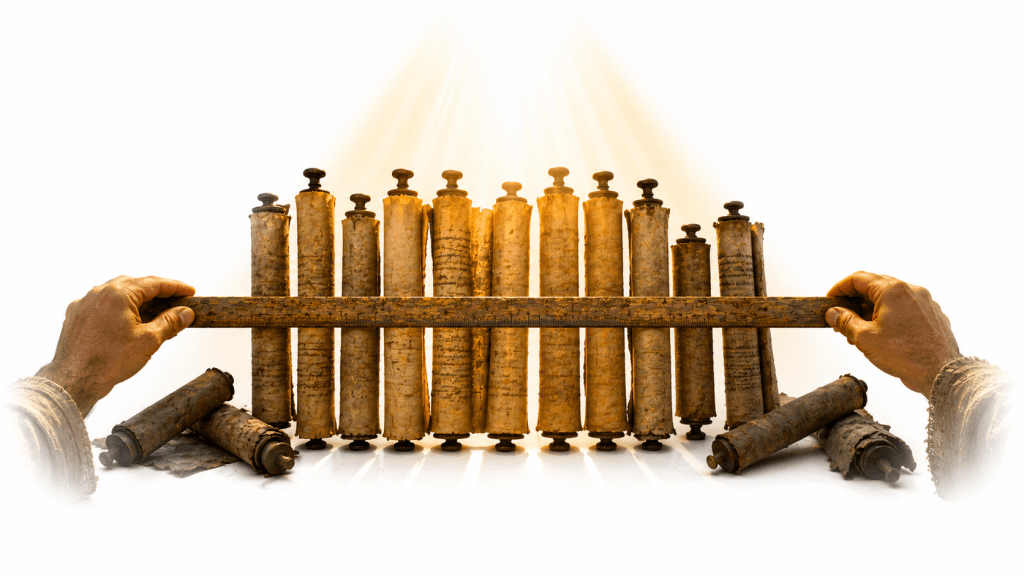
The word canon comes from the Greek kanon; a measuring rod, a rule, a standard. The canon of Scripture is the list of books that meet the standard for recognition as the authoritative Word of God. Not the list of books that the Church decided to authorize. The list of books that were recognized as already bearing the marks of divine origin.
The distinction is not semantic. It is the difference between the Church creating the canon’s authority and the Church identifying the canon’s already-present authority. A measuring rod does not create the object it measures. It identifies the object’s dimensions. The canon, as the Reformers understood it, was the measuring rod by which the church identified what God had already spoken, not the product of the church’s creative authority.
How the Old Testament Canon Was Formed
The formation of the Hebrew canon is considerably less mysterious than its detractors suggest.
The Hebrew Bible, comprising the same books that Protestant Christianity includes in the Old Testament, divided into Torah, Nevi’im, and Ketuvim (Law, Prophets, Writings), was functionally established as the authoritative Scripture of Israel long before the Council of Jamnia in 90 AD is sometimes cited as its formal definition.
The criteria for inclusion were essentially prophetic: was the book written by or under the authority of a recognized prophet of Israel, during the period of the prophetic office? The prophetic period was understood to have closed with Malachi, and the books written after Malachi’s ministry, however pious and useful, were not recognized as prophetic Scripture.
Crucially, the Hebrew canon is the canon Jesus used. When Jesus and the New Testament authors quote “the scriptures,” they consistently quote from the books that constitute the Hebrew Bible. Jesus’s reference to “the law of Moses, and the prophets, and the psalms” (Luke 24:44), the three-part division of the Hebrew canon, identifies the precise scope of what He treated as authoritative Scripture. He did not quote the Apocrypha as Scripture. He did not treat the deuterocanonical books as Scripture.
If the Son of God used a canon, and He did, then the question of which canon He used is not negotiable. He used the Hebrew Bible. The same sixty-six books that Protestant Christianity identifies as the Old Testament.
The Apocrypha — Why the Deuterocanonical Books Are Not In
The deuterocanonical books; 1 and 2 Maccabees, Tobit, Judith, Sirach, Wisdom, Baruch, and additions to Daniel and Esther, are included in the Roman Catholic Bible and treated by Rome as canonical Scripture. The Protestant canon excludes them. Three reasons for exclusion.
They were never part of the Hebrew canon. The Jewish community, the people to whom the Old Testament was entrusted (Romans 3:2), never recognized the deuterocanonical books as Scripture. The rabbis at Jamnia considered and rejected them. Jerome, producing the Vulgate in the fourth century, knew the difference between the Hebrew canon and the Apocrypha and marked it explicitly, though later tradition obscured the distinction.
Jesus and the apostles never cited them as Scripture. The New Testament contains hundreds of quotations from and allusions to the Old Testament. Not one quotation from the deuterocanonical books is introduced in the New Testament with the kind of formula, “it is written,” “as the Scripture says,” “that the Scripture might be fulfilled”, that consistently marks Old Testament citations as authoritative Scripture.
They contain theological errors. 2 Maccabees advocates prayers for the dead (12:44-45) and accepts atoning merit for the living from the deaths of martyrs (7:37-38), doctrines that contradict the New Testament’s account of atonement. A book that teaches what the recognized Scripture contradicts cannot itself be recognized Scripture.
How the New Testament Canon Was Formed
The formation of the New Testament canon is the most historically contested aspect of the canon discussion, and the one most frequently used to argue that the canon was a human product. The historical picture is more straightforward than this argument suggests.
The criterion for New Testament canonicity was essentially apostolic: was the book written by an apostle or under the direct authority of an apostle? The apostles were the authorized witnesses to the resurrection (Acts 1:21-22) whose teaching was binding on the church (Ephesians 2:20). Books that bore apostolic authorship or direct apostolic endorsement carried the weight of apostolic authority. Books that did not, however useful and however edifying, did not carry that weight.
The practical process was not the councils creating the canon but the church using the canon. Long before any formal conciliar decision about which books constituted the New Testament, the churches were reading apostolic letters in their gatherings, copying them, sharing them, and treating them as the authoritative Word of God. The canon was functioning before it was formally defined, because the books that were in it were already producing the fruit of the Word in the communities that received them.
The Muratorian Fragment (c. 170 AD) lists the books recognized as apostolic by the church in Rome, and the list is remarkably similar to the final New Testament canon. The Council of Hippo (393 AD) and the Councils of Carthage (397 and 419 AD) formalized what had been functionally settled for generations.
The councils did not create the canon’s authority. They recognized what the Spirit had already testified to in the life of the church, identifying the books that bore the marks of apostolic origin and confirming the exclusion of books that lacked those marks, however popular some of them had been.
The Catholic Argument — and the Answer
The Catholic argument runs: you needed the Church to give you the canon. Therefore the Church is above the canon. Therefore the Church interprets the canon with authority that the canon cannot override. The answer has two parts.
First, the Church did not give the canon its authority. The Church recognized the canon’s authority. The distinction we established earlier in this series, between creating authority and recognizing authority, applies directly here. The Council of Carthage did not make the Gospel of John apostolic. The Gospel of John was apostolic before the council sat. The council recognized what was already there.
The analogy: a historian who authenticates an ancient document does not create the document’s historical reality. The document predates the historian’s judgment. The historian is identifying what was always true of the document. The council’s recognition of the New Testament books no more creates their authority than the historian’s authentication creates a document’s antiquity.
Second, the canon that was recognized is the canon that judges the Church. If the Church recognized the canon, if the council was in the business of identifying apostolic authority rather than creating it, then the apostolic authority it identified stands over the council that identified it. The measuring rod judges the object measured, not the other way around.
The canon the Church recognized includes every text that the Reformation used to correct the Church’s deviations. Hebrews 10 on the once-for-all sacrifice. Romans 4 on justification by faith. Galatians 1 on the anathema against any other gospel. The Church recognized these texts as apostolic authority. Having recognized them, the Church cannot escape their judgment by placing itself above them.
Why the Canon Is Closed
“Beloved, when I gave all diligence to write unto you of the common salvation, it was needful for me to write unto you, and exhort you that ye should earnestly contend for the faith which was once delivered unto the saints” (Jude 3).
Once delivered. Not being delivered. Not awaiting fresh apostolic supplementation. The faith, the body of Christian revelation, was delivered to the saints in the apostolic generation. The apostolic generation that produced the New Testament is the generation that received the completed revelation. We are the recipients of what that generation preserved.
“If any man shall add unto these things, God shall add unto him the plagues that are written in this book” (Revelation 22:18). Add not. The warning is specific and severe. The revelation is complete. The canon is closed, not by the decision of any human institution, not by the preference of any tradition, but by the declaration of the one who gave it and who declares it finished.
Sixty-six books. Complete. Sufficient. Closed. Not because a council decided so. Because the one who breathed them out declared them enough.
Tomorrow, Day 11, the attacks on the Bible’s authority begin. Eight specific objections. Each one examined and answered from the Word itself.
“Beloved…contend for the faith which was once delivered unto the saints.” — Jude 3 KJV
📖 This post is adapted from Why I Believe the Bible: A Personal Defense of Sola Scriptura. If it helped you, the full book is available on Amazon — or you can support this ministry directly.
thefinalconvergence.com | Follow on Instagram, Facebook, X, and YouTube
If you like to be updated on new blogs, sign up to our newsletter!


Leave a comment