
Published: July 11, 2026 | thefinalconvergence.com
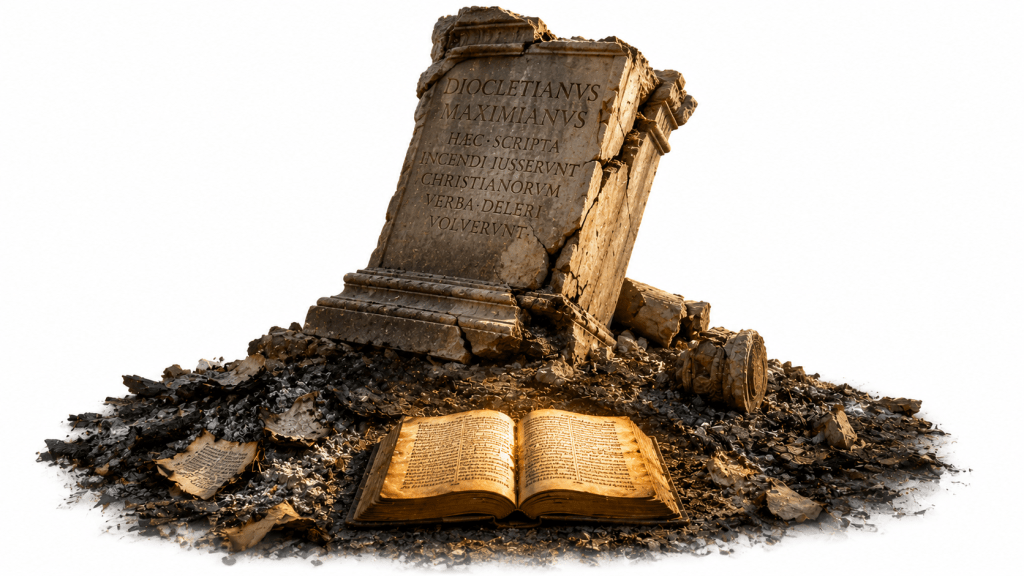
The Bible has enemies. It has always had enemies. And the history of those enemies is one of the most remarkable evidences for the divine origin of the text they were trying to destroy.
No other book in human history has attracted the sustained, organized, resourced, and determined opposition that the Bible has attracted across twenty-five centuries. No other text has been burned, banned, confiscated, criminalized, intellectually dismantled, philosophically refuted, archaeologically disputed, textually deconstructed, and culturally marginalized with the consistency and intensity that the Bible has faced. No other book has had so many people in positions of power expend so many resources to ensure its elimination.
And no other book is still here, still the most widely distributed text in human history, still being translated into new languages, still being read by more human beings in more contexts than any other document, after everything that has been thrown at it.
“The grass withereth, the flower fadeth: but the word of our God shall stand for ever” (Isaiah 40:8). The prophet said it in the eighth century BC. Twenty-seven hundred years of history have confirmed it. Empires that tried to eliminate the Word are gone. Philosophies that declared it finished have themselves been declared finished. The Word stands.
That is not an accident. It is evidence.
Diocletian’s Edict — And What Followed
In 303 AD, the Roman Emperor Diocletian issued one of the most determined anti-Christian edicts in history. His specific targets included the Scripture, every Bible in the Roman Empire was to be confiscated and burned. Churches were to be demolished. Christians who refused to hand over their Scriptures were to be imprisoned or executed. Those who complied, the traditores, those who handed over the texts, gave us the word traitor.
Diocletian was thorough. The persecution was systematic. Roman administrative efficiency was directed at the elimination of the Christian text. When the persecution was at its height, Diocletian reportedly erected a pillar with the inscription: Extincto nomine Christianorum, “The name of Christian is extinguished.”
Twenty-five years later, the Emperor Constantine issued the Edict of Milan, declaring religious tolerance throughout the Empire and effectively establishing Christianity as its favored faith. Constantine ordered fifty new Bibles to be produced at imperial expense. The man who declared Christianity extinguished was gone. The Bibles he burned were being reproduced in their hundreds.
The word stands. The pillar does not.
Voltaire’s Prediction — And What Followed
The French philosopher Voltaire, one of the Enlightenment’s most brilliant and most hostile critics of Christianity, declared in 1778 that within a hundred years of his death, the Bible would be a museum curiosity and Christianity a forgotten superstition. He was confident. He was celebrated. He was one of the most articulate spokesmen the age of reason had produced.
Fifty years after Voltaire’s death, the Geneva Bible Society was reportedly using his house and his printing press to produce Bibles. The story may be embellished in its details, the precise claim has been disputed, but the historical irony is real: Voltaire is known today primarily because Christians study him to understand the Enlightenment critique of the faith. The faith he declared finished is studied through the texts he wanted to end.
The Bible was not finished. Voltaire was. Not as a person, his intellect was genuine, his critique was serious, and he deserves serious engagement rather than dismissal. But his prediction about the Bible’s future was wrong in precisely the way that every similar prediction has been wrong.
Within a century of Voltaire’s death, the British and Foreign Bible Society, the American Bible Society, and dozens of similar organizations were distributing millions of Bibles annually across the world. The nineteenth century, the century Voltaire predicted would see the Bible’s end, was the century of the greatest expansion of Bible distribution in history.
The Rationalist Assault — And What Followed
The eighteenth and nineteenth centuries produced the most sustained intellectual attack on the Bible in its history. The rise of historical-critical method, the application of secular historical tools to the biblical text, was accompanied by confident predictions that the result would be the dismantling of the Bible’s historical claims, the exposure of its internal contradictions, and the demonstration that the text was a human product no more reliable than any other ancient religious literature.
Two centuries of this sustained critical engagement have produced genuine scholarship, genuine advances in understanding the text’s historical context, its literary forms, its transmission history, and the complexity of its composition. Engaging that scholarship honestly is part of taking the Bible seriously.
But the confident prediction that critical engagement would finally expose the Bible as unreliable has not been fulfilled. As we examined in Day 20, the consistent direction of archaeological evidence has confirmed rather than undermined the biblical historical narrative. The manuscript tradition, which we will examine tomorrow, has proven to be more robust and more reliable than the tradition of any comparable ancient text. And the theological claims of the Bible, its account of the human condition, its description of the divine character, its specific historical claims about Jesus, have survived two centuries of intensive critical scrutiny without being decisively refuted.
The Bible is still here. The confidence that critical engagement would end its credibility is no longer quite so confident.
What the Attempts to Destroy It Reveal
The sustained and determined opposition the Bible has attracted across the centuries is itself evidence worth examining. Collections of human religious literature do not generally attract this intensity of opposition. The Vedas have not been systematically burned by Roman emperors. The Upanishads have not been declared extinguished by imperial edicts. The Quran has been opposed in specific historical contexts, but not with the universal, sustained, multi-century campaign of elimination that has been directed at the Bible.
The specific and sustained character of the opposition to the Bible is consistent with the Bible’s own claim about itself: that it is the revelation of the God who stands in direct opposition to every system of human idolatry and human self-sufficiency. A text that consistently exposes the pretensions of every human power, religious, political, philosophical, will consistently attract the opposition of every human power that the text exposes.
The Emperor who declares himself divine will burn the text that says there is one God and no other. The philosopher who declares reason sovereign will dismiss the text that says the wisdom of this world is foolishness with God. The religious institution that has placed itself over the Word will suppress the text that places it under the Word.
The pattern of opposition is the pattern the Bible predicts for itself. The opposition is evidence of the opposition’s recognition, however unconscious, that the text is what it claims to be.
What Has Survived
Twenty-five hundred years. Babylonian captivity. Persian dominance. Greek cultural imperialism. Roman persecution. Medieval suppression for political reasons. Enlightenment intellectual dismantling. Marxist suppression, in the Soviet Union, Bibles were criminalized; the Bible proved more durable than the Soviet Union. Maoist suppression, in China, Christian conversion is still formally restricted; the Chinese church is currently the fastest-growing in the world.
Every empire. Every philosophy. Every political movement. Every intellectual fashion. Every institutionalized effort to eliminate, suppress, or finally refute the Bible. And the Bible is still here.
More than 5 billion copies have been printed. It has been translated into more than 3,500 languages, a number that continues to grow as translation organizations work in the remaining languages of the world. It is read every day by more human beings than any other text in history.
The grass withers. The flower fades. The emperors who declared it extinguished are extinguished. The philosophers who declared it finished are studied in footnotes. The ideologies that banned it have been consigned to the history of failed experiments. The word of our God shall stand for ever.
Not because of the strength of the institutions that defend it. Not because of the skill of the apologists who argue for it. Because the God who breathed it out declared it imperishable, and His word about His Word has proven as reliable as every other word He has spoken.
Tomorrow, Day 24, the manuscript evidence. The most extensively documented text in the ancient world.
“The grass withereth, the flower fadeth: but the word of our God shall stand for ever.” — Isaiah 40:8 KJV
📖 This post is adapted from Why I Believe the Bible: A Personal Defense of Sola Scriptura. If it helped you, the full book is available on Amazon — or you can support this ministry directly.
thefinalconvergence.com | Follow on Instagram, Facebook, X, and YouTube
If you like to be updated on new blogs, sign up to our newsletter!


Leave a comment