
Published: July 20, 2026 | thefinalconvergence.com
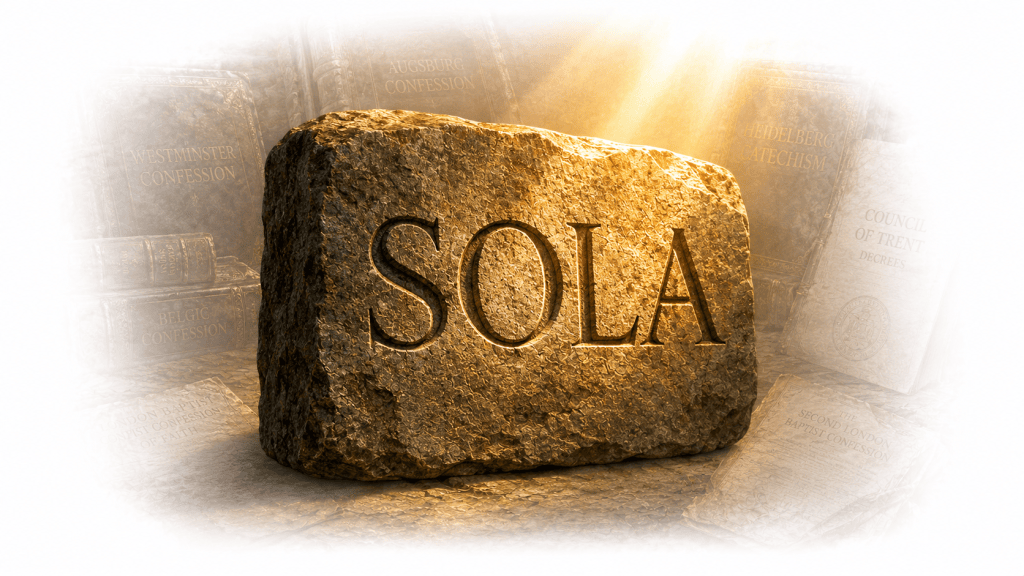
Yesterday’s post introduced the series and planted the stakes. Today the argument begins. The single most important word in the Sola Scriptura formula is the one that tends to receive the least examination. Not scriptura, the Scripture, the text, the Word. That word gets extensive treatment in every confessional theology. What the Scripture is, how it was inspired, why it can be trusted, how it should be interpreted, all of this receives careful and sustained attention.
The neglected word is sola.
Alone.
And the Biblicism argument begins precisely here. Because the confession of Sola Scriptura is only as strong as the specific claim the word alone makes, and the specific claim the word alone makes is exactly where the confessionalist tradition has, in many of its most consistent expressions, quietly walked away from the Reformation’s own principle.
What “Alone” Claims
Sola Scriptura does not claim that the Bible is a final authority, one important source among several that together constitute the governing standard for Christian faith and practice. That position is called prima scriptura, Scripture first, and it is the functional position of Roman Catholicism (Scripture first, Tradition alongside), of Eastern Orthodoxy (Scripture and Tradition together), and of a great deal of confessional Protestant Christianity in practice, if not in formal declaration.
Sola Scriptura claims that the Bible is the final authority. The only infallible rule. The supreme standard by which every other claim to authority is evaluated and against which no other claim to authority can appeal. Not Scripture plus the Magisterium. Not Scripture plus the ongoing prophetic revelation of recognized apostles. Not Scripture plus the confessional tradition of the Westminster Assembly.
Scripture. Alone.
What follows from this claim; immediately, unavoidably, if the word is taken seriously, is that every human document claiming to represent biblical teaching is evaluated by the Word it claims to represent. Not the other way around.
The Westminster Confession does not evaluate Scripture. Scripture evaluates the Westminster Confession.
The Heidelberg Catechism does not govern the reading of Romans. Romans governs the reading of the Heidelberg Catechism.
The decisions of the Synod of Dort do not define the limits of acceptable interpretation of the biblical text. The biblical text defines the limits of acceptable conclusions at Dort.
This is what alone means. And the moment a confessional community begins operating as if the confession evaluates the Scripture, as if the acceptable range of biblical interpretation is defined by the confession rather than the acceptable range of confessional conclusions being defined by the Scripture, that community has abandoned sola while maintaining scriptura.
The Governing Direction
The clearest single test of whether a community is practicing genuine Sola Scriptura or functional Sola Confessio is the direction of evaluation.
Question: In your community, when a careful reading of a biblical text produces a conclusion that differs from the Westminster Confession’s formulation, which governs which?
Does the biblical text govern the confession, meaning the community is willing to examine whether the confession has accurately represented the text, and to revise the confession’s authority in that community if it has not?
Or does the confession govern the biblical text, meaning the community uses the confession to determine the acceptable range of conclusions a careful reader is permitted to reach from the text?
The community that can honestly answer the first question, the biblical text governs the confession, is practicing Sola Scriptura. It is using the confession as what its framers intended: a fallible human summary that is valuable precisely in proportion to its accuracy and subject to correction when its accuracy is in question.
The community that honestly answers the second, the confession governs the text, is practicing Sola Confessio. However loudly it declares Sola Scriptura. However carefully it has been formed in the Westminster tradition. However many generations of faithful believers have passed the confession on as a trusted inheritance. The governing direction reveals the functional authority. And when the confession governs the text, the confession, not the text, is the functional supreme authority.
This is not a hypothetical distinction. It is the lived reality of thousands of believers in confessional communities who have discovered, sometimes at great personal cost, that the Berean test stops at the confessional boundary.
What “Alone” Does NOT Mean
Before pressing further into what alone requires, it is worth being precise about what it does not require, because the critics of Biblicism have built a significant portion of their argument on the assumption that Sola Scriptura in its genuine form is a naïve, tradition-rejecting, scholarship-dismissing, individually anarchic position.
It is none of these things. And the precision matters.
Sola Scriptura does not mean the Bible is the only source of knowledge.
The Reformers read widely. Calvin’s Institutes is saturated with Augustine, Chrysostom, Ambrose, and the patristic tradition. Luther knew the medieval scholastic theology he was critiquing. Zwingli was a Renaissance humanist before he was a Reformer. The claim is not that no knowledge exists outside the Bible. The claim is that no other source of knowledge has the final, binding, infallible authority over Christian faith and practice that the Bible has.
Sola Scriptura does not mean every individual interpretation is equally valid.
The Berean congregation was a community. They tested together. They received teaching from Paul, a trained scholar, with readiness of mind. And they verified together. Sola Scriptura does not produce sixty-six-book anarchy in which every reader’s reading is as authoritative as every other. It produces sixty-six-book accountability, the Word as the common standard to which every reading, whether the individual’s or the confession’s, is accountable.
Sola Scriptura does not mean confessions and creeds have no value.
The value of the Westminster Confession, the Heidelberg Catechism, the Nicene Creed, is real. They are the accumulated product of careful, sustained, community-tested engagement with the biblical text. They are not worthless. They are enormously useful. The Biblicist does not reject them as worthless. The Biblicist insists that their value is proportional to their accuracy, and that their accuracy is evaluated by the text, not by the authority of the tradition that produced them.
What Sola Scriptura, genuine Biblicism, means is exactly what the word says: Scripture alone is the supreme, final, infallible authority. Everything else is evaluated by it. Nothing else shares its authority. And nothing else governs its reading.
The Proverbs Witness
“Every word of God is pure: he is a shield unto them that put their trust in him. Add thou not unto his words, lest he reprove thee, and thou be found a liar” (Proverbs 30:5-6).
Two movements. The positive and the negative.
Every word of God is pure. Not every word of the Westminster Assembly. Not every word of the Synod of Dort. Not every word of any council, pope, apostle, prophet, or tradition. Every word of God. The purity, the freedom from admixture, the reliability, the trustworthiness, belongs to the Word of God specifically, precisely, exclusively.
Add thou not unto his words. The prohibition is direct. The adding that is forbidden here is not merely the addition of new canonical Scripture, though that is certainly included. It is the elevation of any human word to the status of the Word, the treating of any human formulation as co-authoritative with the divine Word that is pure. When the confession is treated as the final court of appeal, when “the confession has settled this” functions as the terminal response to textual inquiry, human words have been added to God’s Word in exactly the sense this verse prohibits.
Lest he reprove thee, and thou be found a liar. The consequence of the addition is not merely doctrinal imprecision. It is the specific charge of falsehood, representing as God’s Word something that is not, or representing the Word as requiring a human system’s authorization to be fully operative. The tradition that places the confession above the text is not making an innocent mistake. It is making a claim about authority that Proverbs 30:6 identifies with the category of the false.
The Most Demanding Position
Here is the irony that the confessionalist critique of Biblicism misses: the genuine Biblicist position is not the lazy position. It is the most demanding position.
The confessionalist who defers to the Westminster Confession on a difficult text has simplified the task of interpretation. The confession provides the answer. The work is the application of the confessional conclusion. Whatever intellectual difficulty the text presents has been resolved in advance.
The Biblicist who brings the same difficult text to the Word itself, without the confessional resolution as a safety net, must do the full work. The original languages. The historical context. The canonical context. The whole of Scripture bearing on the question. The history of interpretation taken as evidence but not as authority. The community testing the reading against the text, not against the tradition.
This is harder. It is more intellectually rigorous. It requires more of the interpreter at every level. The critics who dismiss Biblicism as naïve and scholarship-rejecting have it precisely backwards. Biblicism is not the escape from the demands of serious biblical scholarship. It is the position that takes those demands with the greatest seriousness, because it refuses to let the confessional tradition do the interpretive work that the text itself requires.
The Reformers knew this. Luther’s engagement with the biblical text, in the Greek, in the Hebrew, in historical context, was not the work of a man who had a confessional summary to fall back on. It was the work of a man who had nothing to fall back on except the Word itself. And that is why his convictions had the force they had. They came from the text, not from the tradition.
Tomorrow — The Claim in Full
Today has unpacked the word alone and what it actually requires. Tomorrow, Day 3, the claim at the center of the Biblicism argument is stated in its full form. Not the compressed version from Day 1. The complete, precisely formulated claim that the thirty days will spend their time defending.
The claim that the critics; Sproul, Horton, Williams, Vanhoozer, have not honestly engaged.
The claim the Reformers held.
The claim this series will not walk back.
“Every word of God is pure: he is a shield unto them that put their trust in him. Add thou not unto his words, lest he reprove thee, and thou be found a liar.” — Proverbs 30:5-6 KJV
📖 This post is adapted from Biblicism: The Faith Once Delivered. If it helped you, the full book is available on Amazon — or you can support this ministry directly.
thefinalconvergence.com | Follow on Instagram, Facebook, X, and YouTube
If you like to be updated on new blogs, sign up to our newsletter!


Leave a comment