
Published: August 2, 2026 | thefinalconvergence.com
Five days of the confessionalism argument. The mechanism described. The diagnostic tests offered. The locations identified. The pastoral consequences named. Today, the most precise single argument in the series so far. Not the argument from the Reformers’ method, though that argument was decisive. Not the argument from the mechanism’s pastoral consequences, though those consequences are real. The argument from the Westminster Confession’s own text.
If the Westminster Confession is a faithful summary of biblical teaching, it should be capable of withstanding exactly the kind of Biblicist scrutiny this series has been applying to it. If it is a genuine Sola Scriptura document, if its framers held the Reformation principle they claimed, then the confession should contain within itself the very standard by which it must be evaluated. It does.
“Which things also we speak, not in the words which man’s wisdom teacheth, but which the Holy Ghost teacheth; comparing spiritual things with spiritual” (1 Corinthians 2:13). The Spirit teaching. Spiritual things compared with spiritual. The interpretive principle grounded in the Spirit who breathed out the Word, the Word interpreting itself through the Spirit who authored it, not through a confessional tradition that stands between the Spirit’s Word and the Spirit’s reader.
This is the Westminster Confession’s own doctrine. And the confessional tradition that treats the Confession as the governing interpretation of the Word has violated the doctrine the Confession itself teaches.
What the Westminster Confession Actually Says About Itself
The Westminster Confession of Faith contains, in its opening chapter on Scripture, a set of statements about the nature of biblical authority that, applied consistently, produce the Biblicist conclusion.
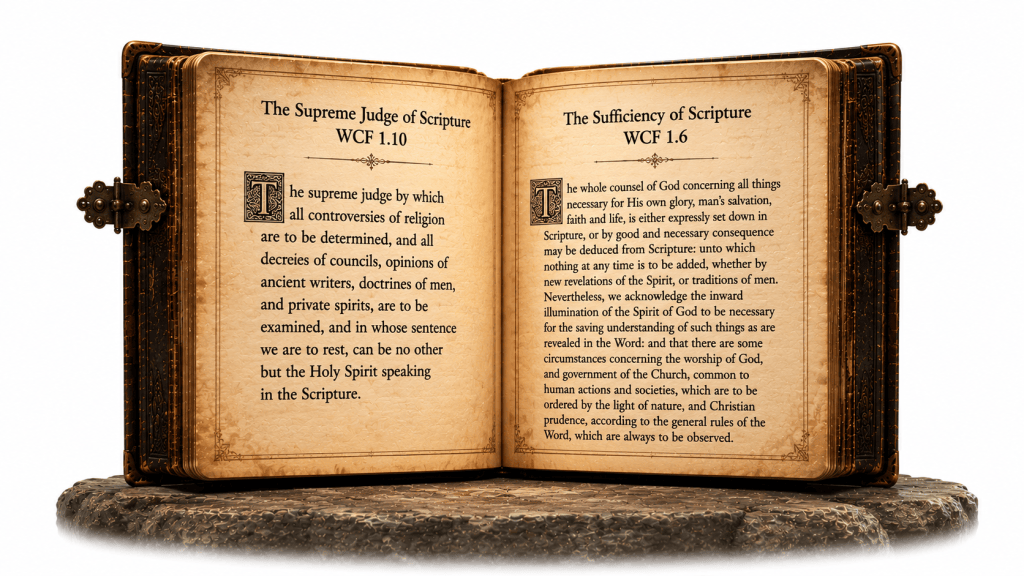
Westminster Confession 1.10:
“The supreme judge by which all controversies of religion are to be determined, and all decrees of councils, opinions of ancient writers, doctrines of men, and private spirits, are to be examined, and in whose sentence we are to rest, can be no other but the Holy Spirit speaking in the Scripture.”
Parse this carefully.
All controversies of religion are to be determined, not most controversies, not the controversies about which the confession has not pronounced. All.
All decrees of councils, councils, including the Westminster Assembly itself. Opinions of ancient writers, including the patristic tradition. Doctrines of men, including the confessional tradition’s systematic theology. Private spirits, including the conscience of the individual believer.
All of these are to be examined by the Holy Spirit speaking in the Scripture. None of them is the supreme judge. The supreme judge, the one in whose sentence we are to rest, is the Holy Spirit speaking in the Scripture.
This is WCF 1.10. The Westminster Confession’s own doctrine. Applied to the Westminster Confession itself, it produces this conclusion: when there is controversy about what the Westminster Confession teaches, the supreme judge of that controversy is not the confessional body. It is the Holy Spirit speaking in the Scripture.
Westminster Confession 31.3 — The Council That May Err
The Westminster Confession’s most explicit statement about the fallibility of confessional and conciliar authority is found in Chapter 31: “All synods or councils, since the apostles’ times, whether general or particular, may err; and many have erred. They are not to be made the rule of faith, or practice; but to be used as a help in both.”
All synods or councils since the apostles’ times may err. The Westminster Assembly was a synod. By the Westminster Confession’s own explicit statement, the Westminster Assembly may have erred. The Westminster Confession is the product of a synod that the Westminster Confession itself declares fallible. The second clause is equally important: they are not to be made the rule of faith or practice. The rule of faith and practice, the governing standard, is the Scripture, not the synod. The synod’s work is a help. A genuine help. But a help, not a rule.
This is not the Biblicist’s external critique of the Westminster Confession. This is the Westminster Confession’s explicit statement about its own proper status. The confessional community that has treated the Westminster Confession as something approaching a rule of faith, that has used it to govern what readings of biblical texts are permissible, has violated the explicit statement of the document it is elevating.
Westminster Confession 1.6 — The Closed and Sufficient Word
“The whole counsel of God concerning all things necessary for His own glory, man’s salvation, faith and life, is either expressly set down in Scripture, or by good and necessary consequence may be deduced from Scripture: unto which nothing at any time is to be added, whether by new revelations of the Spirit, or traditions of men.”
Nothing to be added. Not new revelations, which is the confession’s explicit rejection of the NAR’s ongoing prophetic claims. And not traditions of men, which is the confession’s explicit rejection of the Roman Catholic tradition’s co-authority alongside Scripture.
The traditions of men cannot be added to the Scripture. They cannot be made co-authoritative with the Scripture. They cannot function as the governing framework within which the Scripture must be interpreted. The Westminster Confession’s doctrine of Scripture explicitly rules out the authority claim that the confessional tradition makes on behalf of the Westminster Confession.
The Irony That Closes the Section
The Westminster Confession declares:
- The supreme judge of all controversies is the Holy Spirit speaking in Scripture, not the confessional tradition.
- All synods and councils may err, including the Westminster Assembly.
- Nothing is to be added to the Scripture, not even the traditions of men.
The confessional tradition that treats the Westminster Confession as:
- The governing framework for biblical interpretation
- The final court of appeal for doctrinal questions
- The standard against which textual readings are evaluated
Has violated all three of the Westminster Confession’s own doctrinal commitments about the nature of Scripture and the proper status of human confessional documents.
The Westminster Confession, evaluated by its own standard, is not and cannot be what the Stage Four confessional community has made it. It is a valuable, largely faithful, explicitly fallible human summary, to be used as a help in reading the Scripture that governs it, not as a rule that governs the reading of the Scripture.
The Biblicist is not departing from the Westminster Confession’s own standard. The Biblicist is applying it consistently. The confessional tradition that uses the Westminster Confession as a governing authority has departed from it.
Specific Areas Where the Standard Demands Evaluation
The argument above is structural, about the Confession’s proper status regardless of its specific contents. But honesty requires naming that there are specific areas where the Westminster Confession’s formulations deserve exactly the Berean scrutiny that its own doctrine of Scripture demands.
The Sabbath question. The Westminster Confession in Chapter 21 argues for a strict Lord’s Day Sabbatarianism, that one day in seven is morally obligated under the Mosaic Sabbath pattern, transferred to the first day of the week. Many careful, honest engagements with the relevant New Testament texts; particularly Romans 14:5, Galatians 4:10-11, and Colossians 2:16-17, raise serious questions about whether this formulation is as directly required by the New Testament witness as the Confession claims. The confessional tradition typically settles this question by invoking the confessional authority. The Berean test has not been fully applied.
The Regulative Principle of Worship in its Westminster form. Chapter 21 formulates the Regulative Principle in terms that have produced centuries of controversy about its precise application. Many communities that formally subscribe the Westminster Standards hold the Regulative Principle in a form significantly less restrictive than Chapter 21 requires. The gap between formal subscription and actual practice on this specific point is evidence that the plain text does not produce the Westminster formulation with the clarity the confessional tradition claims.
The marriage and divorce provisions. Westminster Chapter 24 on marriage and divorce represents a specific interpretive conclusion about a complex body of New Testament teaching. Careful engagement with the relevant texts; particularly Matthew 5, Matthew 19, Mark 10, 1 Corinthians 7, produces significant scholarly disagreement about whether the Westminster formulation accurately represents the full range of what the New Testament permits and prohibits.
These are not attacks on the Westminster Confession. They are the Berean scrutiny the Westminster Confession’s own doctrine of Scripture demands. And the confessional tradition that responds to these questions by invoking confessional authority rather than engaging the textual argument has, at precisely those moments, demonstrated that the mechanism of Stage Four has operated.
The Conclusion of Days 11-15
Five days. The mechanism described. The diagnostic tests offered. The locations identified. The pastoral consequences named. The Westminster Confession evaluated by its own standard. The conclusion is not the rejection of the Westminster Confession. It is the recovery of the Westminster Confession’s own doctrine, that the supreme judge of all controversies is the Holy Spirit speaking in Scripture, that all synods may err, that nothing is to be added to the Word.
The Biblicist is the person who holds the Westminster Confession to the standard the Westminster Confession sets for itself. The confessional tradition that cannot submit to that standard has departed from the Confession it claims to honor.
Tomorrow the series enters a new section: Straw Men and Slurs. The specific misrepresentations of Biblicism deployed by its critics, answered directly and with precision.
“Which things also we speak, not in the words which man’s wisdom teacheth, but which the Holy Ghost teacheth; comparing spiritual things with spiritual.” — 1 Corinthians 2:13 KJV
📖 This post is adapted from Biblicism: The Faith Once Delivered. If it helped you, the full book is available on Amazon — or you can support this ministry directly.
thefinalconvergence.com | Follow on Instagram, Facebook, X, and YouTube
If you like to be updated on new blogs, sign up to our newsletter!


Leave a comment