
Published: August 6, 2026 | thefinalconvergence.com
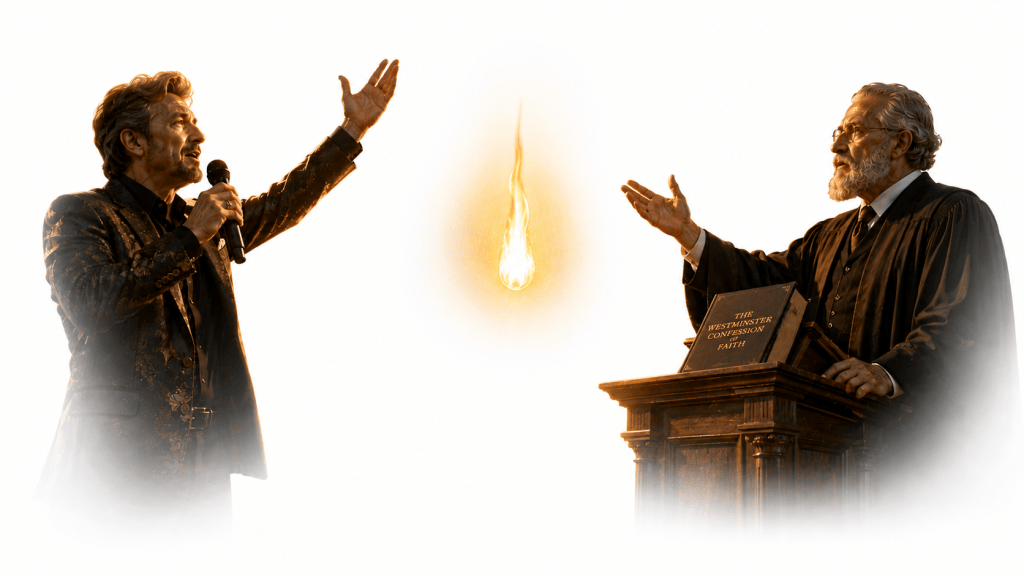
The straw men have been answered. Today the argument enters new territory, not defending Biblicism against misrepresentation, but addressing the most theologically sophisticated objection to the Biblicist position.
The objection is this: the Holy Spirit’s work does not end with the Scripture. The Spirit who breathed out the Word continues to work in the church, guiding the community’s interpretation, illuminating the confession’s conclusions, confirming the tradition’s reading. The Spirit is not merely the author of the sixty-six books. He is the ongoing teacher of the community of believers, and His teaching extends through and is mediated by the tradition He has guided.
This is not the NAR’s explicit claim that new prophecies supplement the Word. It is the confessionalist’s more subtle claim that the Spirit’s continuing work of guidance has produced, across the centuries, the confessional tradition that now governs the reading of the Word the Spirit inspired.
Both forms of the argument, the dramatic charismatic version and the subtle confessionalist version, make the same structural error. And that error has the same name: supplementation. The claim that the Spirit’s ongoing work adds something to the sufficient Word, whether a prophetic word or a confessional formulation, that the Word requires to be operative.
“But the anointing which ye have received of him abideth in you, and ye need not that any man teach you: but as the same anointing teacheth you of all things, and is truth, and is no lie, and even as it hath taught you, ye shall abide in him” (1 John 2:27). The anointing, the Spirit, abides in every believer. The anointing teaches directly. Ye need not that any man teach you, not that human teachers have no value, but that the Spirit’s teaching is not mediated through an authorized institutional interpreter. The anointing teaches of all things. The anointing is truth. The anointing teaches directly, without the confessional tradition as the necessary medium.
The Crucial Distinction: Illumination and Supplementation
The Biblicist position is not that the Holy Spirit’s work is limited to the original inspiration of the Scripture. The Spirit continues to work. His work continues in the believer and the community. That continuing work is real and important. But there is a distinction that the Biblicism argument requires to be maintained with precision.
Illumination: The Spirit enables the believer to receive and understand what the sufficient Word clearly declares. The Spirit opens the eyes of the heart to see what the text says. The Spirit removes the spiritual blindness that prevents the unregenerate person from receiving the Scripture’s testimony about God, about themselves, and about Christ. The Spirit produces in the genuine believer the faith, the repentance, the love, and the obedience that the Word calls for.
In illumination, the Spirit adds nothing to the Word. He adds to the reader’s capacity to receive the Word. The content of the teaching is entirely in the Word. The Spirit enables the reader to receive that content.
Supplementation: The Spirit adds new content, new doctrinal content, new revelatory information, new authoritative interpretation, that is not found in or derivable from the Scripture. The Spirit’s work supplements the sufficient Word with something the Word does not itself contain.
Supplementation is what the NAR claims for its prophets and apostles. It is also, structurally, what the confessionalist claim makes for the Spirit’s guidance of the confessional tradition, the claim that the Spirit has guided the church’s confessional conclusions in a way that attaches His authority to those conclusions above and beyond their derivation from the Scripture.
The Westminster Confession’s own doctrine rules out both forms of supplementation.
What the Westminster Confession Says About the Spirit’s Work
Westminster Confession 1.5 is specific about what the Spirit does in relation to the Scripture: “Our full persuasion and assurance of the infallible truth and divine authority of the Scripture, is from the inward work of the Holy Spirit, bearing witness by and with the Word in our hearts.” By and with the Word. The Spirit bears witness by the Word, using the Word as the instrument. And with the Word, alongside and through the Word’s own testimony. Not beyond the Word. Not adding to the Word. The Spirit’s witness is the Spirit’s bearing witness to the sufficiency and authority of the sufficient and authoritative Word.
The Spirit does not bear witness to the Westminster Confession in the same way He bears witness to the Word. The Confession does not claim this for itself, and the claim would contradict the Confession’s own Chapter 1.
Westminster Confession 1.6 adds: “The inward illumination of the Spirit of God [is] necessary for the saving understanding of such things as are revealed in the Word.” For saving understanding of things revealed in the Word. The illumination is of what the Word has already revealed. The Spirit illuminates the Word’s revelation, He does not supplement it with additional revelation.
Both articles point in the same direction: the Spirit’s work is illumination of the sufficient Word, not supplementation of it.
The Confessionalist Version of the Spirit Argument
The subtle confessionalist move is to attach the Spirit’s work of guidance to the confessional tradition’s development. The claim takes various forms:
“The Spirit has been guiding the church across the centuries, and the confessional tradition represents the Spirit’s guidance.”
“The consensus of the Reformed tradition, maintained across centuries, is evidence of the Spirit’s work in producing reliable interpretation.”
“When we receive the confession, we are receiving the fruit of the Spirit’s work in the community of believers.”
Each of these moves, however carefully stated, functionally elevates the confessional tradition by attaching the Spirit’s authority to it. And each of them is subject to the same decisive objection:
The New Testament does not describe the Spirit’s work of guidance as producing authoritative interpretive traditions that subsequently govern the reading of the Word. The Spirit’s work of guidance in the New Testament is described as:
- Illuminating the Word to the believer (1 John 2:27, 1 Corinthians 2:9-16)
- Producing the fruit of the Spirit in the believer’s character (Galatians 5:22-23)
- Empowering the believer for witness and service (Acts 1:8)
- Interceding for the believer (Romans 8:26-27)
- Confirming the believer’s adoption (Romans 8:15-16)
The Spirit is not described anywhere in the New Testament as guiding confessional bodies to produce authoritative formulations that subsequently govern the reading of the Word He inspired. The claim that He does this has no biblical basis — which means the claim is adding to the Spirit’s described work something the Scripture does not describe.
This is the specific irony of the confessionalist Spirit argument: it makes a claim about the Spirit’s work that the Scripture the Spirit breathed out does not support.
The Direct Access the Spirit Provides
The positive Biblicist doctrine about the Spirit’s work is not a minimized account of the Spirit. It is a maximized account, because it insists that the Spirit’s illuminating work reaches every honest reader directly, without requiring institutional mediation.
The anointing of 1 John 2:27 is not an anointing of confessional scholars only. It is an anointing of every genuine believer. The Spirit who illuminates the text does not illuminate it only for those who have received the confession’s framework. He illuminates it for the plowboy Tyndale gave his life to reach. For the new believer in rural China whose Bible has just been smuggled across the border. For the ordinary reader who comes to the Word without theological training but with genuine repentance and genuine faith.
This does not mean all readings are equally accurate. The anointing is not a guarantee of interpretive infallibility for every believer. The New Testament commends the gift of teaching and the work of scholars who have given their lives to understanding the text accurately. The community’s accountability to the text together is the form the Spirit’s illuminating work takes in the Berean congregation.
But the Spirit’s illuminating work is not restricted to the institutionally authorized interpreter. The anointing abides in every believer. The direct access to the sufficient Word is the Spirit’s own provision, the provision that made Tyndale’s translation project a work of genuine theology rather than merely a linguistic exercise, and that makes the plowboy’s direct reading of the Word a genuine receiving of what the Spirit who breathed it out intended.
The Connection to Both Forms of the Problem
The series has described two failures of the Sola Scriptura principle, one dramatic, one subtle.
The dramatic failure: the NAR and charismatic movement’s addition of prophetic and apostolic voices alongside or above the Scripture, supplementing the sufficient Word with ongoing revelation.
The subtle failure: the confessional tradition’s addition of the Westminster Assembly’s conclusions alongside or above the Scripture, supplementing the sufficient Word with authoritative confessional interpretation.
In both cases, the Spirit is invoked as the source of the supplement. The NAR prophet claims the Spirit’s authority for the word they deliver. The confessionalist claims the Spirit’s guidance for the tradition’s conclusions.
In both cases, the Biblicist answer is the same: the Spirit illuminates the sufficient Word. He does not supplement it. The Word the Spirit breathed out is the Word the Spirit illuminates. Nothing is added by the Spirit’s continuing work to the content of the Word the Spirit originally breathed out.
And the anointing abides in every believer, directly, without mediation, teaching from the Word that the same Spirit authored.
Tomorrow, Day 20, Biblicism and scholarship. The most rigorously academic position available.
“But the anointing which ye have received of him abideth in you, and ye need not that any man teach you: but as the same anointing teacheth you of all things, and is truth, and is no lie, and even as it hath taught you, ye shall abide in him.” — 1 John 2:27 KJV
📖 This post is adapted from Biblicism: The Faith Once Delivered. If it helped you, the full book is available on Amazon — or you can support this ministry directly.
thefinalconvergence.com | Follow on Instagram, Facebook, X, and YouTube
If you like to be updated on new blogs, sign up to our newsletter!


Leave a comment