
Published: August 11, 2026 | thefinalconvergence.com
The final day of the named critics section. Two scholars whose arguments against Biblicism are the most hermeneutically sophisticated in the contemporary Reformed and evangelical world.
Kevin Vanhoozer, theologian at Trinity Evangelical Divinity School, author of The Drama of Doctrine and Is There a Meaning in This Text?, has produced what is arguably the most technically rigorous critique of Biblicism from within broadly evangelical scholarship. His work draws on speech act theory, literary theory, and hermeneutical philosophy to argue that the Scripture cannot be read without the ecclesial and traditional framework that provides the context for understanding what the Scripture is doing.
D.H. Williams, professor at Baylor University, patristics scholar, author of Retrieving the Tradition, argues from the historical study of the early church that the patristic tradition’s “rule of faith” is the necessary hermeneutical context for correct biblical interpretation.
Both scholars deserve genuine engagement. Both make arguments that are more technically sophisticated than those of Sproul or Horton. Both ultimately fail to establish what their arguments require the Biblicist to concede.
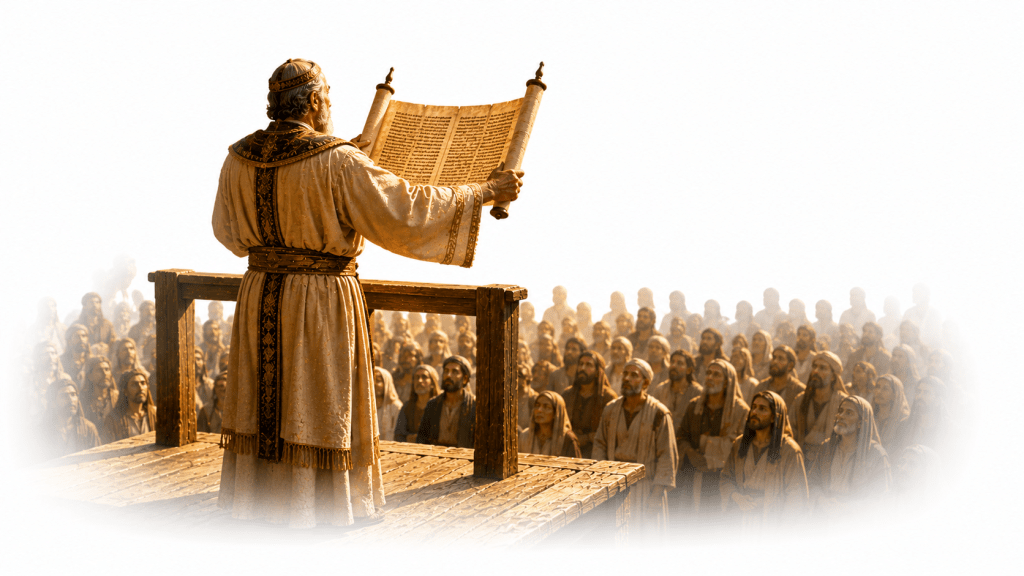
“So they read in the book in the law of God distinctly, and gave the sense, and caused the people to understand the reading” (Nehemiah 8:8). Ezra’s method. Read distinctly. Give the sense. Cause the people to understand the reading. The method is direct engagement with the text, not the application of an external framework governing what the text’s sense is permitted to mean. The text, read distinctly, is sufficient to produce understanding. That is the Biblicist claim. And it is what Nehemiah 8 describes.
Vanhoozer — The Drama of Doctrine
Vanhoozer’s most distinctive contribution to the Biblicism debate is his “drama of doctrine” framework. The Scripture, he argues, is not a static handbook of propositions but a dramatic script, a script for the church’s ongoing performance of the gospel. The church’s theological tradition represents the accumulated performance wisdom of generations who have enacted the drama. Contemporary interpretation cannot ignore this tradition any more than a contemporary actor can ignore the performance history of the play they are staging.
The argument is creative and, in certain respects, genuinely illuminating. The dramatic metaphor captures something real about the Scripture’s narrative character and the church’s ongoing engagement with it.
The problem is the direction of authority the metaphor implies.
If the Scripture is a script and the tradition is the accumulated performance wisdom, the tradition functions as the interpretive key to the script. The reader who comes to the script without the tradition is like an actor who ignores two thousand years of performance history. Naïve, liable to miss nuances, prone to error. The tradition is necessary.
But this metaphor embeds a structural inversion that the Biblicist must name. In the theatre, the text of the play is not self-interpreting, it genuinely requires directorial and performance tradition to become a living drama. But the Scripture is not a play. The Scripture is the living and active Word of God, quick and powerful, the anointing that abides in every believer, the sufficient text that the Spirit who breathed it out illuminates directly.
The drama-of-doctrine framework subtly elevates the tradition to the status of necessary interpretive context, the framework without which the script cannot be correctly performed. This is precisely what the sufficiency of Scripture rules out. The sufficient Word does not require the tradition’s performance wisdom to be understood. It requires the Spirit who breathed it out to illuminate it, which the Spirit does, for every honest reader, without the tradition as the necessary medium.
The second problem with Vanhoozer’s framework: who evaluates whether the church’s performance accurately enacts the script? If the tradition’s accumulated performance wisdom governs the reading of the script, then the script cannot correct the tradition, because the tradition governs the reading of the script. The governing direction is reversed. The drama-of-doctrine framework, pushed to its consistent conclusion, produces the Protestant Magisterium of Day 21.
Vanhoozer — Speech Act Theory and Illocutionary Acts
Vanhoozer’s application of speech act theory to Scripture is technically interesting. He argues that the Bible performs speech acts, locutions (what is said), illocutions (what is done in the saying), and perlocutions (what is effected in the hearer). The tradition helps the church understand the Scripture’s illocutionary acts, what the Scripture is doing, not merely what it is saying.
The tool is genuinely useful. Understanding what a biblical text is doing; commanding, promising, warning, commissioning, does help the reader receive it rightly. Speech act theory is a legitimate analytical tool in service of textual understanding.
The problem arises when the tool becomes the governing framework. When the tradition’s accumulated account of what the Scripture’s illocutionary acts mean becomes the governing interpretation of the Scripture’s illocutionary acts, the tool has become a master. The Biblicist uses speech act theory as a tool for understanding what the text is doing. The Vanhoozer school uses the tradition’s account of what the text is doing as the governing interpretation. The direction of authority is again reversed.
Vanhoozer — The Theological Interpretation of Scripture
Vanhoozer is closely associated with the Theological Interpretation of Scripture movement, the argument that the Scripture must be read theologically, within the church’s theological tradition, rather than merely historically or critically. The movement’s best instinct is genuinely compatible with Biblicism: Scripture should be read as Christian Scripture, as the Word of the God of Abraham, Isaac, and Jacob, of Jesus and the apostles, not merely as ancient religious literature subject to the same historical-critical treatment as any other ancient text. That instinct is correct.
The problem is when “reading Scripture theologically” becomes “reading Scripture through the confessional theological tradition’s conclusions.” The tradition cannot be the context that governs the reading, because the tradition must itself be evaluated by the reading. Reading Scripture theologically means reading it on its own theological terms, the terms it itself establishes, the categories it itself produces, the logic it itself follows.
This is the Day 23 argument applied to Vanhoozer’s specific project: the text must produce its own categories. The TIS movement’s best instinct is Biblicist. Its worst tendency is confessionalist.
Williams — The Rule of Faith
D.H. Williams argues from the patristics that the early church’s “rule of faith”, a brief summary of essential Christian teaching that the early church used as a hermeneutical guide, is necessary for contemporary biblical interpretation. Without this rule, individual readers produce idiosyncratic readings that depart from the church’s essential consensus.
The rule of faith as the early church used it was a brief summary, the faith delivered to the saints, the apostolic deposit, the essential content of the gospel. It served a specific and limited function: guarding against the Gnostic readings that were distorting the Scripture’s meaning by imposing alien cosmological frameworks on it.
The Biblicist response to Williams is direct: the rule of faith as the early church used it was derived from and accountable to the Scripture. Irenaeus used the rule of faith to demonstrate that the Gnostic readings were inconsistent with what the Scripture clearly taught. The rule was a tool for demonstrating consistency with the text, not a governing framework that stood above the text.
When Williams extends the rule of faith from its original, limited, Scripture-derived function to the comprehensive hermeneutical role he assigns it, as the governing context for reading every biblical text, he has expanded the rule far beyond what the patristic evidence supports. Irenaeus did not use the rule of faith to govern what specific texts about Israel, the Mosaic economy, or the prophetic vision of the kingdom were permitted to mean. He used it to rule out cosmological systems that denied the identity of the creator God with the God of Israel.
The limited, Scripture-derived rule of faith that Williams rightly recovers from the patristic tradition is compatible with Biblicism. The comprehensive hermeneutical framework Williams has extrapolated from it is not.
The further irony: Day 18 established that the patristic tradition’s own doctrine of Scripture; Athanasius, Augustine, Chrysostom, is closer to the Biblicist position than to the confessionalist one. Williams’s appeal to the patristic tradition actually supports the Biblicist claim about Scripture’s sufficiency and supreme authority. His use of that tradition to argue for a governing hermeneutical framework above the text is inconsistent with what the patristic witnesses he cites actually believed about the Scripture’s authority.
The Common Failure in Both
Both Vanhoozer and Williams, despite the genuine sophistication of their arguments, make the same structural error: they identify a genuine feature of biblical interpretation (the dramatic character of the Scripture, the church’s performance history, the patristic rule of faith) and then elevate that feature to a governing authority that the feature itself does not claim.
The Scripture’s dramatic character is real, but the Scripture is not a play requiring tradition to complete it. The church’s performance history is valuable, but it is accountable to the script, not governing of it. The patristic rule of faith is important, but it was derived from Scripture, accountable to Scripture, and limited in its function.
Ezra’s method remains the model. Read the text distinctly. Give its sense. Cause the people to understand the reading. The text, engaged honestly, with the Spirit’s illumination and the community’s accountability, is sufficient for that task, without the drama-of-doctrine framework, without the TIS governing tradition, without the extended rule of faith as comprehensive hermeneutic.
Tomorrow, Day 25, the series enters its final section. Biblicism is the future of the faithful.
“So they read in the book in the law of God distinctly, and gave the sense, and caused the people to understand the reading.” — Nehemiah 8:8 KJV
📖 This post is adapted from Biblicism: The Faith Once Delivered. If it helped you, the full book is available on Amazon — or you can support this ministry directly.
thefinalconvergence.com | Follow on Instagram, Facebook, X, and YouTube
If you like to be updated on new blogs, sign up to our newsletter!


Leave a comment