
Published: August 13, 2026 | thefinalconvergence.com
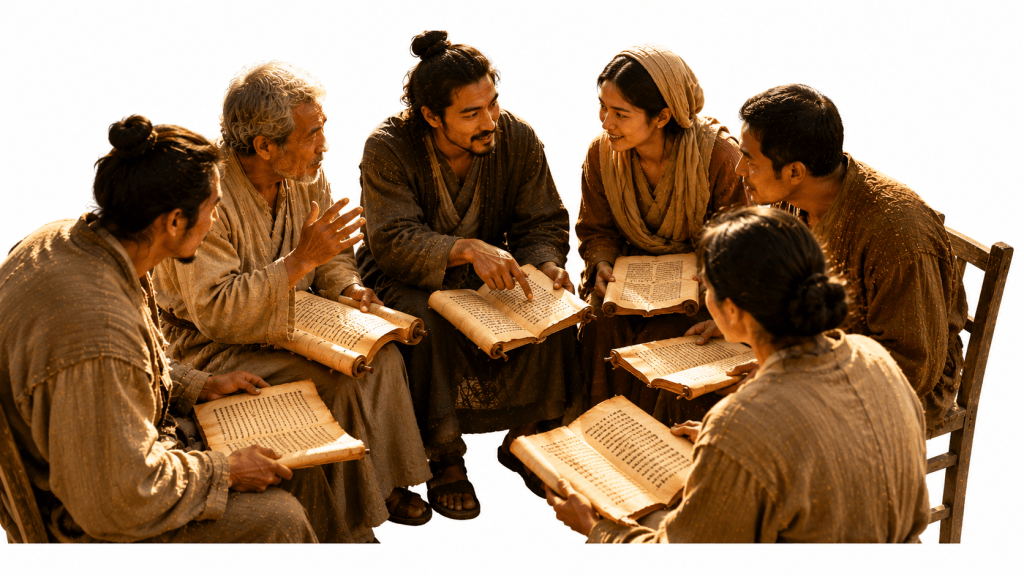
Day 25 established the thesis: the communities that hold the Word above every human system are the communities with a future. Today, what those communities look like. Not in the abstract. In the specific, practical, daily texture of a congregation that has committed to the Biblicist principle and is living it out.
The model is not invented. It is described in Acts 17:11. “These were more noble than those in Thessalonica, in that they received the word with all readiness of mind, and searched the scriptures daily, whether those things were so.” Two movements. Both necessary. Both together. And together they define the Berean community.
Received the word with all readiness of mind. Not in suspicion and not in resistance. Genuine openness, the readiness to receive what the Word declares, to be formed by it, to be corrected by it, to let it say what it says. The Berean community is not a community of perpetual skeptics who never arrive at settled conviction. It is a community of genuine receivers, people who come to the Word expecting to find what it actually says and willing to be changed by it.
Searched the scriptures daily, whether those things were so. Not deferring to the teacher’s authority. Testing. The Word as the standard against which every claim, including the teacher’s, is evaluated. The Berean test is not a posture of distrust toward teachers but of accountability to the text. The teacher is honored by being tested because the test assumes the teacher is making genuine claims about what the text teaches. Both movements. Together. Every day. This is the Berean church.
The Pulpit of the Berean Church
The Berean church’s pulpit is identifiable by a specific characteristic: the text sets the agenda. Not the preacher’s preferred themes. Not the confessional tradition’s systematic categories. Not the cultural moment’s pressing questions, though the sufficient Word addresses all of these. The text sets the agenda. The preacher works through books of the Bible sequentially, passage by passage, week by week, allowing what the text addresses to be what the congregation hears.
This form of preaching places the preacher under the text rather than over it. The preacher working through Romans will eventually reach Romans 9-11. The preacher working through 1 Corinthians will eventually reach the Lord’s Supper, spiritual gifts, and the resurrection. The preacher working through the Psalms will eventually reach the laments, the imprecatory prayers, the celebrations and the confessions. The text has no gaps the preacher can conveniently leave unfilled. Everything the text says, the preacher eventually says.
The congregation formed by this preaching develops genuine biblical literacy, not the ability to locate proof-texts for confessional conclusions, but the ability to follow an argument through a biblical book, to understand what a specific text is doing in its canonical context, to bring what they are hearing back to the text and test it. The Berean congregation is a congregation that can read, and does.
The Formation of the Berean Church
The Berean church forms its members in the Word itself, not in the tradition’s framework for the Word. The catechism class in the Berean church teaches the biblical text. Not the Westminster Shorter Catechism’s questions and answers (though these may be used as tools), the specific texts from which the catechism’s theology is derived, with the exegetical reasoning that connects the text to the conclusion. The student who finishes the Berean church’s catechetical formation can do more than recite the confession’s answers. They can open Romans and find for themselves what Paul says about justification. They can open 1 John and find for themselves what John says about assurance.
The small group in the Berean church reads the text together. Not the study guide that organizes the text into confessional categories. The text, with questions that draw out what the text is saying, what it is doing, what it requires of the reader, where it creates tension, where it is clear, where it is genuinely difficult. The formation is into honest engagement with the sufficient Word, not into the tradition’s predetermined conclusions.
The Berean church’s formation produces people who are capable of the Berean test, because they have been formed in the practice of bringing every claim back to the text.
The Disagreement Culture of the Berean Church
One of the most practically significant characteristics of the Berean church is how it handles disagreement.
The confessional community at Stage Four handles disagreement by invoking the confessional authority: the confession has settled this. The question is closed. The person who continues to press the textual case is disciplined or expected to leave.
The Berean community handles disagreement differently. It brings the disagreement to the text. The person who arrives at a reading that differs from the community’s current consensus presents their textual argument. The community engages the argument, testing it against the text, considering the canonical context, weighing the history of interpretation as evidence. If the argument is exegetically sound, the community receives the correction. If it is not, the community explains why not, from the text, not from the confessional authority.
This is not a community of endless, unresolved uncertainty. The essential things are clear, and the Berean community arrives at settled conviction on them; the deity of Christ, justification by faith, the resurrection, the return of the King. These are not perennially open questions in the Berean community. They are the settled convictions that the plain text of Scripture produces in every honest community that engages it.
But on secondary matters, the specific form of church government, the specific eschatological sequence, the application of specific Old Testament practices, the Berean community holds its conclusions with appropriate confidence and appropriate humility. It knows the difference between the clarity of the essential things and the genuine difficulty of the secondary things. And it handles the secondary things with the grace that Romans 14 models: each person fully persuaded in their own mind, the community united in charity, the text remaining the standard against which every conclusion is evaluated.
The Accountability Structure of the Berean Church
The Berean church is not anarchic, it is structured, but structured around the text rather than around the confessional tradition. The accountability that operates in the Berean church is the accountability of the community to the text together. The individual reader brings their reading to the community. The community tests the individual reading against the whole of Scripture. The community brings its conclusions to the text. The text has the final word.
This means the Berean church has genuine authority structures; elders who teach, preachers who proclaim, teachers who equip. But these authorities are accountable to the text in a way that the confessional community at Stage Four is not. The elder who teaches is tested against the text. The preacher who proclaims is tested against the text. The tradition that has accumulated is tested against the text. No human authority is exempt from the Berean test.
The Berean community uses confessional documents as tools in this process, the Westminster Confession may help clarify what the text teaches on a specific question, and that clarification is genuinely valuable. But when the community discovers that the confessional conclusion does not accurately represent what the text says, the text wins. The confession is revised in its status in the community, not necessarily in its wording, but in the authority it is granted.
The Berean Church and the Tradition
The Berean church is not anti-traditional. Day 18 established this at length. The tradition is a resource, an important, sometimes very important, resource, and the Berean community engages it as such. The Berean church reads the Reformers. It reads the fathers. It reads the best contemporary scholarship. It uses the Westminster Confession as a summary of what careful biblical interpreters have concluded the Scripture teaches, and treats that summary with the respect it deserves.
But the Berean church knows it has glasses on. It engages the tradition with the awareness that the tradition is evidence, not authority. The Berean community reads Calvin’s commentaries as the testimony of an extraordinary exegete who was trying to follow the text, and notices when Calvin’s exegesis conflicts with Calvin’s system, and follows the exegesis. It reads the Westminster Confession as the conclusions of careful men who were trying to summarize what the Scripture teaches, and notices when the confessional conclusion does not quite match the text, and follows the text.
The Berean church honors the tradition by subjecting it to the test the tradition claims to be accountable to: the Word itself.
This Community Already Exists
The Berean church is not a theoretical ideal. It exists. In the house churches of China, in the evangelical congregations of the Global South, in the expository preaching churches where the text genuinely sets the agenda, in the small groups where the Scripture is read together honestly, in the communities of ordinary believers who have never heard the word Biblicism but who practice it every time they open the Bible together and ask: what does this text actually say? These communities are the future of the faithful.
Tomorrow, Day 27, the call. And the beginning of what comes next.
“These were more noble than those in Thessalonica, in that they received the word with all readiness of mind, and searched the scriptures daily, whether those things were so.” — Acts 17:11 KJV
📖 This post is adapted from Biblicism: The Faith Once Delivered. If it helped you, the full book is available on Amazon — or you can support this ministry directly.
thefinalconvergence.com | Follow on Instagram, Facebook, X, and YouTube
If you like to be updated on new blogs, sign up to our newsletter!


Leave a comment