
Published: August 20, 2026 | thefinalconvergence.com
Two days in, the phrase has already appeared twice, on Day 1 as the theme running through the whole series, on Day 2 as the reason the church’s role is custodial rather than authoritative. Today it gets its full weight, because everything in this book stands or falls on it.
The church did not create the Bible. God created the Bible. The church recognized it.
Six words carry the entire argument: recognized, not created. Get this distinction right and every modern challenge to the canon collapses. Get it wrong and you have handed the keys of Scripture to whoever controls the institution.
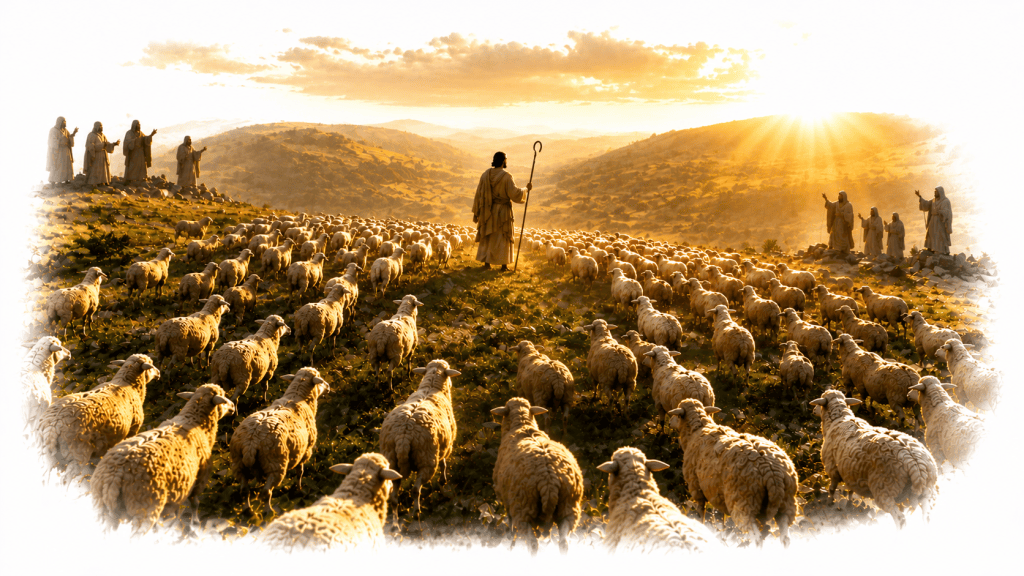
“My sheep hear my voice, and I know them, and they follow me” (John 10:27).
The sheep hear. The sheep recognize. The sheep know the Shepherd’s voice from the stranger’s — not because a council trained them to, but because the voice is the voice of the One they belong to. This is the model of canon recognition in a single sentence. The church did not vote the Shepherd’s voice into authority. The church heard it, knew it, and followed it, because that is what sheep do when the Shepherd speaks.
Two Positions, and Everything Hangs Between Them
There are only two fundamental positions on where the canon’s authority comes from, and the distance between them is the distance between the Reformation and Rome.
The first position says: the church created the canon. The church, by its councils and its Magisterial authority, determined which books would be Scripture. The authority of the Bible therefore rests on the authority of the church that defined it. On this view, the church stands over the Word, the Word is authoritative because the church made it so.
The second position says: the church recognized the canon. God, by inspiring the books, made them Scripture. The church, guided by the Spirit, discerned and acknowledged what God had already done. On this view, the church stands under the Word, the church’s role is custodial, receiving and protecting what God authored, never authoring it.
This is not a fine theological distinction that only scholars need to worry about. It is the difference between a church that stands under the Word in submission and a church that stands over the Word in authority. When the Roman Catholic Magisterium declares that it defined the canon, it is asserting the first position: the church is the judge of Scripture. When Protestant believers confess Sola Scriptura, they are asserting the second: Scripture is the judge of the church.
And the consequences run in opposite directions. If the church created the canon, then the church can revise it, supplement it, or add to it, which is precisely what Rome did at Trent, and precisely what the NAR claims to do with ongoing apostolic revelation. But if the church merely recognized what God had already spoken, then the canon is closed, fixed, and beyond the reach of any human institution to alter.
Everything depends on which of these two you believe. So which does the evidence support?
What Actually Happened in History
History vindicates the recognition position, plainly and repeatedly.
The books of the Old Testament were recognized as divine by Israel, tested by prophetic fulfillment, by covenantal consistency, by the authority of their human authors, long before any official council declared them canonical. When Moses came down from Sinai, the people did not convene a committee to vote on whether the tablets carried divine authority. They received what God had spoken. When the prophets declared thus saith the LORD, their words were recognized as the Word of God by the faithful remnant, tested against the criteria God Himself had given, and preserved as Scripture, centuries before any rabbinic council formally listed the Hebrew canon.
The books of the New Testament followed the same pattern. The apostolic writings were read in churches, copied, circulated, and treated as Scripture by the first and second generations of believers, long before any council met to list them. Paul’s letters were being collected and read alongside the Old Testament Scriptures within the lifetime of the apostles themselves. Peter refers to Paul’s letters as scripture in 2 Peter 3:16, while Paul was still alive, or barely departed. The four Gospels were functioning as authoritative accounts of the life of Christ generations before Carthage.
The councils of the fourth century did not breathe authority into these books. They acknowledged what the Holy Spirit had already impressed upon the hearts of God’s people across the Roman world. By the time the councils met, the recognition was already overwhelming, the councils simply documented, formalized, and defended what the church had already received.
This is the decisive historical fact. The canon was functioning as canon before it was ever formally listed. The recognition preceded the ratification. The sheep were already following the Shepherd’s voice; the councils merely wrote down which voice they had been following.
The Jeweler and the Diamond, Applied
Yesterday’s image bears repeating because it captures the whole thing: a master jeweler who picks up a diamond does not make it a diamond. The stone’s value existed before he ever touched it. He recognizes its worth, cuts it to display its brilliance, and protects it from being confused with glass.
Now apply the parts precisely.
The inspiration is the diamond’s intrinsic worth, placed in the stone by God, present from the moment of creation, entirely independent of any human judgment. The recognition is the jeweler’s expert eye, the trained ability to see what is genuinely there and distinguish it from the glass and paste that would counterfeit it. The cutting and protecting is the church’s custodial work across the centuries, displaying the Word’s brilliance through faithful copying, translation, and defense, and guarding it against the false writings that would be slipped in beside it.
At no point does the jeweler create value. He recognizes, displays, and protects value that God put there. Strip the jeweler away and the diamond is still a diamond. Strip the church away and the Word is still the Word. But strip God’s inspiration away and there is nothing for the jeweler to recognize at all, only glass.
That is why the recognition position honors God and the creation position honors the institution. One says the worth was there before the church saw it. The other says the church conferred the worth by seeing it. Only one of them is true.
Why This Sinks Every Modern Challenge
Watch how the recognition-not-creation distinction answers every major attack on the canon at once.
Rome says the church defined the canon, therefore the church has authority over the canon, including the authority to add the Apocrypha. But if the church only recognized what God had already inspired, then Rome’s addition at Trent was not an exercise of legitimate authority. It was the institution overstepping its custodial role and claiming an authorial one it never possessed.
The secular skeptic says the canon was a fourth-century political construction; Constantine’s power, Nicaea’s agenda, the winners suppressing the losers. But if the books were already functioning as Scripture, already recognized across the whole church, already preserved and read for generations before any council met, then the councils created nothing. The skeptic has mistaken the documentation for the origin.
The NAR says the Spirit is still speaking with apostolic authority, so the canon is functionally open. But if recognition is the church’s response to what God has already inspired through the closed apostolic office, then there is nothing new to recognize. The apostolic foundation was laid once (Ephesians 2:20). The recognition of it is complete. There is no diamond still waiting in the ground for a new jeweler.
The progressive says the church suppressed alternative gospels and diverse revelatory voices. But the church did not suppress the Gnostic gospels by an act of authority, it failed to recognize them, because the Shepherd’s voice was not in them. The sheep heard the stranger’s voice and would not follow.
One distinction. Four challenges answered. That is why recognized, not created is the hinge of the entire book.
The Sheep Still Know the Voice
The deepest ground of the recognition position is not historical or institutional. It is the living reality of John 10:27. The sheep hear the Shepherd’s voice.
This is why ordinary believers, across every century and every continent, have opened the Scriptures and known, not because a scholar certified it, not because a council authorized it, but because the voice in the text is the voice of the One they belong to. The regenerate heart recognizes the Word of God the way a child recognizes a parent’s voice in a crowded room. The recognition is real, immediate, and Spirit-given.
The councils formalized what the sheep already knew. The scholarship documents what the sheep already knew. But the recognition itself runs deeper than both, down to the level where the Shepherd speaks and His own hear Him and follow.
Tomorrow, how that Word was authored and preserved: divine authorship and human stewardship.
“My sheep hear my voice, and I know them, and they follow me.” — John 10:27 KJV
📖 This post is adapted from Canon and Covenant: How God Preserved His Word Through History. If it helped you, the full book is available on Amazon — or you can support this ministry directly.
thefinalconvergence.com | Follow on Instagram, Facebook, X, and YouTube
If you like to be updated on new blogs, sign up to our newsletter!


Leave a Reply