
Published: August 25, 2026 | thefinalconvergence.com
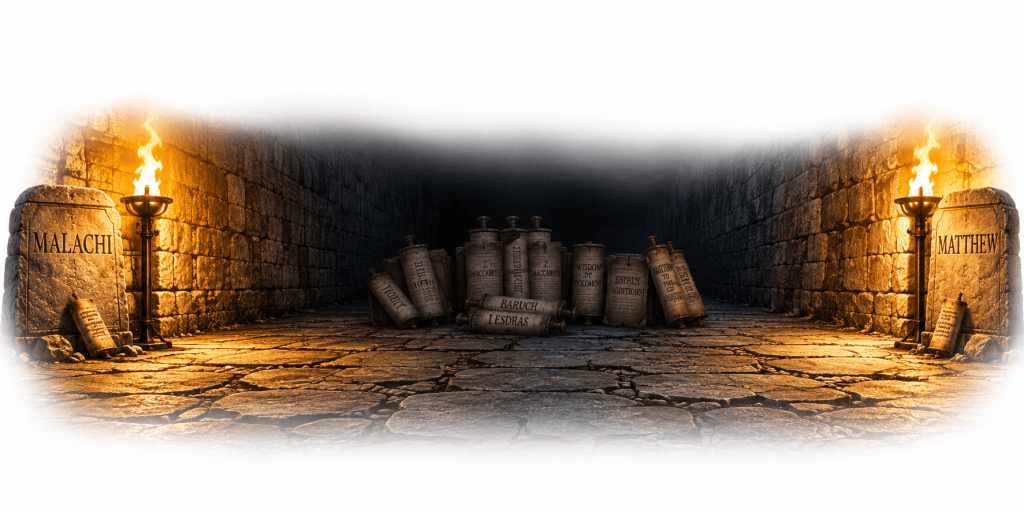
For seven days the series has built the case for a settled, recognized, bounded Old Testament canon; the canon Israel guarded, Jesus confirmed, and the apostles inherited. But there is a set of books that sit, in many Bibles, right between the Testaments. Books your Roman Catholic friends have in their Bibles and you do not. Books that show up in debates, in apologetics, in the occasional accusation that Protestants removed part of the Bible.
The Apocrypha. And the question has to be faced directly: why don’t these books belong?
“Every word of God is pure: he is a shield unto them that put their trust in him. Add thou not unto his words, lest he reprove thee, and thou be found a liar” (Proverbs 30:5–6).
Every word of God is pure. And the warning follows immediately: add thou not unto his words. The danger with the Apocrypha is not that these books are worthless, some have real historical and moral value. The danger is that adding them to the pure Word treats human writing as though it were divine. And Scripture reserves its sharpest warnings for exactly that.
The Books Between the Testaments
Between the last word of Malachi and the first word of Matthew, something remarkable happened: God was silent. For approximately four hundred years, what theologians call the intertestamental period, or the silent years, no recognized prophet arose in Israel. The direct covenantal communication that had thundered through Moses and poured through Ezekiel and Zechariah simply stopped.
This silence was not accidental. It was itself a prophetic act. The completion of the Old Testament canon with Malachi marked the completion of the first great phase of God’s revelation. The preparatory word had been fully spoken. Now Israel would wait for the fulfillment.
But human nature does not wait well. Into that silence poured a substantial body of religious literature, written roughly between 200 BC and 100 AD. These are the books we call the Apocrypha, from the Greek apokryphos, meaning hidden or obscure: Tobit, Judith, the Wisdom of Solomon, Sirach, Baruch, 1 and 2 Maccabees, and others. Some have historical value. Some contain genuine moral instruction. First Maccabees in particular is genuinely useful for understanding the Hanukkah story and the politics of the period. But none of them are Scripture, and treating them as if they were has produced centuries of theological error.
There are four decisive reasons these books do not belong in the canon.
One — The Jewish Community Never Accepted Them
The most fundamental argument is also the simplest: the Jewish people, who were the custodians of the Old Testament, never accepted these books as part of the inspired canon.
This is not a contested claim. The first-century Jewish historian Flavius Josephus stated plainly in Against Apion (around AD 94) that the Hebrew Scriptures consisted of a fixed number of books written by prophets from Moses to Artaxerxes, and he specifically excluded the apocryphal writings on the ground that they were produced after the age of the prophets had ended, and therefore lacked prophetic authority. The rabbinic tradition was equally clear: while individual rabbis occasionally quoted or discussed apocryphal books, no apocryphal book was ever included in the Hebrew Bible used in synagogue worship, recited in prayer, or treated as authoritative for legal rulings.
This matters enormously, because the Old Testament was given to and preserved by Israel. If the very community with the most intimate knowledge of their own prophetic tradition, the people most attuned to the marks of divine inspiration in their own literature, did not include these books, that is a powerful testimony against them.
Two — Jesus and the Apostles Never Quoted Them as Scripture
The New Testament is saturated with the Old Testament, roughly 295 direct quotations and over 600 additional allusions. The writers clearly regarded the Hebrew Scriptures as authoritative and quoted them constantly, with formulas like it is written and the scripture saith.
Not once do any of the New Testament writers quote an apocryphal book that way. Jesus never cited Tobit or the Wisdom of Solomon or Maccabees as Scripture. Paul, who quotes the Old Testament prolifically and reaches even into its obscure corners, never treats an apocryphal text as authoritative.
Some point to possible echoes, the armor of God in Ephesians 6 perhaps recalling the Wisdom of Solomon, or Hebrews 11 perhaps alluding to Maccabean martyrs. But even if such parallels exist, they prove only literary familiarity, not canonical authority. Paul also quotes pagan Greek poets (Acts 17:28; Titus 1:12), and no one concludes that Epimenides and Aratus belong in the Bible. The absence of any authoritative quotation formula for the Apocrypha, when such formulas appear hundreds of times for the canonical Old Testament, is a silence that speaks volumes.
Three — The Apocrypha Contains Doctrinal Errors
A canonical text must be consistent with the rest of inspired Scripture. It cannot teach what contradicts what God has already revealed. By this test, several apocryphal books fail decisively.
The most significant example is 2 Maccabees 12:43-46, which describes Judas Maccabeus offering a sin offering for dead soldiers and concludes that it is a holy thought to pray for the dead, that they may be loosed from their sins. This is the primary text behind the Roman Catholic doctrine of purgatory and prayers for the dead. But it directly contradicts the canonical Old Testament, Ecclesiastes 9:5-6, that the dead know nothing and have no more reward, and the New Testament, Hebrews 9:27, that it is appointed unto men once to die, and after this the judgment. There is no intermediate state in which post-mortem prayers alter eternal destiny.
In Tobit 6, the angel Raphael instructs young Tobias to burn the heart and liver of a fish to produce smoke that drives away a demon. This is not spiritual warfare as Scripture describes it. It is magic, the use of material objects and ritual procedures to produce supernatural effects, and it contradicts the entire biblical framework of prayer, faith, and reliance on God’s power rather than ritual formula.
These are not minor discrepancies or matters of interpretation. They are fundamental theological errors that cannot be reconciled with the inspired canon.
Four — The Church Fathers Made Clear Distinctions
It is sometimes claimed that the early church accepted the Apocrypha as canonical, and that Protestants departed from ancient Christian tradition by rejecting it. This is simply not accurate.
Origen of Alexandria, one of the most learned scholars of the early church, explicitly distinguished the Hebrew canon from the additional books found in some Greek manuscripts, and listed the canonical Old Testament according to the Hebrew tradition. Jerome, the greatest biblical scholar of the patristic era, who translated the Latin Vulgate from the original languages, explicitly stated that the apocryphal books were not part of the Hebrew canon and should not be used to establish doctrine. He included them at others’ insistence but clearly labeled them as outside the canon; his prefaces make the distinction unmistakable. And Athanasius, whose Festal Letter of AD 367 is the first document to list all twenty-seven New Testament books in their final form, placed the Apocrypha in a separate category, books read for instruction but not included in the canon.
The use of apocryphal books by some early Christians for devotional or instructional reading does not amount to canonical recognition. Christians have always read edifying literature outside the Bible; Augustine’s Confessions, Bunyan’s Pilgrim’s Progress, the works of the Reformers, without treating it as Scripture. The same principle applied to the Apocrypha in the early church.
Read for Instruction, Not Received as Scripture
Put the four reasons together and the picture is clear and consistent across every era. The Jewish custodians never received these books. Jesus and the apostles never quoted them as Scripture. Their content, in key places, contradicts the inspired canon. And the most careful early scholars explicitly distinguished them from the Word of God.
This is not Protestants removing books from the Bible. It is Protestants recognizing what the Jewish community, the apostles, and the earliest Christian scholars had all recognized before them: these books are read for instruction, valued for history, occasionally edifying, but they are not the covenant document. The measuring rod does not include them, and it never did.
Which raises the obvious question. If the Jewish community, Jesus, the apostles, and the church fathers all treated these books as outside the canon, how did they end up formally declared Scripture by Rome? The answer is a specific date, a specific council, and a specific motive.
Tomorrow, the Council of Trent, and why Rome added the Apocrypha fifteen centuries after Christ.
“Every word of God is pure… Add thou not unto his words, lest he reprove thee, and thou be found a liar.” — Proverbs 30:5–6 KJV
📖 This post is adapted from Canon and Covenant: How God Preserved His Word Through History. If it helped you, the full book is available on Amazon — or you can support this ministry directly.
thefinalconvergence.com | Follow on Instagram, Facebook, X, and YouTube
If you like to be updated on new blogs, sign up to our newsletter!


Leave a Reply