
Published: August 26, 2026 | thefinalconvergence.com
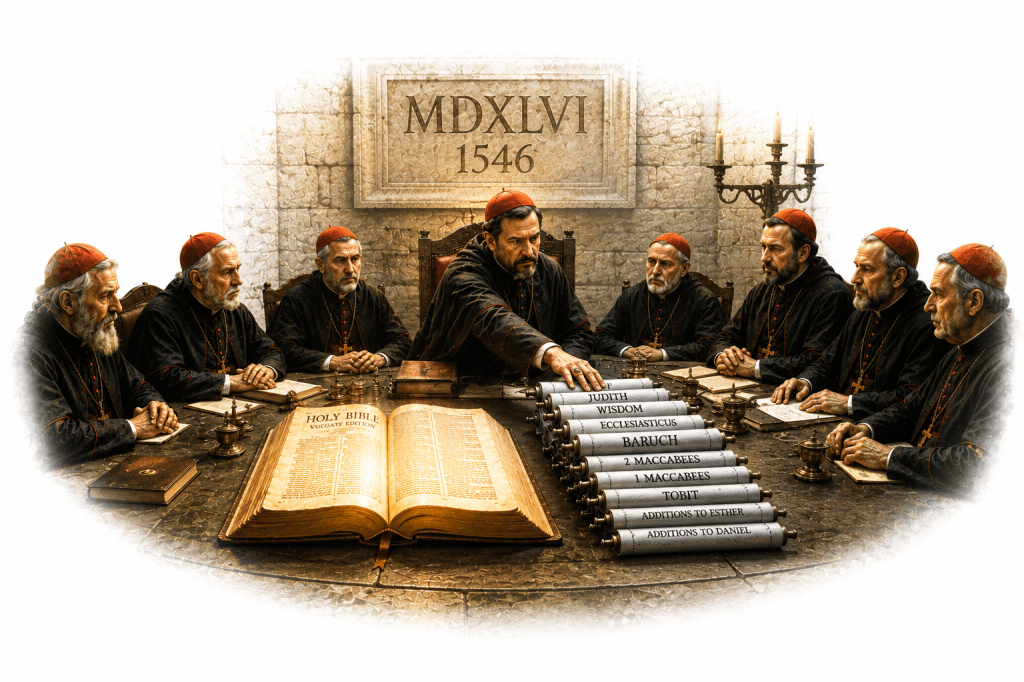
Yesterday established that the Apocrypha never belonged, rejected by the Jewish custodians, never quoted as Scripture by Jesus or the apostles, contradicting the inspired canon at key points, and explicitly set outside the canon by the church fathers themselves. Which leaves one question hanging, and it is the sharpest question in the whole discussion.
If everyone from Josephus to Jerome to Athanasius treated these books as outside the canon, how did they end up formally declared Scripture by the Roman Catholic Church?
The answer is a specific date, a specific council, and a specific motive. And once you see them together, the whole thing becomes clear.
“And he said unto them, Full well ye reject the commandment of God, that ye may keep your own tradition” (Mark 7:9).
That was the Lord’s charge against the religious authorities of His own day, that they would set aside the commandment of God in order to preserve the tradition of men. It is the exact pattern that produced the canonization of the Apocrypha. The books were not added because the evidence demanded it. They were added because a tradition needed defending, and only these books could defend it.
A Date That Tells the Story
The official Roman Catholic canonization of the Apocrypha occurred at the Council of Trent in 1546.
Sit with that date for a moment, because it does most of the work by itself. 1546, a full fifteen centuries after the New Testament canon was closed. Fifteen hundred years after the apostolic age. More than eleven hundred years after Athanasius listed the canon and placed the Apocrypha outside it. Fifteen centuries of church history in which the Apocrypha was read, valued, sometimes printed alongside Scripture, but not formally declared canonical by the whole church.
And then, in 1546, suddenly it was.
This is the fact that is most often obscured in the discussion, and it is the fact that matters most. The Apocrypha did not achieve canonical status in the Roman Catholic Church because ancient tradition and apostolic testimony finally, belatedly, forced the recognition. It achieved canonical status as a specific, deliberate response to a crisis that had erupted just a generation earlier, the Protestant Reformation.
The timing is not a coincidence. The timing is the whole story.
What the Reformers Had Attacked
To understand why Trent needed the Apocrypha, you have to understand what the Reformers had been saying.
Luther, Calvin, Zwingli, Tyndale, and the others had attacked a cluster of Roman Catholic doctrines as unbiblical. Among the most damaging of these attacks were their challenges to the sale of indulgences, the doctrine of purgatory, and the practice of praying for the dead. These were not peripheral matters. The sale of indulgences, the idea that one could pay to reduce time in purgatory, was an enormous source of revenue and the very spark that lit Luther’s Ninety-Five Theses in 1517. Purgatory and prayers for the dead were woven deep into the fabric of Catholic piety and Catholic economics.
And here was the Reformers’ devastating point: none of these doctrines can be found in the canonical sixty-six-book Bible. Search the thirty-nine books of the Hebrew canon and the twenty-seven books of the New Testament, and you will not find purgatory. You will not find a biblical basis for indulgences. You will not find the practice of praying for the dead to release them from an intermediate state of purging.
Where can these doctrines find support? In exactly one place: the Apocrypha. Specifically 2 Maccabees 12, with its account of offering sacrifice for dead soldiers and its conclusion that it is a holy thought to pray for the dead that they may be loosed from their sins.
Do you see the trap Rome was in? The Reformers said: your doctrines aren’t in the Bible. Rome could either surrender the doctrines, and the revenue and authority bound up with them, or it could expand the Bible to include the one book that supported them. Trent chose to expand the Bible.
Authorization, Not Recognition
This is the clearest possible illustration of the distinction this whole series has been built on: the difference between recognition and authorization.
Recognition is what the church does when it acknowledges what God has already inspired, receiving the diamond, discerning the Shepherd’s voice, submitting to a Word that stands above it. Authorization is what an institution does when it confers authority by its own decree, creating the standard rather than bowing to it.
The Council of Trent did not recognize what God had spoken. There was nothing new to recognize; the evidence had pointed the same direction for fifteen centuries. Trent authorized what the Roman Church needed for its own doctrinal agenda. It exercised the authority it claimed over Scripture, the very authority the Reformers denied it had, to declare canonical the books that its threatened doctrines required.
And this is the tell. A church that merely recognizes the canon cannot add to it, because recognition responds to a reality outside itself. Only a church that believes it created the canon can expand it, because if you made the standard, you can revise the standard. Trent’s action was not just wrong about the Apocrypha. It was a demonstration, in real time, of the entire Roman theory of the canon: the church over the Word, defining Scripture rather than submitting to it.
The Reformers said the church stands under the Word. Trent answered by adding to the Word. In doing so, it proved the Reformers’ point more powerfully than any argument could.
The Reformers’ Response — Back to the Hebrew Canon
The Reformers recovered the principle that had governed the early church’s handling of the Apocrypha before Trent corrupted it. They returned to the Hebrew canon, the same thirty-nine Old Testament books affirmed by Jesus and the apostles, and they made the return on explicitly biblical grounds.
Luther did not pretend the apocryphal books did not exist or had no value. He included them in his German Bible, but in a clearly labeled appendix, with the notation that these are books which are not held equal to the Holy Scriptures, and yet are profitable and good to read. That is exactly the right way to treat them: historically interesting, occasionally edifying, but definitively not the Word of God.
Later Protestant Bibles followed the same wisdom. The 1560 Geneva Bible and early editions of the King James Version included the Apocrypha as a separate, clearly labeled section between the Testaments, never mixed into the Old Testament, never presented as part of the canon. And by the 1820s, the British and Foreign Bible Society had stopped printing the Apocrypha altogether, and most Protestant Bibles since have simply omitted it.
This was not a loss. It was a clarification. These are not the books of God’s covenant. The canon stands complete at sixty-six, the number the Jewish custodians recognized, the number Jesus confirmed, the number the apostles inherited, the number the fathers listed. Trent added to it. The Reformation returned to it.
The Lesson That Outlasts the Controversy
The story of the Apocrypha at Trent is more than a historical curiosity. It is a permanent case study in how the canon gets attacked, and it exposes a pattern the church will see again and again.
The pattern is always the same. A doctrine or a practice cannot be supported from the settled Word. So rather than surrender the doctrine, someone expands the Word to accommodate it. Rome did it with the Apocrypha to defend purgatory. And the same logic drives every group that reopens the canon, the cult that adds a new book to support its new teaching, the movement that adds fresh prophetic words to authorize its new practices. In every case, the settled canon said no, and so the canon had to be enlarged.
This is exactly why the recognition principle matters so much. A recognized canon cannot be expanded to rescue a failing doctrine, because recognition submits to a reality it did not create. Only an authorized canon can be stretched to fit, and the moment a church or a movement starts stretching, you are watching Mark 7:9 happen in real time: the commandment of God set aside to keep the tradition of men.
Tomorrow the Old Testament section closes, the canon settled, and why it stands complete.
“Full well ye reject the commandment of God, that ye may keep your own tradition.” — Mark 7:9 KJV
📖 This post is adapted from Canon and Covenant: How God Preserved His Word Through History. If it helped you, the full book is available on Amazon — or you can support this ministry directly.
thefinalconvergence.com | Follow on Instagram, Facebook, X, and YouTube
If you like to be updated on new blogs, sign up to our newsletter!


Leave a Reply