
Published: August 27, 2026 | thefinalconvergence.com
Five days ago the series turned from foundations to specifics, beginning with the Old Testament. Today that section closes — and it is worth standing back to see the whole picture at once, because the case for the Old Testament canon is one of the most secure things in all of Christian apologetics.
Thirty-nine books. Recognized, not created. Confirmed by Christ. Inherited by the apostles. Guarded against every attempt to expand it. Settled and complete.
“For verily I say unto you, Till heaven and earth pass, one jot or one tittle shall in no wise pass from the law, till all be fulfilled” (Matthew 5:18).
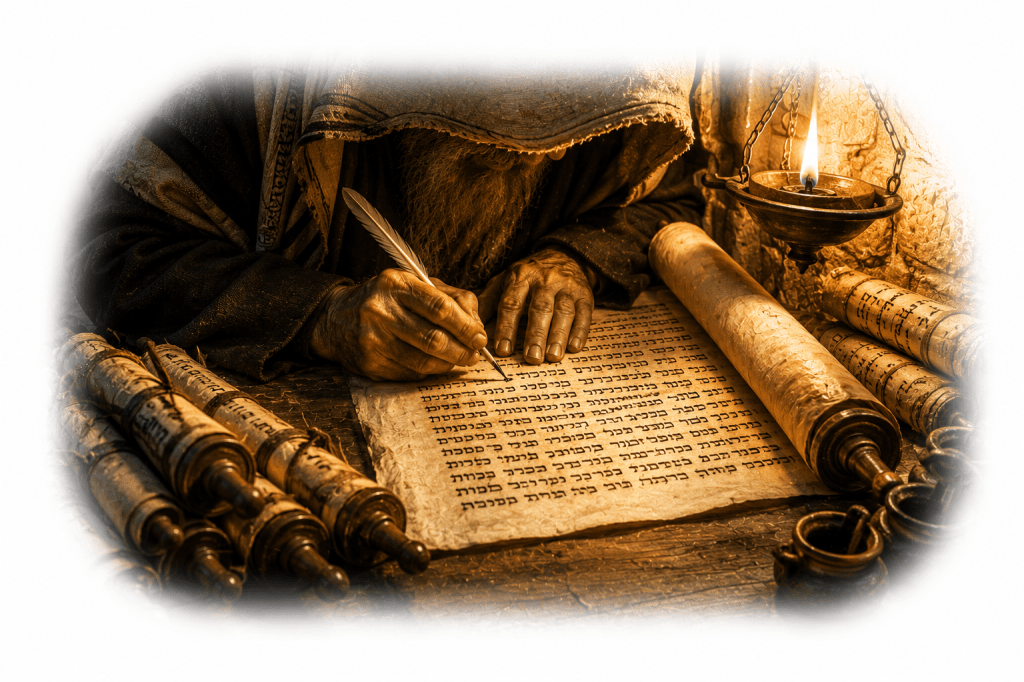
The jot was the smallest letter of the Hebrew alphabet. The tittle was the tiny stroke that distinguished one letter from another — the ancient equivalent of the difference between an E and an F. And Jesus said not one of them would pass from the Law until all was fulfilled. That is how settled the Old Testament is. Not merely the books, not merely the chapters, but every letter, every stroke — preserved by the God who spoke it, until every word finds its fulfillment. A canon guarded to the tittle is a canon you can stand on without flinching.
What the Old Testament Section Established
Walk back through the five days and watch how the case assembled itself.
The canon was formed by recognition, not creation (Day 6). The Hebrew Bible — Torah, Nevi’im, Ketuvim — was recognized in sequence across centuries of covenant history. The Torah established at Sinai, preserved beside the Ark, the measuring rod for every later revelation. The Prophets carrying God’s oracles and vindicated by fulfilled prophecy. The Writings received for their evident inspiration and consistency with what came before. Each layer tested against the last, never contradicting, only building. And crucially: the whole collection was closed and recognized before the New Testament church existed. The apostles inherited it. They did not manufacture it.
Christ Himself confirmed it (Day 7). Not a council, not a manuscript tradition, but the risen Son of God — who named the three-part structure in Luke 24:44, who treated the Scriptures as authoritative down to a single verb, who defined the bounded canon from Abel to Zacharias in Matthew 23:35, first page to last. If Jesus affirmed it, the question is closed. And the apostles received exactly what He affirmed.
The Apocrypha was excluded on solid grounds (Day 8). Not removed — never received. The Jewish custodians did not accept it. Jesus and the apostles never quoted it as Scripture. It contradicts the inspired canon at key points. The church fathers explicitly set it outside. Four independent lines of evidence, all converging on the same verdict.
And Trent’s attempt to add it was exposed (Day 9). The 1546 canonization came fifteen centuries after the canon closed, one generation after the Reformation, driven by the need to defend purgatory and prayers for the dead from the one book that supported them. Authorization, not recognition — the church presuming to stand over the Word rather than under it.
Put it all together and you have a canon of remarkable security. Every angle of attack has been answered. Every attempt to expand it has been shown for what it is.
Why This Canon Can Bear Weight
Here is what makes the settled Old Testament so valuable to the believer: it is the foundation the entire New Testament stands on, and it will bear the weight.
Every major doctrine of the Christian faith has its roots in the Old Testament. Creation, the fall, sin, sacrifice, atonement, covenant, redemption, resurrection, the Messiah, the kingdom of God — all of it is planted in the thirty-nine books and harvested in the twenty-seven. When Paul preached the gospel, he preached it according to the scriptures — and the Scriptures he meant were the Hebrew Scriptures, the settled Old Testament canon. When Jesus explained His own suffering and glory on the Emmaus road, He opened Moses and all the prophets. Strip away the Old Testament, or make it uncertain, and the New Testament loses its roots.
This is why the security of the Old Testament canon matters so much. It is not an antiquarian question. The whole structure of Christian truth rests on the reliability of these thirty-nine books. And they are reliable — recognized by the covenant people, preserved to the tittle, confirmed by Christ, defended against every expansion. You can build a life, a theology, and an eternity on this foundation, because God built it to bear exactly that weight.
The Silence That Points Forward
Remember the four hundred silent years — the intertestamental period between Malachi and Matthew, when no recognized prophet arose in Israel. That silence, we said on Day 8, was itself a prophetic act. It marked the completion of the first great phase of God’s revelation.
But silence is not the end of the story. It is the pause before the greatest word God ever spoke.
God, who at sundry times and in divers manners spake in time past unto the fathers by the prophets, hath in these last days spoken unto us by his Son (Hebrews 1:1-2). The Old Testament closes, and the silence falls, and then — into that silence — the Word Himself is born in Bethlehem. The canon that had spoken of Him for centuries gives way to the One it had promised. The measuring rod that had prophesied the Messiah meets the Messiah in the flesh.
And that changes everything about what comes next. The Old Testament canon was recognized as the record of what God spoke through the prophets. The New Testament canon would be recognized as the record of what God spoke through His Son and the apostles He commissioned. Same God. Same Spirit. Same principle of recognition, not creation. But a new and final phase of revelation — the phase that completes the covenant and closes the canon forever.
Thirty-Nine, and the Foundation Is Laid
So the Old Testament section closes where it should: with a canon settled, complete, and closed at thirty-nine books.
Not thirty-nine plus the Apocrypha. Not thirty-nine plus whatever a later council found politically useful. Not thirty-nine plus the ongoing revelations of anyone who claims a fresh word. Thirty-nine books — the exact canon the Jewish community recognized, the exact canon Jesus confirmed, the exact canon the apostles inherited and built upon, guarded by God down to the smallest stroke of the smallest letter.
This is solid ground. And it is the ground on which the New Testament was written — by men who held a complete, settled, recognized Old Testament in their hands, who quoted it hundreds of times, who preached Christ according to the scriptures, and who were themselves being carried by the same Spirit to produce the final phase of the canon.
Tomorrow the series turns to that final phase. How the New Testament canon was recognized — from scrolls to Scripture.
“Till heaven and earth pass, one jot or one tittle shall in no wise pass from the law, till all be fulfilled.” — Matthew 5:18 KJV
📖 This post is adapted from Canon and Covenant: How God Preserved His Word Through History. If it helped you, the full book is available on Amazon — or you can support this ministry directly.
thefinalconvergence.com | Follow on Instagram, Facebook, X, and YouTube
If you like to be updated on new blogs, sign up to our newsletter!


Leave a Reply