
Published: August 29, 2026 | thefinalconvergence.com
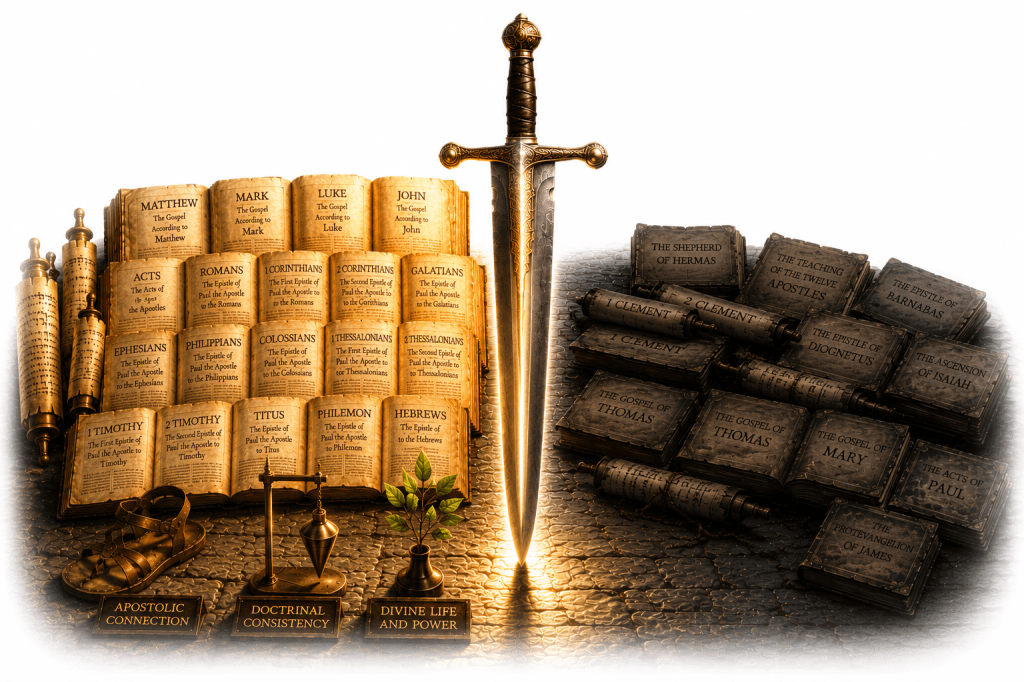
Yesterday traced the organic process by which the New Testament writings moved from scrolls to Scripture, read publicly, copied, quoted, recognized across the empire within decades. But that raises a precise question. When the church recognized these books, what exactly was it recognizing? What made a writing pass, and a forgery fail?
Every generation faces the same challenge, and it is the challenge running underneath this entire series: how do you distinguish the voice of the Shepherd from the voices of strangers? In the context of the canon, it takes a specific form, by what criteria did the early church identify which writings were truly inspired Scripture, and which were merely edifying, or fraudulent?
“For the word of God is quick, and powerful, and sharper than any twoedged sword, piercing even to the dividing asunder of soul and spirit… and is a discerner of the thoughts and intents of the heart” (Hebrews 4:12).
Quick, that is, alive. The Word of God is living. And a living Word can be recognized the way you recognize anything alive: by what it does. That is the deepest of the four tests the church applied. But before we reach it, an essential clarification.
The Criteria Identified Authority — They Did Not Grant It
The early church did not operate from a formal checklist. There was no official committee scoring writings against a predetermined rubric. The process was organic, Spirit-led, rooted in the theological convictions inherited from the apostles. But when we examine the historical record; Origen, Eusebius, Athanasius, Jerome, four clear criteria emerge that functioned as the tests of canonicity.
And here is the point that keeps everything in its proper place: these criteria did not grant authority to Scripture. They identified it. The authority was already present in the inspired writings themselves. The criteria were simply the tools God’s people used to recognize what God had already spoken. This is the recognition principle applied to method. Just as the jeweler’s eye does not create the diamond’s worth but detects it, the four criteria did not confer canonical authority, they discerned it in the books that already possessed it.
Criterion One — Apostolic or Prophetic Origin
The first and most fundamental test: Was this writing produced by a prophet, an apostle, or someone under their direct authority?
This flows directly from the biblical theology of revelation. God speaks through chosen messengers (Hebrews 1:1). His words carry authority because they originate in Him and are transmitted through specific human agents He calls, equips, and authenticates. The prophet in the Old Testament and the apostle in the New were not self-appointed. They were divine appointments.
For the Old Testament, prophetic origin was established by a book’s connection to a prophet; Moses, Samuel, Isaiah, Ezekiel, Daniel. For the New Testament, the test was apostolicity: connection to one of the Twelve or to Paul. Mark was recognized through his association with Peter, Luke through his with Paul. James and Jude, brothers of the Lord and leaders of the Jerusalem church, carried authority from that unique relationship and their evident Spirit-given ministry.
And this criterion is precisely what exposed the forgeries. The pseudonymous writings that flooded the second and third centuries; the Gospel of Thomas, the Gospel of Philip, the Acts of Paul and Thecla, the Apocalypse of Peter, all tried to claim apostolic authority through false attribution. But false attribution can be detected. The early church knew what Peter had taught; they could compare the Apocalypse of Peter with the genuine letters of Peter and see at once that they were not from the same hand. Gnostic theology bears no resemblance to apostolic Christianity. The frauds were exposed by the very criterion they tried to counterfeit.
Criterion Two — Doctrinal Consistency with the Received Word
The second test: Does this writing agree with what God has already revealed?
This principle was not invented by the church. It was given by God, to the law and to the testimony: if they speak not according to this word, it is because there is no light in them (Isaiah 8:20). The Torah itself established it: Deuteronomy 13:1-5 laid down a test for prophets that went beyond fulfilled prediction. Even if a prophet performed signs and wonders, if his message led the people away from the covenant LORD, he was a false prophet. The content of the message mattered as much as any supernatural credential.
Applied to the New Testament, any writing that deviated from the apostolic deposit, the faith which was once delivered unto the saints (Jude 3), was disqualified, no matter how ancient, how spiritually impressive, or how popular. The Gnostic gospels failed decisively. The Gospel of Thomas presents a Jesus who denies the physical resurrection, teaches salvation through secret knowledge rather than faith in His atoning death, and makes statements that are theologically incoherent. This is not the Jesus of the four Gospels, the Lamb of God who died for sin and rose bodily.
And this criterion also reveals something breathtaking. The sixty-six books, written over fifteen centuries by roughly forty authors in three languages across three continents, display a thematic and redemptive unity with no parallel in human literature. Genesis introduces the problem, sin and separation from God. Revelation resolves it, the new creation, the unmediated presence of God with His people. The scarlet thread of the blood of the covenant runs through every book, from the skins God made to cover Adam to the Lamb slain from the foundation of the world. That unity is not the product of human editorial effort. It is the fingerprint of a single divine Author.
Criterion Three — Universal and Early Acceptance
The third test: Was this writing received by the whole church, across different regions, from an early date?
Genuine Scripture does not have to fight for recognition for centuries. It is recognized by the people of God, who know their Shepherd’s voice, from the beginning. The four Gospels, the letters of Paul, and the other major books were read, copied, and treated as the authoritative Word of God from the very first generation.
This directly dismantles a popular myth. The Gnostic gospels were not suppressed ancient documents that competed on equal terms and narrowly lost a political contest. They were produced by minority heretical movements, rejected from the beginning by the mainstream of the Christian community, and consistently opposed by the church fathers. They did not lose a vote. They failed the test of universal reception, they never had it to begin with.
This criterion needs nuance, and the book supplies it honestly. Some genuine books; Hebrews, 2 Peter, Revelation, were debated in certain regions during the second and third centuries. But not because the universal church rejected them; rather because the specific question of their apostolic attribution required careful investigation. The seriousness of that examination is not evidence of uncertainty about the canon. It is evidence of the integrity with which the church approached its responsibility. And by the time the questions were formally addressed at Hippo (393) and Carthage (397), there was no genuine controversy about the twenty-seven books. The councils confirmed what the church already believed and practiced.
Criterion Four — Evidence of Divine Life and Power
The fourth test is the most subjective, and yet, in the operation of the Holy Spirit, the most decisive: Does this writing bear the marks of divine life and transforming power?
Because the Word of God is quick, alive (Hebrews 4:12). It convicts the sinner, comforts the grieving, rebukes the proud, strengthens the weak, reveals Christ, and transforms lives; consistently, across every culture, in every language, in every generation since it was written. This is not a natural phenomenon. No merely human document has produced this effect across two thousand years. The Bible’s power to transform human lives is itself a testimony to its divine origin.
The apocryphal and pseudonymous writings do not produce this effect. They may inform, occasionally inspire, entertain, or instruct. But they do not cut to the heart and lay the soul bare before the living God. They do not produce the fruit of conviction, repentance, faith, and transformation that the canonical Scriptures consistently produce. There is a qualitative difference that God’s people have always sensed, even when they could not fully articulate it.
This is ultimately what Jesus meant: my sheep hear my voice. The canonical test is not merely intellectual. It is spiritual. The Spirit who inspired the Word bears witness in the hearts of God’s people that this Word is from God. Not every personal feeling can claim that witness, the Spirit’s witness must be tested against the other three criteria. But when the Spirit-illuminated reading of a text consistently and universally produces genuine spiritual life, that is evidence of genuine inspiration.
The Criteria Are Tools for Today
These four tests are not historical curiosities. They are tools every believer can use right now, when false writings and false prophets press their claims with renewed confidence.
Hand someone the Book of Mormon and ask you to pray about whether it is Scripture, run the four tests. Apostolic or prophetic origin? No, allegedly dictated through a seer stone in the nineteenth century. Doctrinal consistency? No, it teaches a different gospel and a different Christ. Universal early reception? No, it did not exist until 1830. Marks of divine life and power? Its fruit is cultic control and doctrinal deviation, not saving transformation. Four criteria, four failures.
The same tests apply when a self-proclaimed NAR apostle claims a revelation that supplements Scripture, or a progressive theologian claims Paul’s letters need revising for modern sensibilities. The canon is closed. The criteria are clear. And the sheep know the Shepherd’s voice.
Tomorrow, the councils. What Hippo and Carthage actually did, and what they did not do.
“For the word of God is quick, and powerful, and sharper than any twoedged sword.” — Hebrews 4:12 KJV
📖 This post is adapted from Canon and Covenant: How God Preserved His Word Through History. If it helped you, the full book is available on Amazon — or you can support this ministry directly.
thefinalconvergence.com | Follow on Instagram, Facebook, X, and YouTube
If you like to be updated on new blogs, sign up to our newsletter!


Leave a Reply