
Published: September 4, 2026 | thefinalconvergence.com
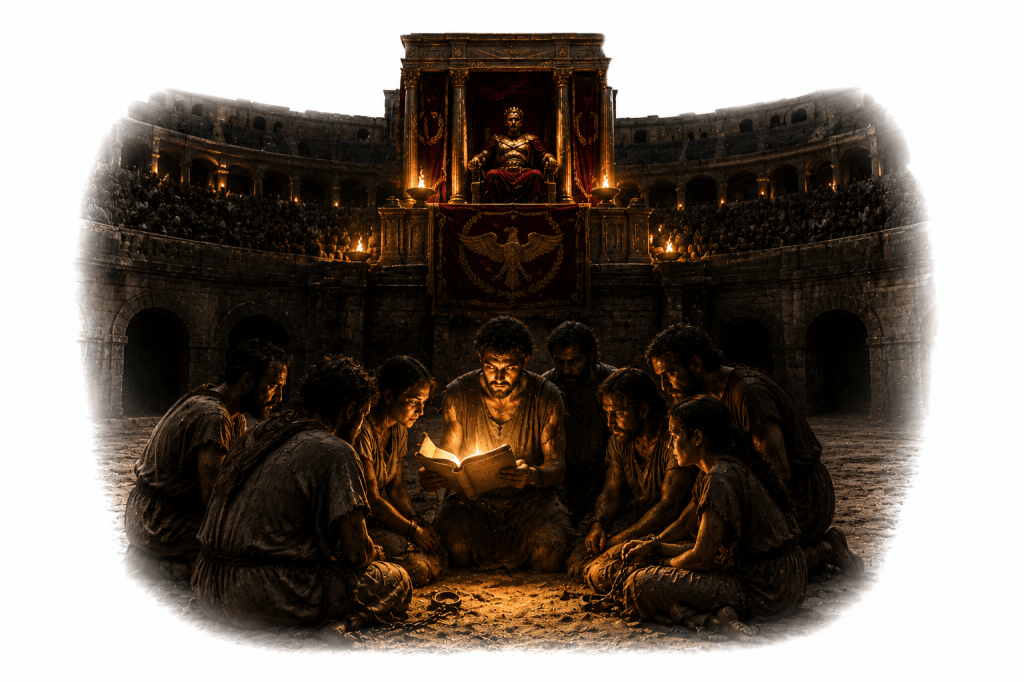
Two days of the rejected-writings section have shown the Gnostic gospels exposed and the “lost books” myth collapsed. Today the section closes by answering the cluster of conspiracy theories head-on, the popular myths that circulate in documentaries, bestsellers, and social media threads, all designed to make you doubt the Bible in your hands, and then showing why the same strategy is still running today under new names.
“Beware lest any man spoil you through philosophy and vain deceit, after the tradition of men, after the rudiments of the world, and not after Christ” (Colossians 2:8).
Vain deceit, after the tradition of men. Paul’s warning is precise. Not every impressive-sounding claim is true. Some are philosophy and vain deceit, human fabrications dressed up as hidden knowledge, designed to spoil you, to carry you off as spoil. The canon conspiracy theories are exactly this: confident, sophisticated, endlessly repeated, and hollow. Today we hold them up to the light.
Myth One — “Constantine Chose the Canon”
The most popular version, made famous by Dan Brown’s The Da Vinci Code: the Roman Emperor Constantine assembled the Bible at the Council of Nicaea in AD 325, choosing which books to include, suppressing the alternatives, and inventing the divinity of Jesus by a close vote.
It is false on every count, as Day 13 established. Nicaea produced no canon list. It did not address which books belonged in the Bible at all, that question is simply not in the record of the council’s proceedings. Nicaea was called to address the Arian controversy over the nature of the Son. And the divinity of Jesus was not invented there; it had been confessed and disputed for centuries before, and it is written plainly into the earliest New Testament documents themselves. The whole Constantine-assembled-the-Bible narrative is a modern fabrication with no basis in primary historical sources. It is philosophy and vain deceit, a compelling story that happens not to be true.
Myth Two — “The Suppressed Gospels”
The second myth follows from the first: the church, backed by imperial power, suppressed dozens of competing gospels that told a different, richer, more inclusive story of Jesus, and only the politically convenient four survived.
Days 16 and 17 dismantled this. The Gnostic gospels were not suppressed treasures that competed on equal terms and lost a political contest. They were produced by minority heretical movements, rejected from the beginning by the mainstream of the church, and refuted by name, the Gospel of Judas exposed by Irenaeus around AD 180, within a generation of its writing. They did not lose a vote. They failed the criteria: false authorship, contradictory theology, no universal reception, no divine power. Calling them suppressed gospels assumes they had a legitimate claim the church crushed. They never had the claim. The church recognized counterfeits and refused them, exactly as the custodians of a treasury refuse counterfeit bills.
Myth Three — “The Winners Wrote History”
The third myth is subtler and more corrosive: the canon simply reflects the views of whoever held power. Orthodoxy is just the heresy that won. The books that made it in are the winners’ documents; the losers were erased.
This sounds sophisticated, but it collapses on two facts already established. First, the recognition ran ahead of any power to enforce it, the core canon was recognized across the empire in the second century, when Christianity was a persecuted, powerless, illegal minority with no ability to impose anything on anyone. The canon was being recognized precisely when Christians were being fed to lions, not when they held imperial power. Second, East and West converged independently on the same twenty-seven books, Greek and Latin churches, divided by language, culture, and theology, arriving at the same conclusion without a central authority coordinating them. Winners writing history produces the winner’s version in the winner’s territory. It does not produce spontaneous agreement among the powerless across rival cultures. That pattern points to recognition under one Spirit, not imposition by one empire.
The Same Strategy, New Names
Here is what ties the whole rejected-writings section together, and why it is not merely ancient history. The production of counterfeit scripture did not end in the second century. It has never stopped. It simply changes names.
In the seventh century, Muhammad claimed that the angel Gabriel revealed the Qur’an to him, offered as the final, corrected Word of God superseding both Testaments. In the nineteenth century, Joseph Smith claimed that golden plates, translated through a seer stone, produced the Book of Mormon, Another Testament of Jesus Christ. Mary Baker Eddy claimed her Science and Health was the inspired key required to unlock the Bible’s true meaning. Each is a reopening of the canon under a different name. And each produces the same result: the biblical text is subordinated to the new revelation, believers are put in subjection to a human authority claiming divine mandate, and the sufficiency of Scripture is denied.
And in our own generation, the New Apostolic Reformation has produced a more sophisticated version of the same strategy. NAR apostles and prophets do not usually claim to be writing new Scripture, they are subtler than that. They claim to receive prophetic words, apostolic decrees, and strategic revelations that carry divine authority for the church’s mission. But the functional effect is identical: their words are treated as binding divine revelation that supplements, corrects, or supersedes the written Word. Congregations who disobey an apostle’s decree are threatened with spiritual consequences. And the biblical test for a prophet is quietly never applied: when a prophet speaketh in the name of the LORD, if the thing follow not, nor come to pass, that is the thing which the LORD hath not spoken (Deuteronomy 18:22). Prophecies that fail are rationalized rather than condemned.
The packaging updates every few centuries, an angel, golden plates, a seer stone, a prophetic word, an apostolic decree. The strategy never changes. It is the serpent’s competing word from Eden, still claiming divine knowledge, still offering divine benefits, still contradicting the sufficiency of what God has actually said.
The Canon Is the Answer
And the canon is the answer to all of it, the ancient myths and the modern movements alike.
A closed, sufficient, authoritative canon means that no human being, however gifted or charismatic, however ancient the manuscript or breathless the documentary, can claim binding divine authority over the church beyond what is written. Every prophet must be tested by the Word. Every apostle must submit to the apostolic writings that are already Scripture. Every claimed revelation must be evaluated by the criteria that have governed canonical recognition from the beginning. And every conspiracy theory about how the canon was really assembled must be measured against the actual historical record, which shows recognition, not imposition, from the first page to the last.
This is the discernment the whole rejected-writings section has been training. The Gnostic gospels, the pseudepigrapha, the lost-books myth, the Constantine legend, the suppressed-gospels story, the winners-wrote-history theory, and the endless parade of new revelations, hold every one of them up to the light of the closed canon and the historical record, and they are exposed as what Paul named them: philosophy and vain deceit, after the tradition of men, and not after Christ.
The Book in your hands was not chosen by an emperor, assembled by a council, or edited by the winners. It was recognized by the people of God, who heard the Shepherd’s voice, tested the spirits, and held fast to that which is good. It stands complete at sixty-six, and every counterfeit that has ever gathered around it, ancient or modern, has been weighed against it and found wanting.
Tomorrow the series turns to what that closed, complete canon actually secures for the church: the sufficiency of Scripture.
“Beware lest any man spoil you through philosophy and vain deceit, after the tradition of men, after the rudiments of the world, and not after Christ.” — Colossians 2:8 KJV
📖 This post is adapted from Canon and Covenant: How God Preserved His Word Through History. If it helped you, the full book is available on Amazon — or you can support this ministry directly.
thefinalconvergence.com | Follow on Instagram, Facebook, X, and YouTube
If you like to be updated on new blogs, sign up to our newsletter!


Leave a Reply