
Published: September 18, 2026 | thefinalconvergence.com
Before we get to manuscripts, before committees, before publishing contracts, there is a prior question that has to be settled, because everything else in this series depends on the answer. Does it actually matter which words are in your Bible? Or is the general message enough, the broad strokes of God’s love, Christ’s sacrifice, the hope of eternal life, regardless of what happens to individual verses?
If the answer is “the general message is enough,” then this whole examination is a waste of time. But the Bible’s own answer is unambiguous, and it was settled not by a scholar or a tradition but by the Lord Jesus Christ Himself, with a precision that leaves no room for the comfortable middle ground of “close enough.”
“Sanctify them through thy truth: thy word is truth” (John 17:17).
Notice what Jesus does not say. He does not say His word contains truth, or points to truth, or conveys the general sense of truth. He says His word is truth, and it is by that truth, by the Word, that His people are sanctified and set apart. If the Word is the very truth that makes us holy, then the words of that Word are not incidental packaging around a message. They are the instrument God uses to sanctify His people. And an instrument that has been altered no longer does exactly what the maker designed it to do.
What Jesus Said About Words
Jesus was not vague about how far the authority of Scripture reaches. He located it in the smallest possible units of the text.
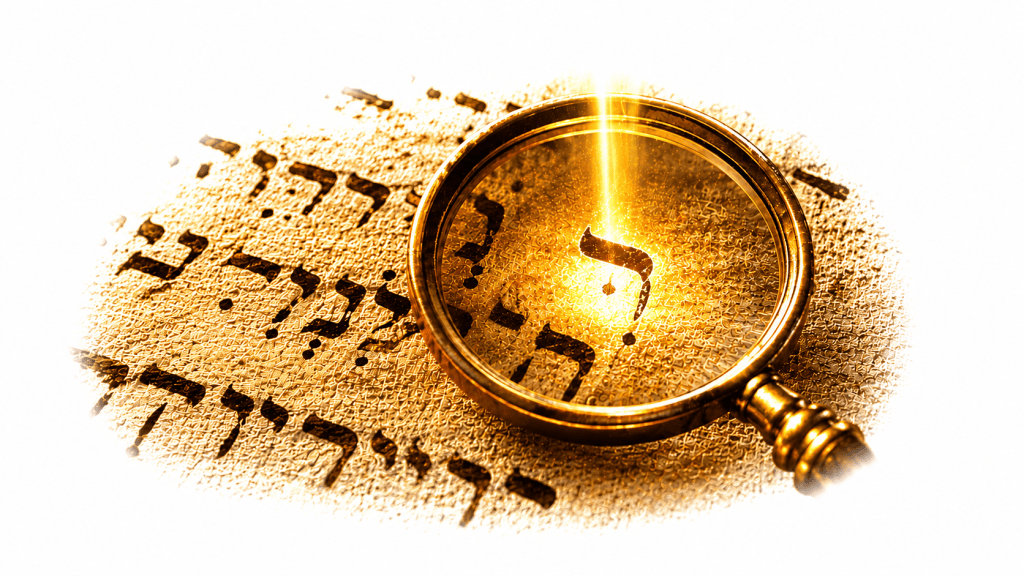
In Matthew 5:18 He declared: Till heaven and earth pass, one jot or one tittle shall in no wise pass from the law, till all be fulfilled. The jot is the yodh, the smallest letter in the Hebrew alphabet, barely larger than an apostrophe. The tittle is the tiny decorative stroke that distinguishes one Hebrew letter from another: the difference between a dalet and a resh, between a mem and a samech. Jesus is not merely defending the broad message of Scripture. He is defending the individual marks on individual letters. The smallest stroke of the pen carries divine authority and will not fail.
Watch, too, how He handled Scripture under pressure. When He confronted Satan in the wilderness, He did not answer with theological concepts or general principles. He answered with precise quotations: It is written… It is written… It is written. Three times, exact words. And when Satan misquoted Scripture in the second temptation, not fabricating a verse, but subtly omitting a qualifying phrase from Psalm 91, Jesus responded not to the sentiment but to the exact wording. The precision was not incidental to the encounter. It was the encounter. The battle in the wilderness was fought over words.
And in John 10:35 He made a statement that should permanently settle this for anyone who takes His authority seriously: the scripture cannot be broken. Not should not. Cannot. The same impossibility as God lying, as God being tempted, as the gates of hell prevailing against the church. The Word of God cannot be broken because it is the Word of God, and the God who spoke it does not fail.
What Paul Said About Inspiration
Paul gives the doctrine its name. Writing to Timothy, he declares: All scripture is given by inspiration of God (2 Timothy 3:16). The word behind “given by inspiration of God” is theopneustos, a compound of theos (God) and pneō (to breathe). Literally: God-breathed. Not God-influenced. Not God-endorsed. Not God-supervised. The very breath of God exhaled into written language.
The implication is exact and demanding. If the words of Scripture are the breath of God, then the corruption, removal, or alteration of any of those words is not merely an editorial matter. It is the removal of something that originated with the breath of God. No human editor has the authority to improve on the divine exhalation. No committee has the competence to decide that certain words of God are unnecessary. And no market-research team can determine which of God’s statements is too difficult for modern readers and may therefore be softened.
Peter fills in how inspiration worked: holy men of God spake as they were moved by the Holy Ghost (2 Peter 1:21). Moved, pheromenoi, is a nautical term for a ship carried along by the wind. The human authors were not passive transcription machines; their personalities, vocabularies, and literary styles are all visible in the text. But the direction was divine. The words they produced were not their opinions about God. They were God’s own communication through them. Which means the words are not the authors’ to edit — and certainly not ours.
Every Word — and the Warning Against Adding
Proverbs states it with characteristic Old Testament directness: Every word of God is pure: he is a shield unto them that put their trust in him. Add thou not unto his words, lest he reprove thee, and thou be found a liar (Proverbs 30:5-6).
Every word. Not the major themes. Not the passages with a proven track record. Every word is pure, and every word is a shield to those who trust God. And then the warning, as severe as any in the wisdom literature, against improving on what God said. Those who add to God’s words will be found liars before God Himself. It is worth sitting with how strong that is. Tampering with the words of God is not filed under “editorial license.” It is filed under lying about God.
Why “Close Enough” Is a Theological Disaster
The most common defense of the modern translation situation is that the differences are minor, that all the versions “say essentially the same thing.” That claim is both factually wrong and theologically catastrophic.
It is factually wrong, as later days in this series will demonstrate in detail: entire verses have been dropped, key doctrinal phrases changed, and the pattern of omission concentrates in the most significant theological passages of the New Testament. The differences are not cosmetic. But the deeper problem is the logic itself. “Close enough” assumes a standard of accuracy that is foreign to the biblical doctrine of inspiration. Jesus said not even a jot or tittle would pass from the Law. That standard is not “close enough.” That standard is every word. When we accept “close enough” as sufficient for Scripture, we have quietly adopted a standard of accuracy lower than the one the Lord Himself established.
Consider an analogy. If a pharmacist gave you medication that was “close enough” to the prescribed formula, one ingredient missing, another substituted, a slightly different concentration, you would not accept it. The consequences of imprecision in medicine can be serious or fatal. The consequences of imprecision in Scripture are eternal. If we demand pharmaceutical precision in medicine, how much more should we demand theological precision in the Word of God?
This is the foundation the rest of the series stands on. The words matter, all of them, because they are the God-breathed truth by which we are sanctified, the shield of those who trust Him, sealed by the One whose word cannot be broken. Which is precisely why it matters very much which words are in your Bible, and which have been quietly removed from it.
Tomorrow, the manuscripts themselves: the two streams your Bible flows from, where they come from, and what each reveals about itself.
“Sanctify them through thy truth: thy word is truth.” — John 17:17 KJV
📖 This post is adapted from Which Bible Can You Trust? Scripture, Manuscripts, and the Quest for the Most Trustworthy Text. If it helped you, the full book is available on Amazon — or you can support this ministry directly.
thefinalconvergence.com | Follow on Instagram, Facebook, X, and YouTube
If you like to be updated on new blogs, sign up to our newsletter!


Leave a comment