
Published: September 21, 2026 | thefinalconvergence.com
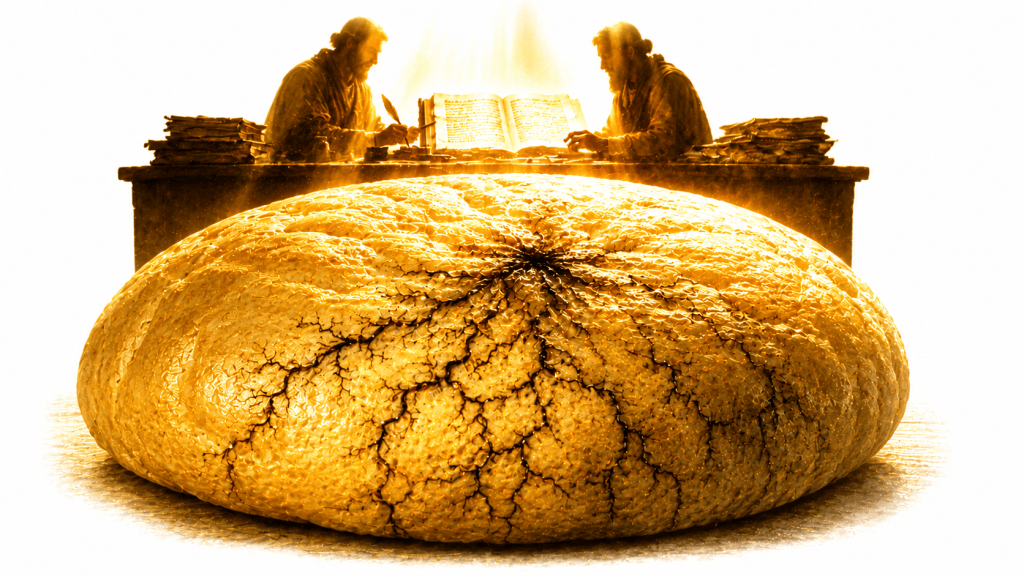
Every modern English Bible you can buy, the NIV, the ESV, the NASB, the CSB, the NLT, traces back through a single decision made by two men in 1881. Understanding that decision, and the men who made it, is the hinge of this entire series. Because when you learn who determined what belongs in your New Testament, and what they believed while they were doing it, the modern translation situation stops looking like neutral scholarship and starts looking like something else.
“A little leaven leaveneth the whole lump” (Galatians 5:9).
Paul’s proverb is about how a small, hidden influence works its way through everything it touches. A pinch of leaven does not stay in one corner of the dough; it changes the entire loaf. That is precisely the story of the modern text. Two scholars, one Greek New Testament, a set of assumptions never proven, and the leaven of those assumptions has now worked its way into nearly every Bible on the shelf. To see how, you have to meet the men.
The Decision of 1881
In 1881, two Cambridge scholars published a Greek New Testament that changed the course of English Bible translation forever. Brooke Foss Westcott and Fenton John Anthony Hort spent nearly thirty years in collaboration producing a text that departed from the Textus Receptus in over five thousand places, omitting entire verses, altering key phrases, and elevating a small cluster of Alexandrian manuscripts over the overwhelming testimony of five thousand Byzantine witnesses.
Their work became the basis for the Revised Version of 1881, the first major English Bible to abandon the KJV’s textual base, and directly or indirectly, the foundation for every major modern translation that followed. This is not a contested claim. By the admission of its own editors, the Nestle-Aland critical text, the current standard behind modern translation work, is essentially the Westcott-Hort text with minor twentieth-century refinements. The foundational assumptions have not changed in nearly a century and a half.
To evaluate that work fairly, we have to know who these men were, not only their credentials, but their convictions. Because the convictions of the men who determine what belongs in your Bible matter enormously. And in this case, we are not guessing at their convictions. They recorded them, in their own letters and published writings.
Brooke Foss Westcott (1825–1901)
By every outward measure, Westcott was a successful Anglican churchman, Regius Professor of Divinity at Cambridge, later Bishop of Durham, author of commentaries still consulted today. A genuinely learned man.
But his own correspondence reveals a theology far from the Protestant orthodoxy he nominally represented. In a letter to the Bishop of Gloucester, Westcott wrote that “no one now, I suppose, holds that the first three chapters of Genesis give a literal history,” denying the historical reliability of the creation, the fall, and the account of origins on which Paul’s argument in Romans 5 depends. He held Catholic sympathies on the Lord’s Supper, believing in the real presence, the very doctrine for which Cranmer, Ridley, and Latimer were burned at the stake. And after visiting a shrine to Mary, he wrote to his wife that he was “almost a Marian.”
There is more, and it is not incidental. In 1851, Westcott and Hort co-founded a secret Cambridge society called the Ghostly Guild, dedicated to investigating paranormal phenomena, hauntings, and the possibility of communication with the dead. This was not a passing youthful curiosity, it was a sustained interest in practices Scripture explicitly and severely forbids (Deuteronomy 18:10-12; Leviticus 19:31). That the man who would spend the next three decades deciding which words belong in the New Testament was, at the same time, seeking contact with the spirits of the dead is not a minor biographical footnote. It says something about his spiritual orientation that no amount of academic credentialing can offset.
Fenton John Anthony Hort (1828–1892)
Hort was, by most assessments, the more systematically brilliant of the two, the primary architect of the critical-text methodology, the man who built the theoretical framework justifying the preference for a handful of Alexandrian manuscripts over thousands of Byzantine witnesses. And his private letters, preserved in the biography his son published in 1896, are extraordinarily revealing.
In 1851, Hort wrote dismissively of what he called “Jesus-worship,” his contemptuous term for evangelical Christianity’s focus on personal faith in Christ, which he compared to Marian idolatry. In the same period, he described the Textus Receptus, the text of Luther, Tyndale, Calvin, the martyrs, and the KJV translators, as “villainous” and “vile.” That is not the language of a neutral scholar following the evidence wherever it leads. It is the language of a man with a conclusion already reached, executing an agenda already formed.
Hort accepted Darwin’s theory within a year of its publication. He denied the literal Adam, the literal fall, and the historical reliability of early Genesis. And he held views sympathetic to universal salvation, questioning the doctrine of eternal conscious punishment. That last point matters more than it may first appear, because it directly parallels the consistent pattern in the Alexandrian manuscripts he preferred: the softening and omission of language about hell and judgment. A man who doubted eternal punishment found himself championing manuscripts that happen to mute the Bible’s teaching on eternal punishment. That is not proof of intent. But it is exactly the kind of alignment between conviction and conclusion that this series asks you to notice.
Assumptions Dressed as Science
The methodology itself, examined closely, turns out to rest on assertion rather than demonstration.
Westcott and Hort gave near-infallible status to two manuscripts, Vaticanus and Sinaiticus. They invented a category, the “Neutral text,” and assigned it to Vaticanus, declaring it the closest surviving witness to the apostolic originals. This was not demonstrated from the manuscript evidence. It was assumed, and then used as a circular argument to dismiss the thousands of manuscripts that disagreed. They declared the Textus Receptus a late, “conflated” text, a supposed later blending of earlier traditions, without producing any historical evidence that such an editorial process ever occurred. The effect was to disqualify five thousand agreeing manuscripts on the strength of a theoretical reconstruction for which no documentary evidence exists.
And they did not go unchallenged. Dean John William Burgon, the most formidable contemporary critic of Westcott and Hort, spent years demonstrating in The Revision Revised (1883) that the patristic evidence, the New Testament quotations of the early church fathers, overwhelmingly supports the Byzantine text, not the Alexandrian. Irenaeus, writing around 180 AD, quotes Mark 16:19, the very verse Vaticanus and Sinaiticus omit. Justin Martyr, around 150 AD, quotes multiple passages in their Byzantine form. The fathers closest in time to the apostolic originals consistently read a text that agrees with the Received Text, not with Vaticanus. If the Alexandrian text were the ancient, original one, the earliest quotations should reflect it. They do not.
Burgon’s arguments were never satisfactorily answered in his lifetime, and they have not been satisfactorily answered since. But by the time he wrote, the Westcott-Hort methodology had already been built into the 1881 revision, and the academic establishment had already committed itself to the critical-text approach. So Burgon’s work was not refuted. It was set aside, made socially inconvenient rather than proven wrong. That distinction matters, because it means the modern consensus rests less on a won argument than on an institutional momentum that never stopped to answer its most serious critic.
The Leaven in Every Loaf
Here is where the anchor verse comes home. The modern critical text, the Nestle-Aland text underlying your NIV, ESV, and NASB, is essentially the Westcott-Hort text with minor twentieth-century revisions. The foundational assumptions have not changed. The preference for the Alexandrian minority has not changed. The five thousand Byzantine witnesses are still being dismissed on the basis of assumptions that were never proven, laid down by two men whose theology was, by the testimony of their own pens, profoundly compromised, in service of a conclusion that was reached before the investigation began.
A little leaven leavens the whole lump. This is not a claim that everyone who reads a modern translation is deceived, or that the men translating today share Westcott and Hort’s convictions, most emphatically do not. It is a claim about the source. The leaven was introduced in 1881, quietly, by two men. And it has worked its way through nearly the entire modern loaf. When you understand where the modern text comes from, the question of this whole series — which Bible can you trust? — stops being a matter of preference and becomes a matter of tracing the leaven back to its source.
Tomorrow, the translators themselves: what the men behind the modern versions have believed, and how you can test them by their fruit.
“A little leaven leaveneth the whole lump.” — Galatians 5:9 KJV
📖 This post is adapted from Which Bible Can You Trust? Scripture, Manuscripts, and the Quest for the Most Trustworthy Text. If it helped you, the full book is available on Amazon — or you can support this ministry directly.
thefinalconvergence.com | Follow on Instagram, Facebook, X, and YouTube
If you like to be updated on new blogs, sign up to our newsletter!


Leave a comment