
Published: September 25, 2026 | thefinalconvergence.com
Yesterday we saw the pattern take shape across the deity of Christ and the blood of Christ: not random variation, but a consistent lean, the modern critical text quieter, more ambiguous, less physical at exactly the points where the Received Text is most explicit. Today we follow that pattern into three more categories, and the last of them is the single most consequential passage in the entire Bible-version debate, twelve verses that decide whether the Gospel of Mark ends in triumph or in terror.
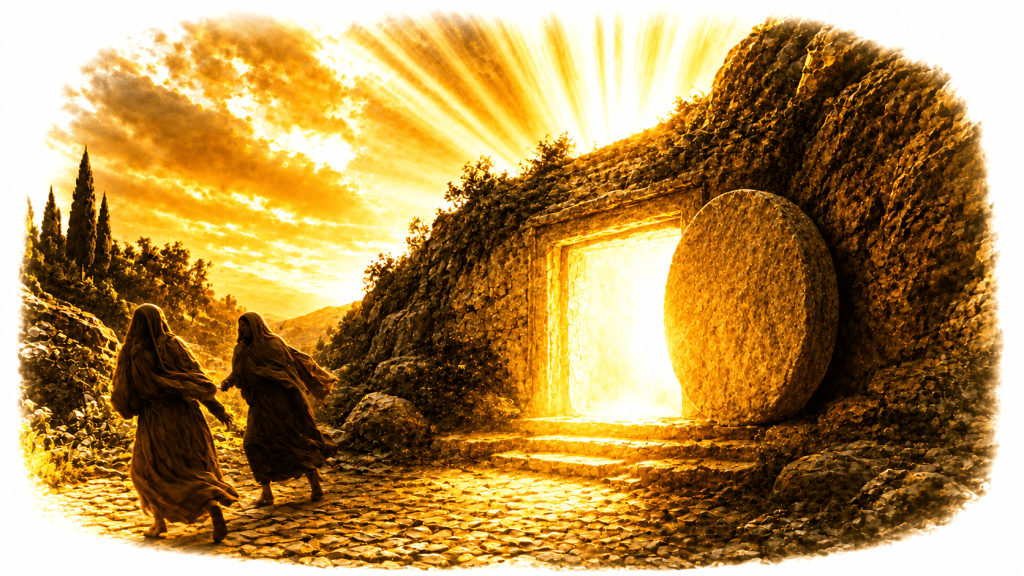
“He is not here, but is risen” (Luke 24:6).
This is the announcement the whole New Testament is built to deliver. The angel at the empty tomb does not say the disciples felt Christ’s presence, or that His memory lived on, or that the movement continued. He says: He is not here, but is risen. A physical body, gone from a physical tomb, because a physical resurrection had occurred. Hold that sentence in mind, because by the end of today you will see that in the modern critical text, the Gospel of Mark never gets to say it. Mark’s Gospel, in the critical editions, ends before the risen Christ ever appears.
Prayer, Fasting, and the Physical Disciplines
Start with the disciplines of the body, and watch the Alexandrian discomfort with the physical show up exactly where you would predict.
Matthew 17:21. After Jesus casts out a demon the disciples could not, they ask Him privately: Why could not we cast him out? In the KJV, Jesus gives a two-part answer, verse 20 on faith like a mustard seed, and then verse 21: Howbeit this kind goeth not out but by prayer and fasting. Modern versions following the critical text omit verse 21 entirely. The disciples’ question is now answered only by the faith saying. The specific prescription, that some spiritual contests require the bodily discipline of prayer and fasting, is gone. What remains is not false. It is incomplete. And the incompleteness is exactly the incompleteness Alexandria’s discomfort with the physical would predict: a tradition that despised the body would not miss a verse commanding the body be disciplined.
Mark 11:26. KJV: But if ye do not forgive, neither will your Father which is in heaven forgive your trespasses. A direct statement from Jesus binding our reception of God’s forgiveness to our willingness to forgive others, an echo of the Lord’s Prayer itself. It is a serious, uncomfortable pastoral warning: the transaction you are asking God to perform for you is one you are refusing to perform for someone else. Modern versions omit it, footnote only. One more warning from Christ’s own lips, gone quiet.
The Resurrection — Mark 16:9-20
Now the passage that matters most. Mark 16:9-20 is twelve verses long, and it is not a marginal add-on. It contains the post-resurrection appearances of Jesus, the Great Commission in Mark’s telling, the promise that signs follow those who believe, Christ’s ascension, and the disciples going out to preach everywhere with the Lord confirming the word. It is the conclusion of the Gospel.
The NIV and ESV bracket these twelve verses with a note: the earliest manuscripts and some other ancient witnesses do not have verses 9-20. That note is technically accurate and profoundly misleading, because of what it does not say.
It does not say that the “earliest manuscripts” in question are essentially Vaticanus and Sinaiticus, two documents, from one geographic tradition. It does not say that Irenaeus, writing around 180 AD, quotes Mark 16:19 directly in Against Heresies, decades before Vaticanus was written. It does not say that the long ending is present in the Old Latin manuscripts, the Syriac Peshitta, the Coptic versions, the Armenian Bible, and over ninety-nine percent of all surviving Greek manuscripts of Mark. The phrase “the earliest manuscripts” implies the oldest witnesses omit the passage. The reality is the reverse: the oldest church fathers include it, and two manuscripts from one tradition omit it against thousands from every other.
Consider what is at stake in those twelve verses. Without them, Mark’s Gospel ends at verse 8: And they went out quickly, and fled from the sepulchre; for they trembled and were amazed: neither said they any thing to any man; for they were afraid. Fear and silence. That is where the Gospel of Mark ends in the critical editions. No resurrection appearances. No commission to preach. No ascension. No confirming signs. Just frightened women running from a tomb, saying nothing to anyone. That is offered as the ending of the second Gospel, and every serious reader should feel how profoundly inadequate it is. Not because the fear and silence are untrue, but because the story does not end there. Christ rose. He appeared. He commissioned. He ascended. He is not here, but is risen. The Majority Text lets Mark say it. The critical text leaves Mark trembling at the tomb.
The Heavenly Witnesses — 1 John 5:7
1 John 5:7, KJV: For there are three that bear record in heaven, the Father, the Word, and the Holy Ghost: and these three are one. One of the most explicit Trinitarian statements in Scripture. The modern critical text removes the heavenly witnesses entirely, leaving only the earthly witnesses of verse 8.
Honesty requires precision here, because this is the passage where the critical-text case is strongest. The Greek manuscript evidence for this verse, the Comma Johanneum, is concentrated in later Byzantine manuscripts, which its critics cite as decisive, and that is a real point. But what is cited less often is that the verse is present in the Old Latin tradition; that Cyprian of Carthage appears to reference the three heavenly witnesses around 250 AD; and that Tertullian, around 200 AD, uses language suggesting familiarity with the concept. The claim that it is a late Latin insertion is not baseless, but it is not as airtight as its advocates suggest, and the patristic evidence places knowledge of the concept well earlier than the surviving Greek manuscripts that contain it. What can be said with certainty is that when the verse is removed, a clear statement of the united heavenly testimony of Father, Word, and Spirit is lost, and it did not deserve to be silenced by following two Egyptian manuscripts against the Latin tradition and the early fathers who knew it.
The Pattern, in Full
Now step back and see all five categories together, the deity of Christ and the blood from yesterday, and today prayer and fasting, the resurrection, and the heavenly witnesses. The direction is identical in every one. The Received Text is more explicit, more physical, more confrontational, more demanding. The Critical Text is consistently less so. Random scribal errors scatter in all directions; some would make the text more explicit, some less. A consistent directional bias points to a consistent directional cause, and the manuscript history names it: the theological environment of Alexandria, where the physical was suspect, where allegory softened the literal, and where the Gnostic Christ was a spiritual being with no blood to shed and no body to rise.
And the verses examined in detail are not the whole list. Also absent from the major modern translations, though present in the King James: Matthew 12:47, Matthew 18:11, Matthew 23:14, Mark 7:16, Mark 15:28, Luke 17:36, Luke 23:17, John 5:4, Acts 15:34, Acts 28:29, Romans 16:24. Each one, taken alone, can be defended on textual grounds. As a pattern, they constitute an indictment.
The Nestle-Aland text differs from the Textus Receptus in over five thousand places. Most are small, a word, a phrase, not a whole verse. But small changes accumulate. A translation consistently shaved toward less blood, less judgment, less fasting, less explicit affirmation of Christ’s deity, and less warning about sin is not a translation with a few imperfections. It is a translation with a theological character. And that character was not chosen by the scholars who produced the NIV or the ESV, most of whom, as this series has said, are sincere. It was inherited from Vaticanus and Sinaiticus. And Vaticanus and Sinaiticus inherited it from Alexandria.
This is not a textual accident. It is a theological fingerprint. And now that you have seen it, it cannot be unseen.
Tomorrow, from what is missing to what God promised: what the Bible itself says about the preservation of its own words.
“He is not here, but is risen.” — Luke 24:6 KJV
📖 This post is adapted from Which Bible Can You Trust? Scripture, Manuscripts, and the Quest for the Most Trustworthy Text. If it helped you, the full book is available on Amazon — or you can support this ministry directly.
thefinalconvergence.com | Follow on Instagram, Facebook, X, and YouTube
If you like to be updated on new blogs, sign up to our newsletter!


Leave a comment