
Published: October 7, 2026 | thefinalconvergence.com
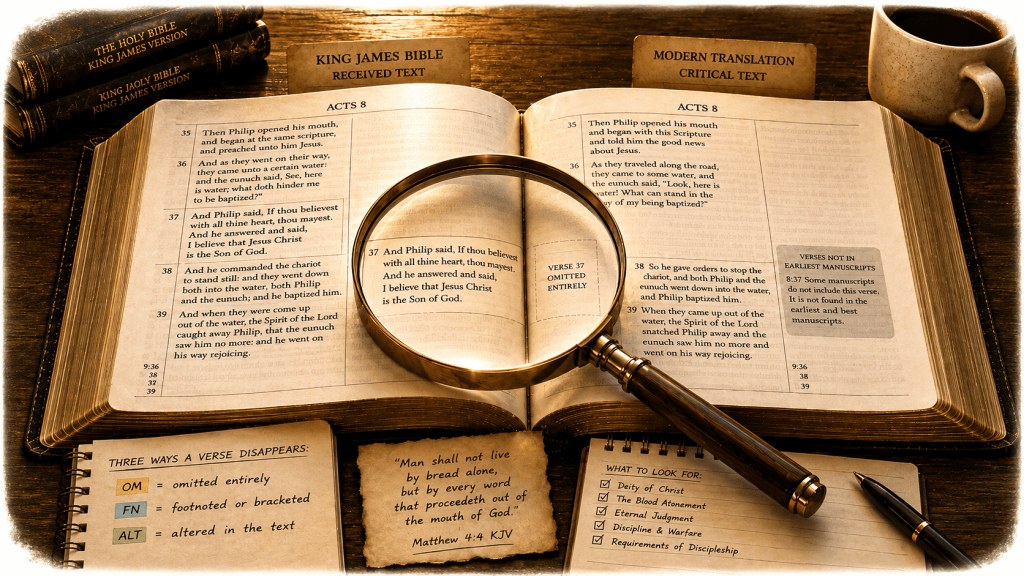
For the next several days we leave the chapter-by-chapter march behind and go deeper into the specific battlegrounds. And there is no better place to start than with something you can do yourself, tonight, with the Bible already on your shelf. Because the strongest evidence in this entire series is not an argument you have to take on trust. It is a comparison you can verify, verse by verse, with your own eyes.
“Man shall not live by bread alone, but by every word that proceedeth out of the mouth of God” (Matthew 4:4).
Jesus answered the tempter not with a word of God but with every word, the whole diet, nothing withheld. Man does not merely survive on Scripture’s general message; he lives on every word that proceeds from the mouth of God. Which means every word withheld is a portion of that life removed from the table. Today we are going to learn to check whether the Bible in your hands is serving the whole meal, or a shortened one, with certain dishes quietly taken away.
Three Ways a Verse Disappears
When translators follow the critical text, a verse present in the King James can vanish in three different ways, and learning to recognize them is the whole skill.
OM — omitted entirely. The verse is simply gone. Where your grandmother’s KJV has Acts 8:37, a modern version jumps straight from verse 36 to verse 38. If you have never compared them side by side, you would never know a verse had been there at all. The versification itself is the tell: an unexplained gap in the numbers.
FN — footnoted or bracketed. The verse is present, but hedged, set in brackets, or lifted out of the main text into a footnote, with a note like “the earliest manuscripts do not include this.” This is the most revealing category, because here the editors are showing you their hand. They are telling you, in real time, that they chose to follow the Alexandrian minority over the Byzantine majority, and that they were uncertain enough about the choice to flag it. When you read one of those footnotes, you are watching the Westcott-Hort methodology operate on the page in front of you.
ALT — significantly altered. The verse is there and unbracketed, but a doctrinally weighted phrase inside it has been changed or dropped. These are the easiest to miss and often the most costly, because nothing signals that anything is gone. You have to know the fuller reading to notice the thinner one.
Learn those three, OM, FN, ALT, and you can audit any Bible on earth.
What to Look For, Book by Book
Here is a working list to take to your own Bible. Open it to each reference and see for yourself which of the three you find. I have grouped a representative sample by where they fall.
In the Gospels of Matthew and Mark: Matthew 5:22 (does yours condemn anger “without a cause,” or all anger?); Matthew 6:13 (does the Lord’s Prayer still end “For thine is the kingdom, and the power, and the glory” or is that in a footnote?); Matthew 17:21 (prayer and fasting, present or gone?); Matthew 18:11 (“the Son of man is come to save that which was lost”); Matthew 23:14; Mark 7:16; Mark 9:44 and 9:46 (the repeated warning, “where their worm dieth not”); Mark 11:26 (the warning on unforgiveness); Mark 15:28; and Mark 16:9-20 (the entire resurrection ending, bracketed?).
In Luke and John: Luke 2:33 (does yours read “Joseph and his mother” or “the child’s father”?); Luke 4:4 (“but by every word of God” the very words of today’s anchor, and often the very words removed); Luke 17:36; Luke 23:17; John 3:13 (“which is in heaven” present?); John 5:4 (the angel troubling the water at Bethesda).
In Acts and the Epistles: Acts 8:37 (the eunuch’s confession, the whole verse); Acts 15:34; Acts 28:29; Romans 8:1 (does the “no condemnation” still carry its full clause?); Romans 16:24 (Paul’s benediction); Colossians 1:14 (redemption “through his blood” is the blood still named?); 1 Timothy 3:16 (“God was manifest in the flesh” or “He”?); 1 John 5:7 (the heavenly witnesses); and Revelation 22:19 (does yours read “book of life” or “tree of life”?).
You will not need a seminary degree for any of it. A KJV in one hand, your own translation in the other, and ten quiet minutes will show you more than a hundred arguments could.
Notice Where They Cluster
Once you have found a dozen of them, step back and ask the question that turns a list into an argument: what do these verses have in common?
They cluster. Not randomly across the Bible, but in identifiable doctrinal zones, the deity of Christ (1 Timothy 3:16, John 3:13, Acts 8:37), the blood atonement (Colossians 1:14, Revelation 1:5), eternal judgment (Mark 9:44-46, the worm-dieth-not repetitions), spiritual discipline and warfare (Matthew 17:21, prayer and fasting), and the hard requirements of discipleship (Mark 11:26 on forgiveness). Some individual choices could be defended on textual grounds one at a time. But a pattern is a different thing than a data point. When every arrow points the same way, toward a shorter, softer, less confrontational text, the consistency of the direction is itself the evidence. That is what the Alexandrian environment that produced Vaticanus and Sinaiticus would be expected to leave behind: a Christ a little less explicitly divine, a cross a little less bloody, a hell a little quieter, a discipleship a little less demanding.
What to Do When You Find One
Suppose you open your Bible tonight and there it is, a gap where Acts 8:37 should be, or a bracket around the end of Mark, or a footnote confessing that “some manuscripts do not include” a verse you have loved for years. What then? Not panic, and not a bonfire.
First, understand what the footnote is actually telling you: the editors made a choice, and they were honest enough to flag their uncertainty. That honesty is an opening, not an insult, it invites you to weigh the choice yourself rather than simply receive it. Second, remember the standard of this series, held for twenty days now: no one is saved or lost over a single verse, and the person reading a modern version is your brother or sister in Christ. This is not about condemning a translation’s readers. It is about wanting the whole meal for yourself and for the people you teach. Third, get yourself a copy of the faithful stream, a KJV, or another Received Text translation, and read the fuller text, and see whether what was removed was worth keeping. In nearly every case, you will find it was: a warning you needed, a name of Christ you were missing, a drop of blood you did not know had been wiped from the page.
Every word that God breathed out belongs in the Bible you read. These verses belong. Their removal was not a scholarly upgrade; it was a subtraction, from doctrine, from discipleship, and from the completeness of the revelation God promised to preserve for every generation, including yours. You do not have to take that on my word. Man lives by every word that proceedeth out of the mouth of God, so go and see, word by word, which words are still on your table.
Tomorrow, we follow the money: a closer look at who profits from the Bible business, and why the incentives run the way they do.
“Man shall not live by bread alone, but by every word that proceedeth out of the mouth of God.” — Matthew 4:4 KJV
📖 This post is adapted from Which Bible Can You Trust? Scripture, Manuscripts, and the Quest for the Most Trustworthy Text. If it helped you, the full book is available on Amazon — or you can support this ministry directly.
thefinalconvergence.com | Follow on Instagram, Facebook, X, and YouTube
If you like to be updated on new blogs, sign up to our newsletter!


Leave a comment