
Published: October 9, 2026 | thefinalconvergence.com
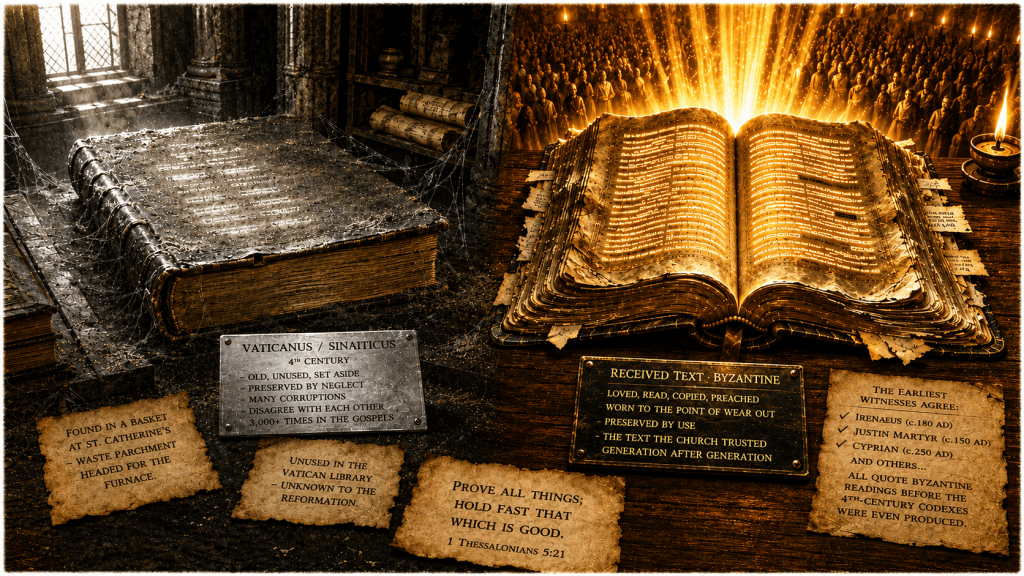
If you press almost any defender of the modern translations for the one reason the critical text should be preferred, you will eventually arrive here: the manuscripts behind it are older. Vaticanus and Sinaiticus date to the fourth century; most Byzantine manuscripts are later; and the older a witness, the closer it stands to the original, so the oldest manuscripts must be the most reliable. It sounds like simple common sense. It is also the single most important argument in the entire debate, and it does not survive a careful look.
“Prove all things; hold fast that which is good” (1 Thessalonians 5:21).
Paul’s command is not to reject all things, nor to accept all things, but to prove them, to test, to weigh, to examine, and only then to hold fast to what proves good. It is the exact instruction the older-is-better argument requires, because that argument is precisely the kind of claim that sounds good on first hearing and must be proven before it is held. So let us do what Paul says. Let us test it.
The Hidden Assumption
The argument has a buried premise, and once you see it, the whole thing wobbles. It assumes that the age of the surviving parchment tells you the reliability of the text written on it. But those are two entirely different things, and conflating them is the error at the root of the whole methodology.
Age of parchment measures one thing: how long this particular physical object has lasted. Reliability of text measures something else entirely: how faithfully these words match what the apostle wrote. A manuscript can be very old and very corrupt. A manuscript can be younger and yet transmit an older, purer text, because it is a faithful copy of a copy of a copy stretching back before any surviving parchment. The date stamped on the object is not the date of the reading it carries. To assume it is, to treat “oldest surviving copy” as identical to “most original text,” is to mistake the age of the bottle for the age of the wine.
Why the Corrupt Copies Survived
Here is the point that turns the argument inside out, and it is worth reading slowly, because it is decisive.
Ask yourself why a manuscript survives fifteen centuries in readable condition. Parchment does not last because it is holy. It lasts because it is not used. A scroll that is read daily, carried from town to town, copied and recopied by candlelight, handled by generations of believers, is a scroll that wears out. It is loved to death. The working Bibles of the Greek-speaking church, the manuscripts that were actually trusted, actually read, actually preached from, were used until they fell apart, and then reverently replaced by fresh copies. That is why so few very ancient Byzantine manuscripts survive: they were used up.
Now ask the reverse. What kind of manuscript survives in pristine condition for sixteen hundred years? Often, the kind that nobody used, because the church that possessed it recognized it as defective and set it aside. A manuscript known to be corrupt was not copied and not carried and not worn out. It sat. And sitting, undisturbed, is exactly what preserves parchment. So the very survival of a manuscript in excellent condition can be evidence against it, not for it: it may have lasted precisely because the church that held it did not trust it enough to use it to death. The “oldest and best” may be old because it was not best.
Remember where the two star witnesses were found. Codex Sinaiticus was pulled from a basket of parchment at St. Catherine’s Monastery, parchment reportedly headed for the furnace as waste. Codex Vaticanus sat in the Vatican Library, unknown to and unused by the entire Protestant Reformation. Neither was a working Bible of the believing church, worn thin by faithful use. Both survived, in part, because they were not in the hands of the people who were reading, copying, and dying for the Word.
The Two Witnesses Disagree With Each Other
Set aside the survival question and grant, for the sake of argument, that older is better. The argument still faces a problem its defenders rarely mention: the two oldest, most exalted manuscripts, Vaticanus and Sinaiticus, the very foundation of the critical text, disagree with each other in over three thousand places in the Gospels alone.
Sit with that number. These are supposedly the two most reliable witnesses to the original text, from the same tradition, both elevated to near-infallible status by Westcott and Hort. And they contradict one another more than three thousand times in the Gospels. If two witnesses to the same event disagree three thousand times, you do not conclude that they are your most trustworthy witnesses. You conclude that at least one of them, and probably both, is unreliable at many points, and that neither can simply be trusted on its own authority. The “oldest and best” are not even consistent with each other. A tradition that cannot agree with itself three thousand times cannot claim to be the stable, reliable standard against which thousands of other manuscripts are dismissed.
What the Earliest Witnesses of All Actually Read
And now the fact that quietly settles the matter. If “older is better” is the rule, then let us go to the oldest witnesses of all, older than Vaticanus, older than Sinaiticus. Not manuscripts, but quotations. The early church fathers quoted the New Testament extensively in their own writings, and some of them wrote before the fourth-century codices were even produced. Their quotations are a dated snapshot of what the text said in their time and place.
So what did they read? Irenaeus, writing around 180 AD, decades before Vaticanus existed, quotes Mark 16:19, one of the very verses the codices omit. Justin Martyr, around 150 AD, quotes passages in their Byzantine form. Cyprian in the third century attests readings the modern text sets aside. The fathers standing closest in time to the apostles consistently read a text that agrees with the Received Text tradition, not with Vaticanus and Sinaiticus. This is the quiet demolition of the whole argument: if the Alexandrian text were truly the ancient, original one, the earliest quotations should reflect it. They do not. By the argument’s own standard, earliest is best, the Byzantine readings are attested earlier than the manuscripts used to overthrow them.
Proving All Things
Put the tests together. The older-is-better argument assumes parchment-age equals text-reliability, but those are different things. It overlooks that corrupt manuscripts survive because they were not used, while faithful ones wore out from use. It rests on two star witnesses that contradict each other three thousand times in the Gospels. And it collapses under its own rule the moment you consult the truly earliest witnesses, the second-century fathers, who read the Byzantine text before the “oldest” codices were made.
None of this means age is worthless as evidence; it is one factor among several, and a fair textual method weighs it. What it means is that age alone cannot bear the weight the modern argument places on it. “Older, therefore better” is not a conclusion. It is an assumption dressed as one, precisely the kind of plausible-sounding claim Paul told us to prove before we hold it. Prove it, and it does not hold. What holds is the text the believing church actually used, actually trusted, and actually wore out in faithful service: the Majority Text, the Received Text, the stream that reached us not because a few copies sat undisturbed in a library and a waste-basket, but because generation after generation of Christians could not stop reading it.
Tomorrow, the deepest layer of all: not the manuscript evidence for the Received Text, but the doctrine that stands behind it. Providence, preservation, and why the two are the same question.
“Prove all things; hold fast that which is good.” — 1 Thessalonians 5:21 KJV
📖 This post is adapted from Which Bible Can You Trust? Scripture, Manuscripts, and the Quest for the Most Trustworthy Text. If it helped you, the full book is available on Amazon — or you can support this ministry directly.
thefinalconvergence.com | Follow on Instagram, Facebook, X, and YouTube
If you like to be updated on new blogs, sign up to our newsletter!


Leave a Reply