
Published: October 11, 2026 | thefinalconvergence.com
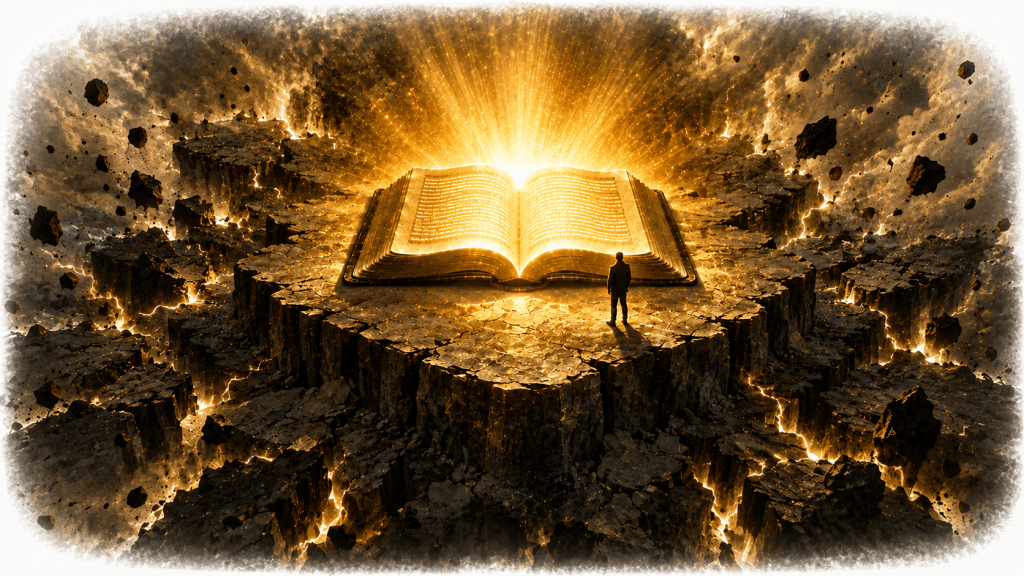
There is a moment in almost every serious investigation when the evidence stops being abstract and becomes personal. When it is no longer about manuscripts and publishing corporations and nineteenth-century scholars. When it becomes about you, the Bible on your nightstand, the translation your church uses, the version your children are memorizing, the words you reach for when everything else gives way. If you have followed this series this far, that moment has either already arrived or it is arriving now.
“If the foundations be destroyed, what can the righteous do?” (Psalm 11:3).
David asks this in a psalm about being urged to flee, “flee as a bird to your mountain,” his advisers tell him, because the wicked are bending their bow and the very foundations of order are giving way. And his question cuts to the bone: when the foundations themselves are under attack, what is left for the righteous to stand on? It is the exact question this series has been circling for twenty-five days. Because Scripture is not one item among many in the Christian life. It is the foundation, the ground beneath doctrine, worship, discipleship, and hope. And if the foundation can be quietly shifted, softened, and set on disputed and ever-changing ground, then David’s question becomes ours. What can the righteous do? The answer begins with refusing to pretend the question isn’t being asked.
The Landscape We Have Crossed
Before we talk about standing, it is worth pausing to see how much ground we have actually covered, because the case for concern is not one dramatic claim but a cumulative weight, and the weight is only visible when you set the pieces side by side.
We traced two manuscript traditions across two thousand years and found they are not equal, not in breadth, not in consistency, not in the company they kept. We examined the men who shifted the English-speaking church from one tradition to the other in 1881, men who called the Received Text “villainous,” who founded a society to investigate contact with the dead, who did not believe every word of Scripture was the breath of God. We followed the money and found the most widely read Bibles in evangelical America owned by corporations with no theological commitment to their content, driven by incentives that reward difference and perpetual revision. We opened the texts side by side and counted what was missing, not in obscure corners, but in verses about the blood of Christ, the reality of hell, the necessity of fasting, and the explicit identity of Jesus as God manifest in the flesh.
And we examined, one by one, five translations that have moved past imperfection into something that must be named plainly: the Mirror Bible, inserting universal-reconciliation theology as though it were translation; Dake’s, wrapping a sound KJV text in notes that teach three separate Gods; The Message, replacing the inspired text with one man’s impressions and rendering the Lord’s Prayer with a phrase drawn from Western occultism; The Passion Translation, claiming prophetic authorization for additions no Greek scholar has found in the original; and the New World Translation, inserting words that exist in no manuscript in any language in order to deny the deity of Christ.
That is the landscape. It is not a comfortable one. And no single item on that list, taken alone, would necessarily unsettle a foundation. But that is not how foundations are undermined. They are not dynamited in a day. They are eroded, one shifted stone, one softened verse, one revised edition at a time, until a structure that looks unchanged is standing on ground that has quietly moved beneath it.
What This Is Not
Here we must be careful, because there is a version of this conversation that goes wrong very quickly, and this series has refused it from the first day and refuses it now.
The wrong version declares that everyone reading a modern translation is spiritually compromised, that faith built on the NIV or the ESV is faith built on sand, that salvation itself depends on reading the right edition. This series has not argued any of that, and it does not argue it now. God’s grace has reached people through imperfect instruments throughout the entire history of the church. The core of the gospel, that Jesus Christ died for sinners and rose again, and that salvation comes through faith in Him, is present in even the most deficient of the mainstream modern translations. God is not stymied by publishing corporations. If that is where your mind goes when you hear “foundations,” set the fear down. Standing firm is not the same as panic, and discernment is not the same as condemnation.
What this series has argued is more precise, and it is worth restating cleanly as we turn toward response: that the manuscript tradition behind the KJV, the Geneva, and the whole Tyndale lineage is broader, better attested, more internally consistent, and more faithfully preserved than the minority tradition behind the modern versions; that the pattern of what the modern text removed is not random but directional, consistently away from the explicit, the physical, the confrontational, and the costly; and that every believer who takes seriously that God breathed out every word has reason to care which words are in their Bible and which have been quietly set aside. That is the whole case. It does not require alarm. It requires attention.
What the Righteous Can Do
So, David’s question. If the foundations be destroyed, what can the righteous do? The psalm itself refuses despair. David does not flee to the mountain as his advisers urge. The very next verse answers the question: “The LORD is in his holy temple, the LORD’s throne is in heaven.” The foundations may be assaulted, but the Lord still reigns, and His Word, He has promised, He will keep. The righteous are not left helpless when the ground is shaken. They are called to stand, and standing begins with three simple, unspectacular resolves.
First, refuse to look away. The single most common response to uncomfortable evidence is not to argue with it but to avoid it, to change the subject, to assume someone else has surely dealt with it, to let the discomfort fade back into routine. Standing firm begins by declining that ease. You have seen the footnotes now. You cannot un-see them. The faithful response is not to bury the question but to hold it.
Second, measure everything by the Word itself. Isaiah gave the remnant its standard: to the law and to the testimony. When the foundation is in question, you do not settle it by preference, by habit, or by what is most comfortable in the hand. You settle it by the standard Christ Himself set, every jot, every tittle, not one word passing away, and you let the text you read answer to that standard. If it can, rest in it. If it cannot, ask why.
Third, resolve to be part of the remnant rather than the drift. We saw on Day 20 that Scripture guarantees a remnant will hold the full Word through whatever comes, the only open question is whether we will be among them. That is not a decision made in a crisis. It is a decision made now, quietly, before the pressure comes: the settled resolve that when the foundations are shaken, you will be found standing on the rock and not on the shifting sand.
The foundations are being tested. That much this series has shown. But a tested foundation is not a destroyed one, and a God who numbers the sparrows has not lost His grip on His Word. What the righteous can do is exactly what the faithful have always done in every dark hour: hold to the whole counsel of God, measure everything by it, and refuse to be moved. In the days ahead we will get practical, how to weigh the decision, and how to act on it. But it begins here, with the resolve itself: I will not build on ground that moves.
Tomorrow, the most important textual decision you will ever make, and why it is more within your reach than you think.
“If the foundations be destroyed, what can the righteous do?” — Psalm 11:3 KJV
📖 This post is adapted from Which Bible Can You Trust? Scripture, Manuscripts, and the Quest for the Most Trustworthy Text. If it helped you, the full book is available on Amazon — or you can support this ministry directly.
thefinalconvergence.com | Follow on Instagram, Facebook, X, and YouTube
If you like to be updated on new blogs, sign up to our newsletter!


Leave a Reply