
Published: October 17, 2026 | narconnections.com
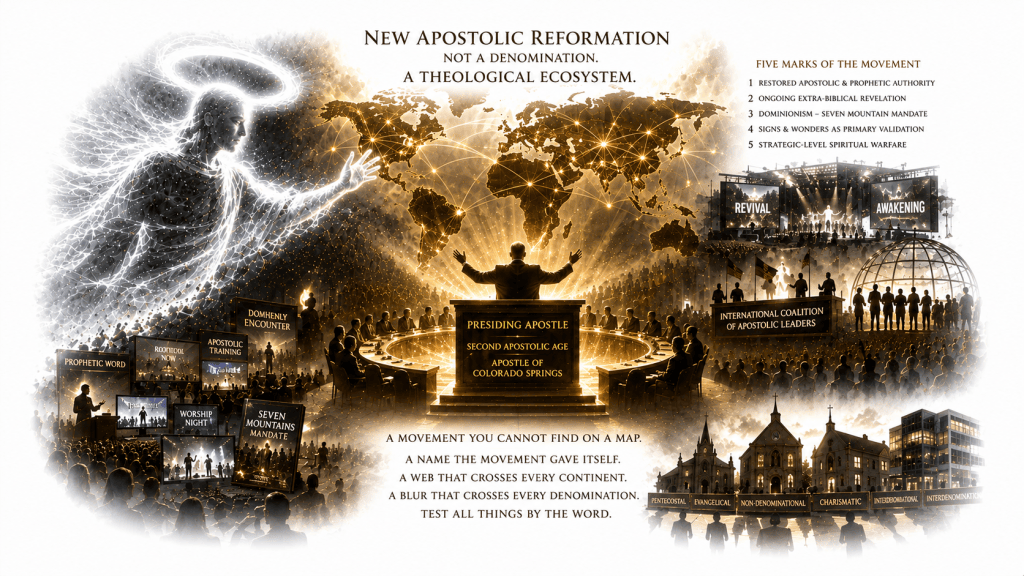
Welcome to a new investigation, and, in a real sense, the continuation of one long argument. For several volumes now, this series has been laying a foundation: that truth is real and knowable, that the gospel is simple, that Scripture is the Word of God, that it alone is our rule, that its canon is closed, and that its text has been faithfully preserved. All of that was groundwork. Today we begin to build on it, because a foundation is laid so that something can be tested against it. And there is a movement in the church today that quietly denies every single stone of that foundation, while insisting, with apparent sincerity, that it is not a movement at all.
“For such are false apostles, deceitful workers, transforming themselves into the apostles of Christ. And no marvel; for Satan himself is transformed into an angel of light” (2 Corinthians 11:13-14).
Paul is describing a specific danger, and it is not the danger of an obvious enemy. It is the danger of disguise. False apostles do not announce themselves as false; they transform themselves into the apostles of Christ, they take on the appearance, the vocabulary, the credibility of the real thing. And Paul says we should feel no marvel at this, because it follows the pattern of the enemy himself, who comes not as darkness but as an angel of light. The most dangerous deceptions in the church have never looked like deception. They have looked like light, beautiful, sincere, and reassuring. Hold that principle, because it is the master key to everything this book will document. We are not looking for villains twirling mustaches. We are looking for light that is not quite the true Light.
A Movement You Cannot Find on a Map
Here is the first and strangest fact about the New Apostolic Reformation: its most prominent participants will tell you, with every appearance of honesty, that it does not exist. Ask the worship leader at a church that sings Bethel music whether she belongs to the NAR, and she will look at you with genuine puzzlement. Ask a campus pastor at an Elevation satellite whether his church has NAR connections, and you will get a polished denial and a gentle suggestion that you are being divisive. Ask a Christian university president whether his institution has ties to the movement, and he will point you to a statement of faith that sounds orthodox enough and imply that further questions are unwelcome.
In most cases, this is not conscious deception. It is the predictable result of the movement’s most important structural feature: it is not a denomination. It is not a membership organization. It has no rolls to sign, no headquarters to join, no single doctrinal statement to affirm. The New Apostolic Reformation is a theological ecosystem, a set of shared convictions about apostolic authority, prophetic revelation, spiritual warfare, and cultural dominion that functions as the invisible grammar of a vast, interconnected relational network. A person can be thoroughly formed by it without ever signing a document, attending a particular conference, or using the movement’s own vocabulary. The theology has traveled so far and so fast, through the conference circuit, the worship-music industry, the publishing world, and the pastoral training pipeline, that millions of believers are being shaped in its assumptions without knowing they were ever enrolled in its school.
And that is precisely what makes it so difficult to expose and so easy to wave away as a conspiracy theory. When the evidence is relational rather than institutional, shared stages, mutual endorsements, book blurbs, rather than membership cards and bylaws, anyone with something to lose can reach for the same defense: guilt by association. This book exists to answer that charge with documentation. The associations it traces are not incidental, not occasional, and not mere cultural proximity. They are sustained, mutually beneficial, and theologically consequential. They tell a story, and this series is going to tell that story aloud.
A Name the Movement Gave Itself
One point must be settled at the very start, because it defuses the first objection every defender raises. The term “New Apostolic Reformation” was not invented by critics. It was coined by C. Peter Wagner, the movement’s own principal architect, a former Fuller Seminary professor who became the most consequential apostolic networker of the late twentieth century. Wagner introduced the term in the 1990s to describe what he believed was a genuine, historic work of the Spirit: the restoration, after centuries of absence, of the five-fold offices of Ephesians 4:11, with special emphasis on the offices of apostle and prophet.
Wagner was explicit about what he meant. He spoke of a Second Apostolic Age beginning around the year 2001. He believed God had restored to living men and women the same apostolic authority Peter, Paul, and John once carried, authority not only to preach and plant churches but to govern the church, issue binding decrees, receive authoritative revelation beyond Scripture, and take dominion over the cultural and political institutions of whole nations. He built the International Coalition of Apostolic Leaders to institutionalize it and led it as its self-designated Presiding Apostle until his death in 2016. He believed he was part of the most important development in the church since the Reformation. So when someone insists the NAR is a slur invented by its enemies, the answer is simple: the man who named it thought he was describing the greatest move of God in five hundred years.
Five Marks of the Movement
The movement resists neat definition, and its participants use that resistance as a shield. But a consistent cluster of five commitments marks it and separates it from classical Pentecostalism, from Reformed Christianity, and from the historic evangelical faith.
The first is restored apostolic and prophetic authority, not merely that the gift of prophecy continues, but that the governing offices of apostle and prophet have been restored, so that living title-holders claim the authority the New Testament writers held. The apostle’s word cannot be questioned by those under his “covering”; prophetic declarations carry divine weight independent of Scripture. The second is ongoing extra-biblical revelation, rarely framed as adding to the canon, which would be too easily rejected, but delivered in softer language: downloads, prophetic words, heavenly encounters, angelic visitations, decrees and declarations. The effect is the same; a prophet’s word is received with a reverence Scripture never authorizes. The third is dominionism, marketed as the Seven Mountain Mandate: that the church must take dominion over seven cultural spheres, religion, family, education, government, media, arts, and business, often on the premise that Christ will not return until His church has established that reign. The fourth is the elevation of signs and wonders as the primary validation of ministry, an inversion of the biblical order, in which Scripture warns that signs may accompany false prophets as readily as true ones. The fifth is strategic-level spiritual warfare, organized, apostolically directed prayer to bind territorial demons over cities and nations, supported by Wagner’s theory of “spiritual mapping,” a practice with no New Testament foundation but immense power as an organizing mechanism.
Not one of these five can be established from Scripture by ordinary grammatical-historical reading. And each, in its institutional expression, has produced documented abuse, failed prophecy, and exploitation on a large scale. Which raises the question this whole book is written to answer: why do so many mainstream evangelical leaders still share platforms with, endorse the books of, and sing the music produced by ministries built on these five foundations?
Two Threads That Turn Names Into a Picture
Before we go further, you need two interpretive keys, because they are the threads that run through every chapter and turn a scattered pile of names into a single coherent map.
The first thread is interconnectedness across continents. The NAR is not an American subculture that occasionally exports a conference. It is a genuinely worldwide web: a California church whose spiritual DNA runs through a Canadian revival sparked by a South African evangelist; a sixty-nation apostolic network headquartered in Pasadena with a European gateway in Amsterdam; a training school drawing students from more than fifty countries and seeding them back onto every continent. Wherever this book names a figure, watch for the lines running outward from him to other nations. They are always there, because the movement understands itself, correctly, as one worldwide phenomenon.
The second thread is the denominational blur. The movement’s genius is that it does not require anyone to leave his denomination. It operates above and across the historic confessional walls, dissolving them not by argument but by proximity, shared platforms, shared worship, shared conferences, shared endorsements, until an Assemblies of God official, a nondenominational Bethel pastor, a Pentecostal university president, and a charismatic prophetess all sit on one governing council presenting a united front, and the ordinary believer can no longer use a denominational label to tell where a church actually stands.
Keep those two threads in view, the web that crosses every continent and the blur that crosses every denomination, and the map assembles itself.
Why This Is Worth Thirty Days
I do not write about this movement as an outsider. I spent roughly forty years inside NAR-influenced Christianity, born into it, formed by its churches on two continents, carried along by its culture, before a faithful chorus of discernment teachers placed the Word of God in my hands and taught me to test everything by it. I was not merely corrected. I was rescued. And rescue raised an urgent, practical question that sent me into years of research: if the movement I had lived in was not what it claimed to be, which churches were safe? Which pastors could be trusted? Which worship music was sound, and which was smuggling aberrant theology into hearts with every repeated chorus?
That research became a database, a platform, and now this book. Every connection it names is documented; every affiliation is verifiable; every public statement attributed to a figure has a source. The goal is not to destroy reputations. The goal is to tell the truth about a movement extraordinarily good at concealing what it is, and to arm ordinary believers to see it. Over the next thirty days we will trace the whole web: its history, its architects, its institutions, its celebrity pastors, its worship-music pipeline, and finally what to do about it. Not out of suspicion, and not to make you cynical, but so that you can obey the one instruction that stands behind the whole investigation: know who is leading you. Because false apostles do not come announcing themselves. They come transformed into the apostles of Christ, as their master comes transformed into an angel of light, and the only safeguard that has never failed is the Word held up to the light to see whether the light is true.
Tomorrow, where this all came from: the historical roots, from a Los Angeles mission in 1906 to a doctrine condemned as heresy in 1949 and quietly rehabilitated in our own time.
“For such are false apostles, deceitful workers, transforming themselves into the apostles of Christ. And no marvel; for Satan himself is transformed into an angel of light.” — 2 Corinthians 11:13-14 KJV
📖 This post is adapted from NAR Connections: Connecting The Dots. If it helped you, the full book is available on Amazon — or you can support this ministry directly.
thefinalconvergence.com | Follow on Instagram, Facebook, X, and YouTube
If you like to be updated on new blogs, sign up to our newsletter!


Leave a Reply