
Published: October 19, 2026 | narconnections.com
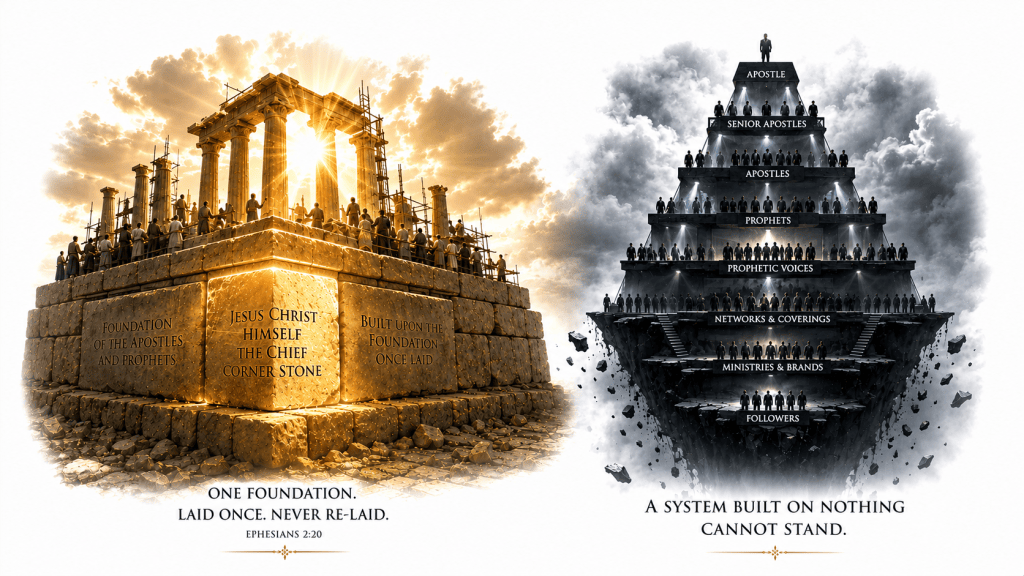
Before we can name a single architect or institution, we have to understand the one doctrine that makes all of them possible. Remove it, and the New Apostolic Reformation is merely a network of enthusiastic charismatic churches with some eccentric practices and a tendency toward domineering leadership. Keep it, and the movement becomes something categorically different: a reconstituted government of the church that claims to supersede denominational authority, to operate with revelatory access to God’s present will, and to hold its people accountable to a hierarchy standing outside and above the accountability of Scripture. That doctrine is the restored office of apostle and prophet, and everything else in this book is built on it.
“And are built upon the foundation of the apostles and prophets, Jesus Christ himself being the chief corner stone” (Ephesians 2:20).
This single verse is the quiet demolition of the entire structure, and it comes from the same letter the movement leans on. Paul says the church is built upon the foundation of the apostles and prophets, and a foundation, by its very nature, is laid once. You do not lay a foundation, build a house on it, and then lay the foundation again. The apostles and prophets did their foundational work in the first century, and the church has been building on it ever since, with Christ Himself as the chief corner stone, the fixed reference point that determines the shape of everything laid upon it. Hold this image, because the whole debate turns on it: is the office of apostle a foundation (laid once, finished) or an ongoing function (repeated in every generation)? Ephesians 2:20 answers plainly. And a foundation laid twice is no foundation at all.
The Verse the Whole Edifice Leans On
The movement builds its case on Ephesians 4:11, where Paul lists Christ’s gifts to the church: apostles, prophets, evangelists, pastors, and teachers. The movement reads this as a description of perpetual offices the church has neglected since the first century and that God is now sovereignly restoring, and it argues that the recovery of these offices, especially apostle and prophet, is the precondition for the church’s maturity, unity, and dominion.
This is not an abstract position. It is the operational framework of the entire network. It is why one apostle publicly identified several well-known megachurch pastors as fellow apostles. It is why one prophet’s entire empire rests on the claim to hold the prophetic office with governmental authority. It is why a prominent prophetess issues national prophetic decrees. Take away the restored office, and none of these ministries can stand as they are; keep it, and every one of them has a warrant. So the doctrine deserves a careful, direct answer, not a dismissal.
Here is the movement’s strongest argument, stated fairly: Ephesians 4 says the five gifts were given until we all come in the unity of the faith unto a perfect man. The church has plainly not reached that unity yet, so, the argument runs, the offices of apostle and prophet must continue until she does. It sounds airtight. But it contains a subtle and decisive error. The passage does not say the offices continue. It says the goal continues. Christ gave apostles and prophets to lay the foundation once, and gave evangelists, pastors, and teachers to build the church upon it toward maturity, and those building functions (proclaiming the gospel, shepherding the flock, teaching sound doctrine) manifestly do continue in every faithful church to this day. What does not continue is the foundational office. The church presses toward the unity of Ephesians 4 precisely by holding fast the completed apostolic deposit those first apostles left her in Scripture, not by manufacturing new apostles to pour the foundation again.
And the credentials settle it. The New Testament apostle was directly commissioned by the risen Christ, was an eyewitness of the resurrection, and could perform the signs of an apostle, credentials no living person can claim, and that the New Testament never once suggests would be reproduced. The apostolic deposit is preserved, complete and sufficient, in Scripture. The movement cannot accept that sufficiency, because sufficiency renders living apostles unnecessary, and the entire structure depends on their necessity.
How the Doctrine Rebuilds Church Government
The restored offices do more than exalt certain individuals. They reorganize the government of the church itself, and in doing so, they build the denominational blur straight into the movement’s architecture.
A denomination governs through written constitutions, elected officers, ordination boards, and congregational votes, structures deliberately designed to distribute authority and make it answerable. The apostolic network replaces all of that with a different model: authority flows downward, personally and relationally, from the apostle to those who have placed themselves under his “covering.” One leading apostle has described the shift candidly, a move away from bureaucratic, legal, rational structure toward personal apostolic authority, and away from the democratic accountability of members who could check the leader’s decisions.
This is exactly why the movement can dissolve confessional walls so effortlessly. An apostle’s covering is not tied to any denomination; it floats free across them. A pastor can remain nominally Baptist, Assemblies of God, or nondenominational while functioning under apostolic covering that answers to no church at all. Networks span sixty nations without a shared confession; coalitions credential apostles across every continent by application and dues rather than by ordination and examination. The old walls are not argued down, they are simply rendered irrelevant by a parallel authority structure that runs straight through them. That is the denominational blur operating at the deepest possible level: the level of church government itself.
Fathers, Sons, and the Trap of “Covering”
In practice, the network runs on a vocabulary of family that softens the hierarchy and makes it nearly impossible to question. The apostle is a “spiritual father”; those under him are his “sons” and “daughters”; loyalty to the father is framed as honor, and honor as the very channel through which blessing and anointing flow. Follow the logic to its end: to question the father is to dishonor him, and to dishonor him is to forfeit the inheritance. It is a closed loop that converts ordinary discernment into a spiritual offense.
“Covering” completes the trap. The believer is taught that he is spiritually exposed and unprotected unless he is submitted under apostolic authority, so submission is sold not as bondage but as safety. Now, the New Testament does honor genuine spiritual fathers who labored in the gospel; Paul spoke tenderly of the churches he begot in Christ. But he did the opposite of what “covering” does. He pointed those churches away from himself and toward the Lord. He refused to be their master. And he commended the Bereans for testing even his own preaching against the Scriptures. The apostolic “covering” inverts all of this, binding the son to the father in exactly the way the apostle Paul deliberately refused to bind anyone to himself.
The Accountability Vacuum Is the Design
Every historic model of church order, whatever its shape, was built with the same protective instinct: that no minister should hold authority answerable to no one but himself. The Presbyterian has his presbytery, the Anglican his bishop, the Baptist his congregation, and each, whatever its weaknesses, provides an authority external to the minister that can examine, correct, and if necessary remove him.
The apostolic model removes that external authority by design. The apostle is credentialed by a coalition of his peers, covered by relationships he chose, and accountable to a network he often leads. There is no body above him empowered to discipline him, because the whole point of the restored office was to place him at the top of the government of the church. And the consequences are not hypothetical. When self-styled apostles publicly commissioned a revivalist whose ministry then collapsed within weeks in moral scandal, not one of them retracted his decree. When a movement prophet’s predictions failed and grave abuse was finally exposed, the framework survived intact. Again and again, when discipline was needed, it was civil authorities, not the network, that acted. A structure built to place its leaders beyond the reach of external correction will, with perfect predictability, fail to correct them. The accountability vacuum is not a flaw in the apostolic model. It is the apostolic model, functioning as designed.
The Prophet Completes the Machine
The restored government rests on two offices, and the second completes it. If the apostle governs, the prophet supplies the revelation the apostle executes, the ongoing stream of directive words telling the network where God is moving and what He requires. This is why the prophetic councils matter as much as the apostolic coalitions. The dyad is self-reinforcing: the prophet confirms the apostle’s authority with a word from the Lord, and the apostle grants the prophet a governing platform, each validating the other in a closed circuit that no external, Scripture-tethered authority is permitted to interrupt.
Put the two together and you have a complete alternative government for the church: revelation without a closed canon, and authority without accountability. Every architect, every institution, every worship label, every celebrity pastor we will examine in the days ahead is built on this one foundation. Which is why it had to be understood first, and why Ephesians 2:20 is the verse to keep in hand for the entire journey. The church is built on the foundation of the apostles and prophets, with Christ as the chief cornerstone, and that foundation was laid once, completely, and preserved for us in Scripture. Every attempt to pour it again, to install living apostles at the top of the church and living prophets with a word that rivals the Word, is not a restoration of the foundation. It is a rival building, raised on ground the true Foundation already occupies.
Tomorrow, the core doctrines where the movement breaks with Scripture, and the measuring rod it has quietly tried to move.
“And are built upon the foundation of the apostles and prophets, Jesus Christ himself being the chief corner stone.” — Ephesians 2:20 KJV
📖 This post is adapted from NAR Connections: Connecting The Dots. If it helped you, the full book is available on Amazon — or you can support this ministry directly.
thefinalconvergence.com | Follow on Instagram, Facebook, X, and YouTube
If you like to be updated on new blogs, sign up to our newsletter!


Leave a Reply