
Published: October 25, 2026 | narconnections.com
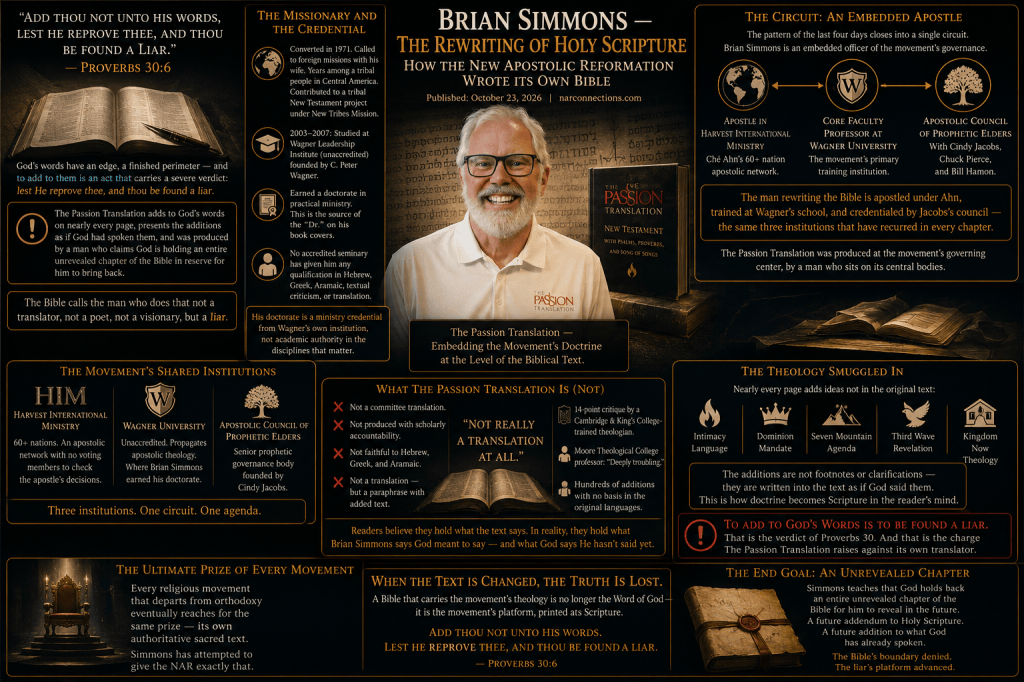
There is a category of danger in this book unlike all the others, because its object is not a sermon, a conference, or a book that can be weighed and set aside. Its object is a Bible, or something that presents itself as one. Today we examine the most consequential single project in the movement’s entire forty-year effort to normalize its theology: the rewriting of Holy Scripture in a form that embeds the movement’s doctrine at the level of the biblical text itself, so the reader can no longer tell what God actually said from what the apostolic movement wishes He had said. Every religious movement that departs from orthodoxy eventually reaches for the same prize, its own authoritative sacred text. Brian Simmons has attempted to give the New Apostolic Reformation exactly that.
“Add thou not unto his words, lest he reprove thee, and thou be found a liar” (Proverbs 30:6).
This is the Bible’s own defense of its own boundaries, and it is remarkably blunt. God’s words have an edge, a finished perimeter, and to add to them is not a small creative liberty but an act that carries a severe verdict: lest he reprove thee, and thou be found a liar. The one who adds to God’s words puts his own words in God’s mouth, and Scripture calls the man who does that not a translator, not a poet, not a visionary, but a liar. Hold that hard word for today, because it is the exact charge the record raises against The Passion Translation, a text that adds to God’s words on nearly every page, presents the additions as if God had spoken them, and was produced by a man who claims God is holding an entire unrevealed chapter of the Bible in reserve for him to bring back.
The Missionary and the Credential
Fairness first, because the story begins honorably. Simmons was converted in 1971 and, with his wife, answered a call to foreign missions, spending years among a tribal people in Central America and contributing to a tribal New Testament project under New Tribes Mission. This deserves honest acknowledgment: that is a legitimate mission with serious linguistic training, and tribal Bible translation is demanding, honorable work. His years in Panama were real missionary service.
The problem is what came after. From 2003 to 2007 Simmons studied at the Wagner Leadership Institute, the unaccredited school founded by C. Peter Wagner to propagate apostolic theology, the same school we met in Day 5, and earned there a doctorate in practical ministry. That is the source of the “Dr.” he places on every book cover. And here is what that “Dr.” does not mean: no accredited seminary, no department of biblical languages, no university with genuine academic standing has ever granted Brian Simmons any qualification in Hebrew, Greek, Aramaic, textual criticism, or translation. His linguistic training was practical missionary preparation; his doctorate is a ministry credential from Wagner’s own institution, whose curriculum trains students in apostolic leadership, prophetic ministry, and the Seven Mountain Mandate. When readers accept The Passion Translation partly because its translator is a “Dr.,” they are trusting an academic authority that, in the disciplines that matter for translating Scripture, simply does not exist.
The Circuit: An Embedded Apostle
Now watch the pattern of the last four days close into a single circuit, because this is the structural heart of the whole chapter. Simmons is not a translator with incidental NAR sympathies. He is an embedded officer of the movement’s governance. He holds the office of apostle within Ché Ahn’s Harvest International Ministry, the sixty-nation network from Day 8. He is a core faculty professor at Wagner University, the school from Day 5. And he sits on the Apostolic Council of Prophetic Elders alongside Cindy Jacobs, Chuck Pierce, and Bill Hamon, the prophetic council we will meet tomorrow, and on which the grandfather from Day 6 also sits.
Trace the circuit and it names itself: the man rewriting the Bible is apostled under Ahn, trained at Wagner’s school, and credentialed by Jacobs’s council, the same three institutions that have recurred in every chapter of this section. This is not coincidence, and it is not guilt by association. It is the movement’s own governance structure producing exactly what such a structure was always going to produce. The Passion Translation was not made at the margins of the movement by a lone eccentric. It was produced at its governing center, by a man who sits on its central bodies, using the credential its own school conferred.
“Not Really a Translation at All”
The Passion Translation is marketed as a translation worked from Hebrew, Greek, and Aramaic, and Simmons insists it is a translation, not a paraphrase. That distinction is everything, because a reader who believes he holds a translation believes he is reading what the text says. In reality it was a solo project without the scholarly committee every responsible translation requires, and the scholars who examined it reached devastating verdicts. A Cambridge- and King’s College-trained theologian produced a fourteen-point critique concluding it is not really a translation at all, documenting phrases in the English with no basis whatever in the Greek. The head of Old Testament and Hebrew at Moore Theological College, himself a member of the committee that produces the NIV, published a detailed analysis of Simmons’s Psalms and concluded that the result is no longer the Bible. That is not a hostile outsider; it is a working translator of one of the world’s most-used Bibles, examining the text against the manuscripts. And in January 2022, Bible Gateway, the most widely used Bible platform in the world, which hosts even frankly paraphrastic versions, removed The Passion Translation from its site entirely.
One verse shows the method. Where the Greek of Galatians 2:19 says simply that Paul died to the law that he might live to God, The Passion Translation expands it into living for God “in heaven’s freedom”, words for which there is no basis whatever in the Greek of the sentence or its surrounding chapter. It is an interpolation presented as translation. Multiply that across an entire Bible, always drifting in the same doctrinal direction, and you no longer have an imperfect rendering of Scripture. You have a systematic overlay of one movement’s theology onto the text.
The Doctrine Sewn Into the Text
And the direction of the drift is the whole point, because the additions are not random. They move, consistently, toward NAR theology, which is exactly what makes The Passion Translation categorically worse than a merely loose paraphrase. Where Psalm 119 turns on the Hebrew word for “word” or “promise,” Simmons repeatedly renders it “prophecies”, quietly converting the Bible’s greatest psalm on the sufficiency of God’s written Word into a charter for ongoing prophetic revelation. Where Jesus announces the kingdom in Mark 1, the translation adds language about the kingdom being “experienced in fullness,” importing Kingdom Now dominion theology into the mouth of Christ. The biblical name for God as jealous and avenging is softened into emotional language about “passion,” dissolving the holiness that grounds repentance. And Paul’s simple greeting of grace and peace becomes a “decree” spoken over the readers’ lives, the movement’s “decree and declare” practice inserted into the apostolic letters as if it were the text itself.
Here is why this is so much more dangerous than an ordinary bad paraphrase. Because it is presented as translation rather than commentary, the reader has no way to tell the addition from the original, unless he can read the manuscripts, which the intended audience cannot. The reader who opens it thinking he is reading the Bible is, at every point where it diverges from the manuscripts, reading one apostle’s theology instead, and he cannot see the seam. This is the displaced measuring rod of Day 4 in its final and boldest form: not moving the standard, not overriding it, but rewriting it, so the very instrument a believer would use to test the movement has been pre-loaded with the movement’s answers.
The Bridge to the Mainstream
The endorsers of The Passion Translation are, almost without exception, figures of the NAR world or its immediate orbit, Ahn, Bill Johnson, Chuck Pierce, and others we have met or will meet. What is missing is as telling as what is present: not one recognized biblical-language scholar from outside the movement appears among them. A translation endorsed by apostles and prophets rather than by linguists and textual critics was never designed for their assessment. It was designed for a community in which apostolic authority and prophetic experience, not Hebrew lexicons and Greek grammar, are the governing authorities.
But the most consequential endorsement reached outside that world, and in this case it went well beyond endorsement. John and Lisa Bevere, whose books fill mainstream Christian bookstores and whose conferences draw broad evangelical audiences, did not merely praise The Passion Translation; by John Bevere’s own public account they were part of the project itself. On the day the New Testament released in October 2017, he told his followers they were “so excited to be a part of this project” and commended what had become one of their favorite translations, directing readers to buy it. That is a striking thing for a mainstream evangelical teacher to attach his name to, not a cautious commendation from a distance, but active promotion of a paraphrase produced by an apostle of Ché Ahn’s network who claims its very words were given him by direct revelation. This is the mutual-endorsement economy working exactly as designed, and it is the same back-door mechanism as the worship-music pipeline: a trusted, familiar name carrying the movement’s product across a threshold its own apostolic branding could never cross. The only difference is that here the familiar name did not merely wave the product through the door, by his own testimony, he helped carry it in.
The Prophet Over the Text
And now the claim that removes any remaining doubt about what The Passion Translation actually is. Simmons’s qualifications, in his own account, are not academic but revelatory. He has admitted to a “minimal background in biblical languages”, an admission later quietly removed from the promotional materials where it once appeared. Asked directly what qualified him to translate the Bible, he answered that he was told to do it by the Lord. And he has claimed to have been taken to heaven and shown a book titled “John 22”, an additional, hidden chapter of John’s Gospel that he says God will one day permit him to bring back and reveal to the church.
Weigh that against Proverbs 30:6. The apostle John wrote twenty-one chapters. The canon is closed. A man who claims access to an unrevealed twenty-second chapter of a Gospel is not a translator working under the authority of the Word, he is a prophet claiming revelatory authority over it. He has not only added to God’s words on the page; he claims God is holding still more words in reserve for him personally to deliver. That is the posture the movement’s apostolic-prophetic structure has claimed from the beginning, now applied directly to Scripture itself, and it is precisely the posture Proverbs 30:6 warns against, with precisely the verdict Proverbs 30:6 pronounces.
Why This Cannot Be Easily Undone
The strategy is structurally identical to the worship-music pipeline, but applied to the Bible itself, and far harder to reverse. A congregation can exchange one set of songs for another. A congregation taught for years that The Passion Translation is the Bible cannot be so easily redirected, because the standard by which every error would be corrected has itself been altered. Such a congregation will find the claims of the movement’s apostles and prophets far more plausible than a congregation formed on the actual text, and it will never perceive the discrepancy, because it has been told the discrepancy is the Word of God. The foundation has been moved, and everything built upon it leans.
But the test, at least, is available to anyone, and it requires no Greek at all. Set any passage of The Passion Translation beside the King James, the ESV, or the NASB, and look up the additions in an interlinear. They will not be in the Greek or the Hebrew. They came from Brian Simmons, formed at Wagner’s institute, apostled under Ché Ahn, seated on Cindy Jacobs’s council, claiming a heavenly chapter of John. This is why the recovery of a trustworthy, sufficient Bible is the first and last answer to everything this book documents. When the movement has rewritten your Bible, the way back is a Bible it did not write.
Tomorrow, the other half of the movement’s government: Cindy Jacobs, the worldwide prophetess, and the office of prophet that supplies the revelation the apostles execute.
“Add thou not unto his words, lest he reprove thee, and thou be found a liar.” — Proverbs 30:6 KJV
📖 This post is adapted from NAR Connections: Connecting The Dots. If it helped you, the full book is available on Amazon — or you can support this ministry directly.
thefinalconvergence.com | Follow on Instagram, Facebook, X, and YouTube
If you like to be updated on new blogs, sign up to our newsletter!


Leave a Reply