
Published: October 28, 2026 | narconnections.com
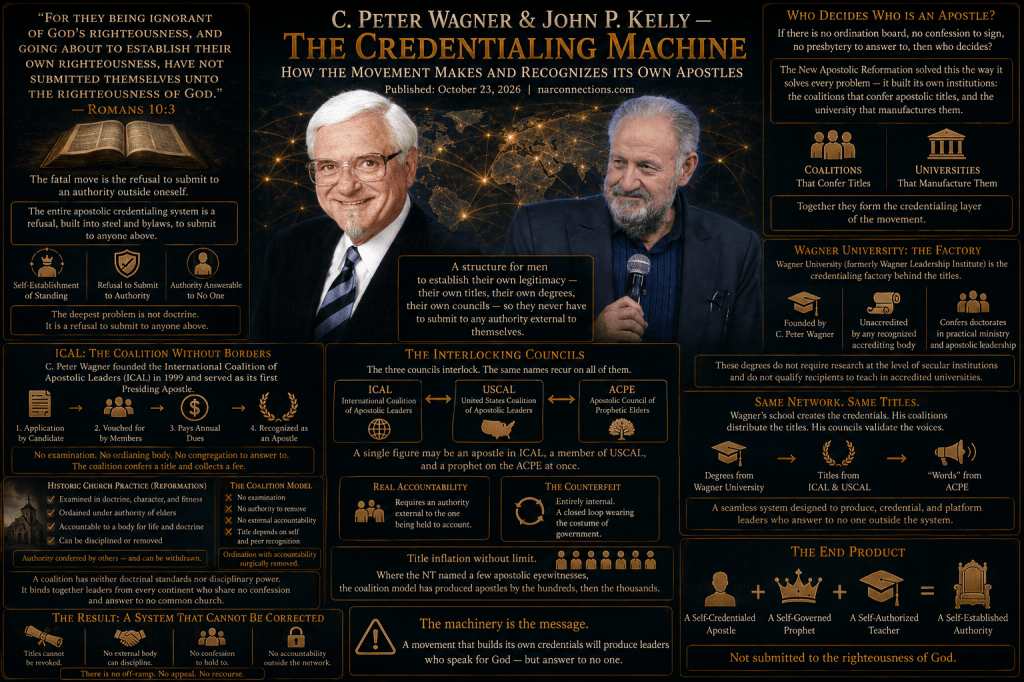
For eleven days we have traced the architects, the men and women who built the movement’s theology and its empires. Today we turn from the builders to the machinery, and ask a question the whole enterprise had to answer early: if there is no ordination board, no confession to sign, no presbytery to answer to, then who decides who is an apostle? A movement that abolishes denominations still needs some way to say who is in and who is out. The New Apostolic Reformation solved this the way it solves every problem, it built its own institutions: the coalitions that confer apostolic titles, and the university that manufactures them. Together they form the credentialing layer of the movement, and understanding it dissolves the mystery of how a man becomes an “apostle” with no one to answer to.
“For they being ignorant of God’s righteousness, and going about to establish their own righteousness, have not submitted themselves unto the righteousness of God” (Romans 10:3).
Paul is describing a very particular spiritual failure, and it maps onto the credentialing machine with uncanny precision. The problem he names is not open rebellion but self-establishment, men going about to establish their own standing rather than submitting to the standing God confers on His own terms. The fatal move is the refusal to submit to an authority outside oneself. That is the exact architecture of the whole apostolic credentialing system: a structure for men to establish their own legitimacy, their own titles, their own degrees, their own councils, precisely so they never have to submit to any authority external to themselves. Hold Romans 10:3 over the machinery today, and you will see that its deepest problem is not this or that doctrine. It is a refusal, built into steel and bylaws, to submit to anyone above.
ICAL: The Coalition Without Borders
C. Peter Wagner co-founded what is now the International Coalition of Apostolic Leaders in 1999 and presided over it as its first Presiding Apostle. Its purpose is disarmingly simple to state and radical in effect: to gather the world’s self-identified apostles into a single peer network. And the mechanism of membership is the whole story. Membership is by application and dues. A candidate is vouched for by existing members, pays an annual fee, and is thereby recognized as an apostle in good standing. That is the entire mechanism. There is no examination in doctrine, no ordaining body with authority over the candidate’s life, no congregation to which he must answer. The coalition confers a title and collects a fee, and the title travels with the man wherever he goes.
The word coalition is doing enormous work. A denomination has doctrinal standards and disciplinary power; a coalition has neither. By design, ICAL binds together apostolic leaders from every continent who share no confession and answer to no common church, the cross-continental web and the denominational blur in a single institution. To feel the weight of what this replaces, set it beside the historic practice it discarded. In the churches of the Reformation, a man called to ministry was examined, in doctrine, in character, in fitness, by a body of elders external to himself, ordained under their authority, and held answerable to them for the whole of his ministry. The examination could fail him. The ordaining body could discipline or remove him. His authority was conferred by others and could be withdrawn by others, which is precisely what made it accountable. The coalition abolishes every step of that. There is no examination that can fail a candidate, no body with power to remove him, no authority external to the man his title depends upon. What Wagner built is ordination with the accountability surgically removed, the conferral of office without the possibility of its revocation.
The Interlocking Councils
Beneath the international body sits the United States Coalition of Apostolic Leaders, the American expression of the same idea, and beside them the Apostolic Council of Prophetic Elders we met on Day 10, which governs the prophets. And here the machinery reveals its true nature, because the three councils interlock. The same names recur on all of them. A single figure may be an apostle in ICAL, a member of USCAL, and a prophet on the ACPE at once, credentialed three times over by bodies whose memberships overlap almost completely.
This is not accountability; it is its counterfeit. Real accountability requires an authority external to the one being held to account. In these councils the accountability is entirely internal, apostles vouching for apostles, prophets confirming prophets, each body populated by the leaders of the others. It is a closed loop wearing the costume of church government. And the effect of a credentialing body with no gate is perfectly predictable: title inflation without limit. Where the New Testament names a small, specific, closed circle of apostles, those commissioned by the risen Christ and eyewitnesses of His resurrection, the coalition model has produced apostles by the hundreds, then the thousands, scattered across every continent, each recognized because others already recognized are willing to recognize him. The very abundance of apostles is itself the refutation: the word has been so thoroughly diluted that it now certifies nothing except one’s standing inside the network that issues it.
The Coalition That Denies It Is One
Now the strangest feature of the whole apparatus, and one of the most revealing things in this entire book. The men who lead these coalitions are, very often, the very same men who most loudly insist that the New Apostolic Reformation does not exist. A longtime convener of the national coalition has written to distance a “biblical” apostolic ministry from the “NAR caricature.” A well-known apologist and radio host, himself an apostle within that coalition, has become the movement’s foremost public defender, dismissing the NAR as largely a boogeyman constructed by its critics. A worldwide crusade evangelist plays the identical part from the stadium platform. Three men near the operational center of the apostolic network unite in telling the church that the network they help to lead is a fiction.
The maneuver is always the same, and it deserves to be named plainly. There is no membership card that reads “New Apostolic Reformation,” no headquarters with that name over the door, the term is a description of a movement, coined, as Day 1 documented, by the movement’s own architect. So its defenders exploit the absence of a formal organization to deny that the thing itself exists: they point to any single doctrine and find someone outside the movement who also holds it; they broaden the label until it means everyone and therefore no one; and they dismiss the critic as a conspiracy theorist chasing a phantom. But a man who convenes a coalition of self-styled apostles, sits on its governing councils, and publicly defends its leaders has not refuted the movement by denying its name. He has only demonstrated how it shields itself, for the surest cover any movement can possess is a respected spokesman who assures the watching church that there is nothing here to see. This is the Day 1 paradox made concrete: the movement that says it does not exist is defended, at its operational center, by the men who run its coalitions.
Where the Titles Are Made
Titles must be manufactured somewhere. Behind every apostle credentialed by a coalition stands a question: where do these people come from, and who trains them? A network that repudiates the seminary, the ordination exam, and the accredited degree still requires a supply of leaders formed in its convictions, and it built its own parallel academy to produce them. At the center stands Wagner University, formerly the Wagner Leadership Institute, now chaired by Ché Ahn. Its faculty and graduates are a directory of the movement’s leadership: Brian Simmons drew from it the doctorate he places on every cover of The Passion Translation; Cindy Jacobs holds a doctorate from it and teaches within it; and a steady stream of lesser-known figures pass through it into apostolic and prophetic ministry across the network. It is the schoolhouse of the movement’s governing class.
But a degree from Wagner University is not a degree in the ordinary sense. Its programs form students in the movement’s distinctives, apostolic and prophetic ministry, strategic-level spiritual warfare, spiritual mapping, the Seven Mountain Mandate. A student does not emerge equipped to exegete the Hebrew of the Psalms or to trace a doctrine through the councils and the Reformation. He emerges activated, commissioned, and titled, formed in a system whose authority rests on claimed revelation rather than on the disciplined study of the text. It is not a weaker version of a seminary pursuing the same ends. It is a different kind of institution pursuing different ends, using the vocabulary of the academy to dignify them.
The Word the Movement Does Not Advertise: Unaccredited
The single most important fact about Wagner University is one it does not advertise: it is not accredited by any recognized accrediting body. The distinction matters enormously and is easily lost on the ordinary Christian. Accreditation is the external verification that a school’s degrees mean what they claim to mean, that its faculty are qualified, its curriculum substantive, its standards real. An unaccredited institution grants degrees answerable to no one but itself. When such a school confers a doctorate, the “Dr.” that results carries all the social authority of the word and none of the substance that authority is supposed to represent.
The movement has learned to exploit that gap with precision. This is how a man with a minimal background in the biblical languages can present himself as qualified to produce a Bible translation, and how a woman with an undergraduate degree in music can be received as a theological authority over nations. The credential is real as a credential and empty as a qualification, and the audience cannot tell the difference, which is the entire point. And here is where Romans 10:3 lands hardest: the unaccredited degree is a way of establishing one’s own righteousness, manufacturing the appearance of a legitimacy no external authority ever conferred, precisely so one never has to submit to the standard a real examination would impose. When a leader’s authority rests on a doctorate, the believer has every right to ask the one question the movement has arranged for its audiences never to think of asking: accredited by whom?
The Self-Credentialing Loop, and the Pipeline
Step back and the whole circuit becomes visible, and it never once touches an external standard. Bill Hamon founded the school that granted his own degrees, then used those degrees to credential the ministers he ordained. Wagner built the institute that trained the apostles his coalition then recognized. Ahn chancellors the university whose graduates populate the network he leads. Degrees are granted by schools the leaders founded, titles conferred by coalitions the leaders populate, prophetic words validated by councils the leaders chair. A young believer entering this world sees apostles with doctorates, professors with prophetic mantles, and universities with impressive names, and has no way of perceiving that the whole structure certifies itself, that there is no point anywhere in it where an authority outside the movement has verified a single claim.
And this academy is not small. Beyond Wagner University, the wider pipeline runs at industrial volume: Bethel’s school draws thousands from more than fifty nations; Charis operates nearly fifty campuses across the continents; Christian International has trained, by its own count, more than a quarter of a million people. Set end to end, the movement’s training institutions have formed hundreds of thousands of workers in a single generation, none examined by any authority outside the movement, all carrying its theology outward as worship leaders, youth pastors, and church planters into congregations that would never knowingly adopt the doctrine arriving with them. The schools do not need to convert a church. They need only to staff it.
What Scripture Requires Instead
Against all of this, Scripture knows a completely different order. The elders of the New Testament church were appointed within local congregations, required to meet public standards of character, and held accountable to the flock they served and to one another. Authority in the body of Christ is distributed, examined, and answerable; it is never a self-certifying title floated across nations by a dues-paying coalition. Scripture does prize trained and tested teachers, but the training it envisions is formation in sound doctrine, tested against the Word and confirmed by a church that can examine it. The remedy is not anti-intellectualism; it is discernment, and it comes down to the question Romans 10:3 presses: has this man submitted to an authority outside himself, or has he merely established his own?
Strip away the language of apostle and prophet, the doctorates and the councils and the coalitions, and what remains is a membership society that sells legitimacy and calls it the government of God, men going about to establish their own righteousness, who have not submitted themselves to the righteousness of God. That is the machine.
Tomorrow we will watch it network: the Revival Alliance and the ARC, where the inner family of the movement links arms with the mainstream church-planting world.
“For they being ignorant of God’s righteousness, and going about to establish their own righteousness, have not submitted themselves unto the righteousness of God.” — Romans 10:3 KJV
📖 This post is adapted from NAR Connections: Connecting The Dots. If it helped you, the full book is available on Amazon — or you can support this ministry directly.
thefinalconvergence.com | Follow on Instagram, Facebook, X, and YouTube
If you like to be updated on new blogs, sign up to our newsletter!


Leave a Reply