
Published: November 1, 2026 | narconnections.com
Yesterday we saw how the movement captured the ordinary Sunday through Hillsong’s songs. Today we meet the most gifted communicator the celebrity-pastor generation has produced, and see what happens when extraordinary talent is placed in the service of a post-doctrinal, experience-driven model of church. Steven Furtick is, by raw ability, the finest preacher of his generation: a communicator of genuine rhetorical brilliance whose church, Elevation, has become one of the largest and most culturally fluent in America. And that gift is precisely what makes him dangerous. Talent is not doctrine. A brilliant communicator formed in a theology of self and spectacle will communicate that theology brilliantly, and Furtick is the case study in exactly that.
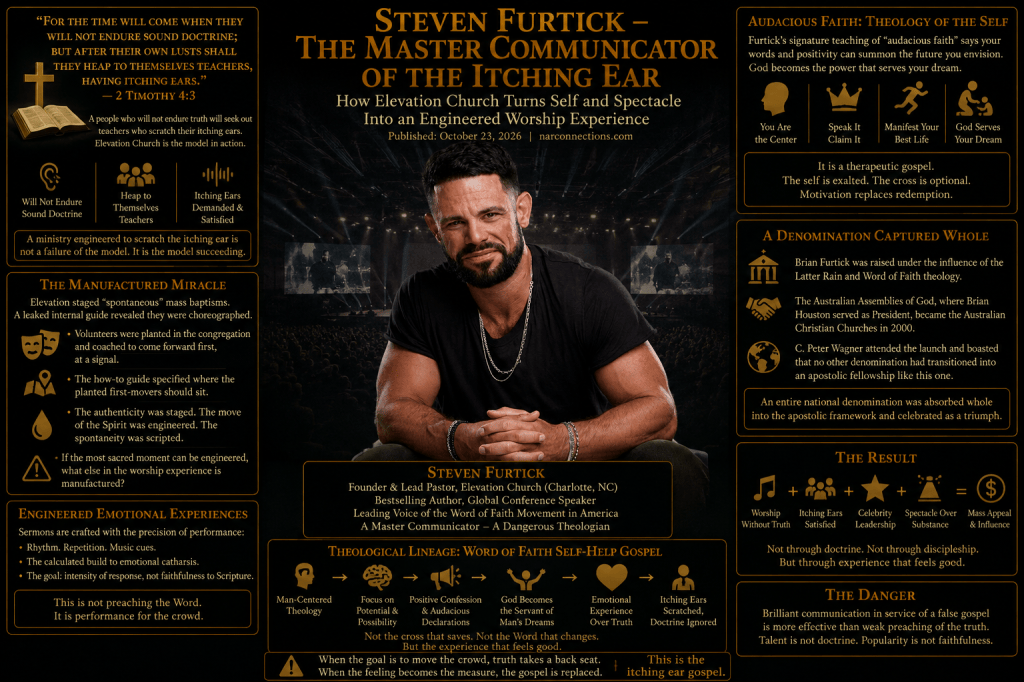
“For the time will come when they will not endure sound doctrine; but after their own lusts shall they heap to themselves teachers, having itching ears” (2 Timothy 4:3).
Paul is warning Timothy about a coming condition of the church, and every phrase of it describes the world we are entering today. Notice the sequence, because it is diagnostic. First, people will not endure sound doctrine, the careful, sometimes uncomfortable exposition of the Word becomes something they can no longer sit still for. Then, having lost the appetite for truth, they do not simply drift; they actively heap to themselves teachers, they go looking for, and gather in great number, the voices that will give them what they now crave. And the craving is named precisely: itching ears. Not hungry hearts seeking to be fed the truth, but itching ears seeking the pleasurable sensation of being stirred. Hold this verse over the Elevation model, because it is the whole thing in one sentence. A ministry engineered to scratch the itching ear, to move the room, to produce the sensation, to deliver the emotional experience the crowd came for, is not a failure of the model. It is the model succeeding at exactly what 2 Timothy 4:3 warned would one day be demanded.
The Manufactured Miracle
Nothing exposes the Elevation model more completely than the spontaneous-baptism controversy, so start there, because once you see its logic you see it everywhere. Elevation staged what it presented as spontaneous, Spirit-prompted mass baptisms: ordinary people rising unplanned from their seats, moved by the sermon, to be baptized on the spot. Then a leaked internal document revealed that these events were choreographed. Volunteers were planted in the congregation and coached to come forward first, at a signal, so that the rest of the crowd would follow the manufactured momentum. The how-to guide even specified where the planted first-movers should sit.
Set aside for a moment the manipulation of a sacred ordinance, and consider what the episode reveals about the entire enterprise. The authenticity was staged. The move of the Spirit was engineered. The spontaneity was scripted, down to the seating chart. A ministry willing to manufacture the appearance of the Spirit’s work in its most public moment has told you the governing logic of the whole operation: the effect on the crowd is the goal, and whatever produces the effect is justified. The baptisms were presented as the unscripted move of the Spirit; the Spirit’s move was scripted, down to where the planted volunteers should sit. That is the model in a single image.
And once you have seen the logic of the staged baptism, you see it everywhere in Elevation. The sermons themselves are engineered emotional experiences, built with a craftsman’s attention to rhythm, repetition, music cues, and the calculated build to catharsis. This is not preaching in the biblical sense, the faithful exposition of a text so the Spirit may apply the Word, but performance in the theatrical sense, in which the measure of success is the intensity of the crowd’s response. The gift is real and the production is superb. But the governing question is never whether the congregation has understood and submitted to Scripture; it is whether the room has been moved. A ministry that engineers the feeling of the Spirit’s presence has already decided that the feeling is what matters, which is precisely the itching ear being scratched.
Audacious Faith and the God Who Serves
Beneath the spectacle lies a specific theology, and it is Word of Faith rendered in the idiom of the self-help conference. Furtick’s signature teaching centers on “audacious faith”, the conviction that the believer’s bold declarations and relentless positivity can summon the future he envisions, with God repositioned from sovereign Lord to the power that serves the dreamer’s dream. It is a therapeutic gospel in which the human self, its potential, and its aspirations occupy the center where God and His glory belong.
Listen to where the sermons actually point. They are about the hearer, his greatness, his breakthrough, his destiny, far more than they are about Christ crucified for sinners; and where the cross appears, it is frequently a motivational illustration rather than the atoning heart of the gospel. This is the man-centered inversion the movement produces wherever it goes, delivered here by its most talented practitioner. And it explains the appetite Paul named. A generation that “will not endure sound doctrine” but wants its ears scratched will not gather to hear that it is sinful and needs a Savior. It will heap to itself the teacher who says it is destined for greatness and only needs more audacious faith to claim it. Furtick has not created that appetite; he has supplied it, with more skill than anyone alive.
Indifferent to Heresy
The doctrinal carelessness the model requires has surfaced most starkly in the company Furtick is willing to keep on a platform. He convened a widely promoted revival event that platformed and celebrated T.D. Jakes whom holds to modalism, a teaching about the nature of God that the historic church examined long ago and condemned as heresy. That a man associated with a condemned heresy could be embraced and celebrated without hesitation, as though what a teacher holds about God were beside the point, reveals precisely how doctrine functions in this world: as fine print, negotiable the moment it stands in the way of reach.
Furtick’s own public attempts to articulate the nature of God have wandered into confused and evasive territory more than once, and none of it is surprising within a framework that, in Hillsong’s candid phrase from yesterday, “does not build strong on theology.” This is the through-line connecting Furtick to everything before him: when sound teaching is treated as the divisive small print that gets in the way of filling a room, error is not merely tolerated, it is given a stage, a spotlight, and a crowd. And a people who “will not endure sound doctrine” will not object, because sound doctrine is the very thing they came to be relieved of.
The Accountability That Isn’t
Furtick’s personal finances have drawn sustained scrutiny, most visibly a large multimillion-dollar home, while Elevation declines to disclose his salary. And the church’s accountability structure is the familiar counterfeit this whole blog series and my book has traced: its board of overseers is composed largely of other celebrity megachurch pastors from the same network, men whose own ministries operate on the same model and who have every incentive to protect it. This is accountability among peers who share the very arrangement being examined, which is to say, no accountability at all. It is the interlocking-council problem from Day 12 in miniature, wearing the name of a board of overseers: a closed loop of men who cannot correct in another what they practice themselves.
And Elevation is not free-floating. It is a member of the Association of Related Churches, the network we will examine tomorrow, which formed Furtick within its “launch large” model and its “Moses model” theology of the visionary senior pastor who receives the church’s vision directly from God. That connection places Furtick inside the same relational and financial web as the ARC’s leadership, and it explains why Elevation reproduces the pattern so faithfully: professional production, aggressive growth, a personality-centered pulpit, and a governance structure built around the founder’s vision rather than a plural, mutually accountable eldership.
Elevation Worship: The Pipeline Extended
If Hillsong pioneered infiltration by worship and Bethel perfected it, Elevation Worship has carried the same strategy to a younger, more urban, more musically current audience. Songs like “Graves Into Gardens” and “Do It Again” are sung in tens of thousands of congregations that have never heard a Furtick sermon and would be surprised to learn the music originated in his church. And the theology travels with the song, exactly as it does with Hillsong and Bethel: the same experiential premise that worship is chiefly the felt encounter with divine presence, the same man-centered emphasis, the same emotional architecture engineered for effect.
This is the pattern from yesterday, extended to a new demographic. A congregation that would carefully vet a guest preacher will adopt an Elevation anthem without a second thought, because it arrives as music rather than as doctrine, and the music has already done its work by the time anyone thinks to ask what it teaches. Elevation Worship is not a side project; it is the most effective delivery system Furtick has, reaching far beyond anything his pulpit could touch. Which is exactly why, tomorrow and Days 20-21 will show, the worship-music pipeline deserves examination as a system in its own right.
Why the Giftedness Is the Danger
Furtick sits at the confluence of every stream this section documents. He is an ARC ally tied to Chris Hodges; he has shared platforms and warm mutual endorsement with the Hillsong world; he has celebrated a teacher associated with a condemned heresy; and Elevation Worship carries the same experiential theology into churches that would never invite him to preach but will happily sing his songs. That is why he belongs here despite never claiming an apostolic title or issuing a prophetic decree. He is the mainstream face of the movement’s method, spectacle over substance, self over Christ, effect over truth, and his very giftedness ensures that method is delivered to millions with irresistible skill.
And here is the sober principle to carry out of this blog: the more excellent the delivery, the more urgent the discernment. We instinctively lower our guard before great talent; we assume that what is done so well must be true. But 2 Timothy 4:3 warns of a day when people will gather teachers precisely because those teachers scratch the itch, and nothing scratches an itching ear like genius. The test the movement has trained a generation to stop applying is the only test that protects: not “was I moved?” but “was I fed the truth?” A staged spontaneity, an engineered catharsis, a gospel about my own destiny, these can move a room to tears and leave it further from Christ than it began. The remedy is not to distrust every gifted preacher, but to remember that the gift authenticates nothing. Only the Word does. Endure sound doctrine, even when a lesser voice delivers it, over an itch expertly scratched by the most gifted communicator alive.
Tomorrow, the man at the center of the whole mainstream bridge, the apostolate in a business suit: Chris Hodges and the ARC.
“For the time will come when they will not endure sound doctrine; but after their own lusts shall they heap to themselves teachers, having itching ears.” — 2 Timothy 4:3 KJV
📖 This post is adapted from NAR Connections: Connecting The Dots. If it helped you, the full book is available on Amazon — or you can support this ministry directly.
thefinalconvergence.com | Follow on Instagram, Facebook, X, and YouTube
If you like to be updated on new blogs, sign up to our newsletter!


Leave a Reply