
Published: October 24, 2026 | narconnections.com
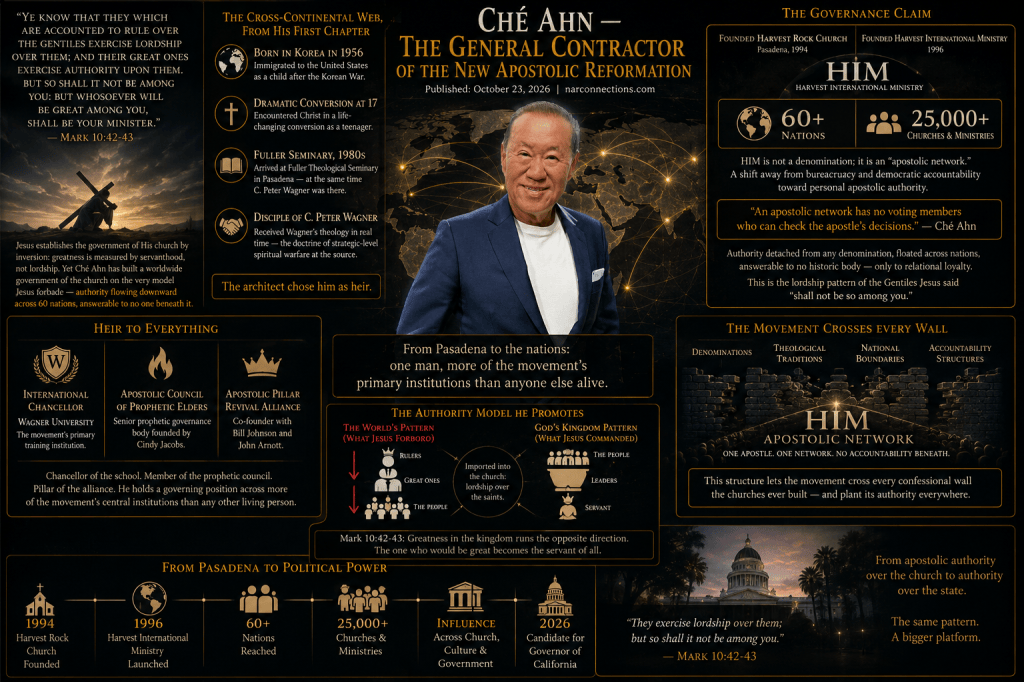
When C. Peter Wagner died in 2016, the question of who would inherit the operational center of the New Apostolic Reformation was already, in practice, answered. No single figure held more of the movement’s threads than the man Wagner had mentored, credentialed, and named as his successor at the movement’s own university. If Wagner was the architect and Hamon the grandfather, this man is the general contractor who keeps the whole structure standing and expanding, and he occupies more of the movement’s primary institutions at once than anyone else alive. His name is Ché Ahn, and today he is also a candidate for governor of California.
“Ye know that they which are accounted to rule over the Gentiles exercise lordship over them; and their great ones exercise authority upon them. But so shall it not be among you: but whosoever will be great among you, shall be your minister” (Mark 10:42-43).
This is the Lord Jesus establishing the government of His own church, and He does it by inversion. The world’s pattern is authority flowing downward, rulers who exercise lordship, great ones who exercise authority over those beneath them. And Jesus draws a hard line against importing that pattern into His church: but so shall it not be among you. Greatness in the kingdom runs the opposite direction, the one who would be great becomes the servant of all. Hold this verse against everything that follows, because Ché Ahn has built a worldwide government of the church on precisely the model Jesus forbade: personal apostolic authority flowing downward across sixty nations, answerable to no one beneath it, the lordship pattern of the Gentiles, installed at the head of twenty-five thousand ministries and now walking toward a statehouse.
The Cross-Continental Web, From His First Chapter
Ahn’s story is, from the beginning, the story of the worldwide web this book exists to trace. Born in Korea in 1956, he immigrated to the United States as a child after the Korean War, was dramatically converted at seventeen, and in the 1980s arrived at Fuller Theological Seminary in Pasadena, at the same moment, in the same place, that C. Peter Wagner was undergoing his own migration from sober missiologist to apostle of the supernatural.
That timing was the hinge of Ahn’s entire life. He received Wagner’s theological development in real time, absorbed the doctrine of strategic-level spiritual warfare directly from the man inventing it, and emerged as the most consequential protégé of one of the most consequential mentors in modern American Christianity. Where most figures in this book inherited the movement’s ideas secondhand, Ahn learned them at the source, from the architect himself, which is exactly why the architect chose him as heir.
The Governance Claim
Ahn founded Harvest Rock Church in Pasadena in 1994 and, in 1996, the instrument of his worldwide reach: Harvest International Ministry. HIM began with fourteen churches; it now claims some twenty-five thousand affiliated churches and ministries across more than sixty nations. But the number is not the point, the structure is. HIM is not a denomination; it is an “apostolic network,” and the distinction is doctrinal, not merely organizational.
Ahn has described the shift openly and candidly: a move away from bureaucratic, legal, rational structure toward personal apostolic authority, and, in his own words, away from democratic accountability, since an apostolic network has no voting members who can check the apostle’s decisions. Read that against Mark 10:42-43 and the collision is total. The New Testament knows nothing of a permanent worldwide tier of apostolic authority standing above the local church. It presents elders accountable to their congregations, who must meet the same character standards required of every overseer. Paul’s own authority rested on his direct commissioning by the risen Christ, and it was exercised for the churches, never as an unaccountable government over them. Ahn’s network dissolves that accountability by design: authority detached from any denomination, floated across sixty nations, answerable to no historic body, only to the relational loyalty of those beneath it. That is precisely the “exercise lordship over them” that Jesus said shall not be so among you. And it is precisely the structure that lets the movement cross every confessional wall the churches ever built.
Heir to Everything
The institutional inheritance is documented and specific, and it is staggering in its concentration. Ahn became International Chancellor of Wagner University, the movement’s primary training institution, the same unaccredited school from which Brian Simmons drew the doctorate he uses to credential his rewriting of the Bible. He sits on the Apostolic Council of Prophetic Elders, the senior prophetic governance body founded by Cindy Jacobs. And he is one of three “apostolic pillars” of the Revival Alliance, the inner family he co-founded with Bill Johnson and John Arnott, the same Toronto-to-Bethel axis we traced yesterday.
Chancellor of the school, member of the prophetic council, pillar of the alliance: Ahn holds a governing position across more of the movement’s central institutions than any other single living person. If you wanted to draw the movement’s organizational chart on one page, his name would sit at more of the junctions than anyone’s. This is why he, and not any of the movement’s more famous faces, is its true operational center.
Lakeland, From the Other Side of the Stage
We saw the 2008 Lakeland Revival yesterday from Bethel’s vantage. From Ahn’s, it is even more revealing, because he was the hinge of the whole event. When Wagner determined that Todd Bentley needed “apostolic alignment,” he discovered that Ahn was the coalition member closest to Bentley. Ahn brought in Johnson and Arnott, his fellow Revival Alliance pillars, and on a stage broadcast worldwide the three of them formally commissioned Bentley while Wagner decreed his influence would increase. Ahn opened his own address by borrowing John the Baptist’s words about Christ, that he must decrease and Bentley must increase.
Within weeks the revival collapsed; Bentley abandoned his wife for a ministry intern, and no independent verification of a single healing claim survived scrutiny. Not one of the apostles who had decreed divine empowerment over him acknowledged that their public prophecies had been false. The lesson is structural, not incidental: a governance framework in which apostles claim authority to decree anointing over a man, witnessed by millions, contained no mechanism whatsoever for discerning the moral reality of that man’s life. The Berean test, examining everything against Scripture, had been replaced by apostolic ceremony and relational trust, and the result was exactly what that substitution must always produce.
The ARC Bridge — How the Apostolate Goes Mainstream
Here is the single most strategically important thing Ché Ahn does, and the reason he matters for the chapters ahead. He has a documented record of drawing megachurch pastors who do not call themselves NAR figures into apostolic self-identification. On tape, Ahn has acknowledged that Robert Morris, Chris Hodges, Larry Stockstill, and roughly twenty other megachurch pastors were, in his view, actually apostles. And the overseers of Chris Hodges’s Church of the Highlands then functioned as “Apostolic Elders,” the precise vocabulary of the office framework Wagner and Ahn spent thirty years building. This is the Association of Related Churches, whose member congregations represent hundreds of thousands of weekly attenders across the mainstream of American evangelicalism, quietly adopting the governance language of the movement.
The doctrinal implication travels with the vocabulary. Once a pastor accepts the title “apostle” or “apostolic elder,” he has implicitly validated the framework that title carries, extra-biblical revelation, territorial governance, Seven Mountains dominion, submission to apostolic covering. He may never have consciously embraced those doctrines, but the word imports them. This is the denominational blur reaching its most consequential stage: the movement is no longer merely growing at the margins but transforming the largest, most established institutions of American Christianity from within, and dissolving the very line between “mainstream evangelical” and “NAR” that discerning believers depend upon. When we reach the celebrity-pastor web later in this series, remember that Ahn is the man who built the bridge they walked across.
From the Church Mountain to the Government Mountain
Ahn has taught the Seven Mountain Mandate for decades, and he defines an apostle as one sent with extraordinary authority to disciple nations, which quietly evacuates the Great Commission of its evangelistic content and refills it with governmental content, so that “make disciples of all nations” becomes “exercise authority over nation-states.” Its trajectory reached its logical end in his politics: he supported the effort to overturn the 2020 election and spoke at the January 5, 2021 rally in Washington the night before the Capitol was attacked, declaring in the language of apostolic decree that believers would rule and reign. In 2025, reporting a 2:30 a.m. encounter he took as a divine call, he announced his candidacy for governor of California.
Within his own theology, an apostle moving from church government to civil government is not a category shift, it is the doctrine doing exactly what it was always designed to do. And this is where Mark 10:42-43 lands with full weight. Jesus said the lordship pattern of the rulers of the Gentiles shall not be so among you. A theology that redefines the apostle as one who governs nations, and then sends him from the sanctuary to the statehouse to do it, has not merely stretched the office. It has reached for the precise form of authority Christ forbade His servants to seek, and called the reaching obedience. The chapter’s warning is not partisan; a Christian may hold any number of political views. It is that the apostolic-governmental doctrine itself inverts the servant-shape Jesus gave His church.
The European Gateway, and Where It Breaks
One last thread proves how genuinely worldwide this is. Ahn’s network reached Europe through Amsterdam, where a lead pastor, Arleen Westerhof, holds the office of apostle within HIM and sits on Cindy Jacobs’s prophetic council, raising up national-level prophets while her husband, Dick Westerhof, formed a companion coalition that builds a Dutch apostolic network committed to the Seven Spheres. Amsterdam, a financial and cultural center of post-Christian Europe, is no accidental location for the continental arm of an American apostolic network. Through credentialed, academically serious figures who move easily in institutional settings, the framework has been planted in the heart of the Netherlands. For a movement that resists the charge of being a loose American subculture, its Amsterdam beachhead is one more proof that the web is genuinely worldwide.
And here is where it all breaks. Strip away the twenty-five thousand ministries, the sixty nations, the chancellorship and the councils and the campaign, and you are left with a single claim: that a man may hold, over the church and over the nations, an unaccountable governing authority that flows downward from himself. Against that claim stands one sentence from the Lord of the church: it shall not be so among you. Ché Ahn is the most institutionally powerful man in the movement precisely because he has built, more completely than anyone alive, the one thing Jesus told His servants never to build. That is not a small error at the edge of a good work. It is the whole structure, raised on the exact ground Christ fenced off.
Tomorrow, the callback that binds this book to the last: Brian Simmons and The Passion Translation, the apostle who rewrote the Bible.
“But so shall it not be among you: but whosoever will be great among you, shall be your minister.” — Mark 10:43 KJV
📖 This post is adapted from NAR Connections: Connecting The Dots. If it helped you, the full book is available on Amazon — or you can support this ministry directly.
thefinalconvergence.com | Follow on Instagram, Facebook, X, and YouTube
If you like to be updated on new blogs, sign up to our newsletter!


Leave a Reply