
Published: November 4, 2026 | narconnections.com
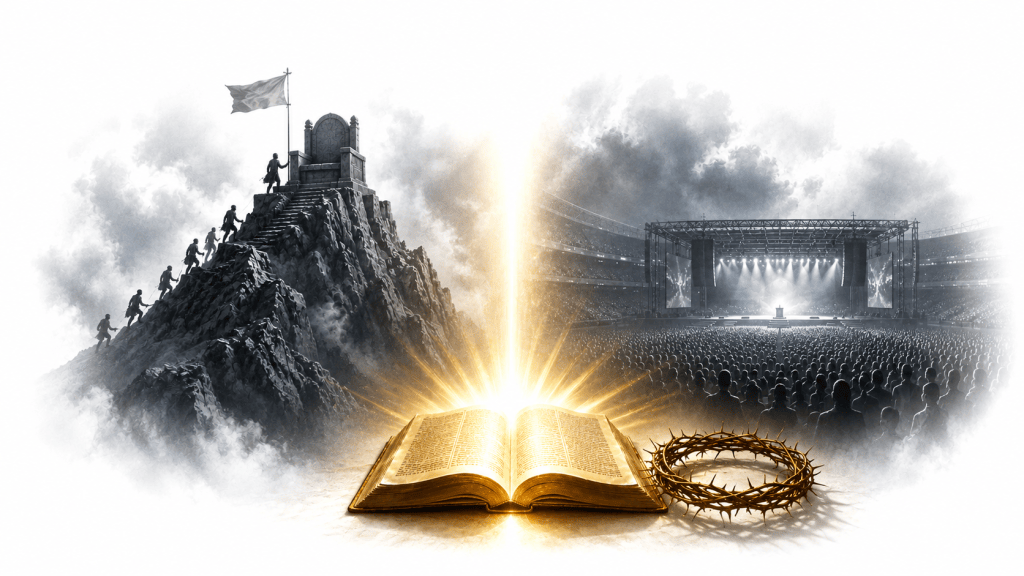
We close Part Four today by following the movement out of the church and into two arenas where the stakes could not be higher: the seat of political power, and the evangelization of the nations. For most of this blog series the Seven Mountain Mandate has appeared as a doctrine, the teaching that the church is called not merely to preach the gospel but to take dominion over seven “mountains” of culture, government chief among them. Today it appears as an operation, because in our own moment the doctrine has stopped being theoretical. And alongside it we meet the movement’s export arm, the worldwide evangelists carrying its gospel to the ends of the earth under the one banner that silences objection in advance. Both, in the end, come down to a single question: not whether the church should engage the nations, but with what gospel.
“But though we, or an angel from heaven, preach any other gospel unto you than that which we have preached unto you, let him be accursed” (Galatians 1:8).
This is the most absolute sentence Paul ever wrote, and its severity is the point. He does not merely caution against another gospel; he pronounces a curse, and he aims it first at himself (“though we”), and then at an angel from heaven. No credential is high enough to exempt a false gospel: not an apostle’s, not an angel’s. The authority of the messenger, however exalted, cannot sanctify the message if the message is false. Hold that over both halves of today’s blog, because it is the blade that cuts through both. A dominion movement that reaches the halls of power, and an evangelistic movement that fills the world’s stadiums, both trade on the authority and scale of the messenger, the office, the anointing, the crowd, the sincerity, the sacrifice. And Paul says none of it matters if the gospel is another gospel. A false gospel with a government office is still accursed. A false gospel preached to a million people is still accursed, only now it is accursed at the scale of a million.
First, the Necessary Fence
Before a single name, a boundary must be set, because this is the most politically charged material in the entire blog series and it is easily mistaken for something it is not. The concern here is not that Christians vote, hold office, or bring their convictions into public life. Christians can and should be good citizens across the whole political spectrum, and nothing in this blog says otherwise. The concern is a specific theology, dominionism, that fuses the mission of the church with the seizure of political power, recasts the Great Commission as a campaign to capture institutions, and, at its worst, sacralizes a political leader as an anointed instrument beyond ordinary scrutiny. That is not Christian citizenship. It is, in the book’s own phrase, a different gospel wearing a flag. And the critique that follows would be identical whatever partisan direction the flag happened to point, the error is in the theology of dominion itself, not in any party, candidate, or coalition. Keep that fence firmly in view through everything below.
The Mandate at the Seat of Power
No one has done more to translate the Seven Mountain Mandate from abstraction into a political battle plan than Lance Wallnau, a businessman turned self-styled apostle and prophet who fuses the vocabulary of the executive coach with the authority of the seer, teaching for two decades that occupying the mountains, especially government and media, is the church’s central assignment. His defining move was to cast a political figure as God’s anointed “Cyrus,” a modern echo of the pagan Persian king God used in Isaiah, a framing that handed a generation of charismatic voters a prophetic rationale for their politics. In Wallnau the prophet and the political operative became the same man, and the mountain of government the prize.
And the mandate has now reached the summit. A prosperity-gospel televangelist of the Word of Faith stream was installed, in 2025, to direct a newly created White House Faith Office, a preacher of the charismatic-dominionist world holding formal position at the seat of national power, convening religious leaders to shape federal policy. The symbolism has not been subtle: a political leader publicly called “the greatest champion of faith we’ve ever had,” and, at an Easter event, a political leader’s suffering compared to Christ’s own, a comparison Christians across the spectrum, conservatives among them, rebuked as blasphemous. This is the Seven Mountain Mandate at its logical destination: not merely a believer serving in government, but a dominionist preacher installed at the seat of power, speaking of a politician in language once reserved for Christ. The mountain has been climbed, and an idol has been carried to the top of it. Around these figures runs the machinery, the intercession platforms that fuse prayer with a specific political program, the pastors’-network activism built on revisionist Christian-nationalist history, the prophets who declare a divinely guaranteed political outcome and the mobilized faithful who move to enforce it, and the measured apologist whose very moderation lends the whole enterprise a respectability its firebrands cannot.
Why It Inverts the Gospel
Here John 18:36 must be set directly against the mandate, because the Lord Jesus faced this exact temptation and refused it. Standing before the supreme political power of His day, He declared: My kingdom is not of this world: if my kingdom were of this world, then would my servants fight… but now is my kingdom not from hence. He refused the crowds who would take Him by force to make Him king. And in the wilderness, when the devil offered Him all the kingdoms of the world, the mountain of government, handed over in an instant, He refused it, because it was offered on the enemy’s terms. The One who is Lord of every mountain would not seize it that way. His church, if it is His, must not either.
So dominionism fails on two levels at once. Theologically, it inverts the gospel: it sends the church to seize the mountains of civilization when Christ sent her to preach repentance and make disciples, swapping the mission of the church for the ambition of the world. And practically, it corrupts both the church and the state it courts: it binds the gospel to a partisan program, so the good news rises or falls with an election and the name of Christ is spent on a candidate; it teaches believers to place their hope in princes, which Scripture expressly forbids; and in its most advanced form, a preacher likening a president to the crucified Lord from a government office, it slides into the very idolatry of political power that Christ refused in the wilderness. This is where Galatians 1:8 lands on the first half of today’s blog: a gospel fused with the seizure of a nation is another gospel, and the flag it wears cannot save it from the curse.
The Most Disarming Face: Evangelism
Now the second arena, and the movement wears no more disarming face than this one. Every other mechanism in this blog can be questioned without any sense of disloyalty to Christ, but the export arm operates under a banner that feels beyond criticism: evangelism. Who could object to winning the lost, to stadium crusades and mass altar calls and the sending of the gospel to the nations? That is precisely the point. The worldwide evangelists are the movement’s missionaries, carrying its theology to the ends of the earth under the one banner that silences objection in advance, which is exactly why their gospel must be examined most carefully of all.
And it is organized. The export arm has a name, a Global Evangelist Alliance spanning more than a dozen worldwide regions, whose executive committee gathers the crusade heirs, the Bethel revival evangelists, and even figures from the respectable mainstream, and which offers its members a standing invitation to the Empowered21 Global Congress. The evangelism arm and the headquarters of the blur are, by their own admission, one network. At its center stands the heir of the great African crusade tradition, a genuinely large-scale operation whose courage is real, but whose signature claims (mass healings, even resurrections) are always promoted where no skeptic with a hospital record could verify them, unlike the miracles of Christ and the apostles, performed openly before hostile witnesses who could not deny them. And tellingly, this same evangelist is one of the movement’s most vocal deniers that the movement exists, dismissing the critics as conspiracy theorists while co-chairing an alliance embedded in Empowered21, sitting on its Global Council, and endorsing a documented roster of the movement’s most controversial figures. As Day 1 said: the label is deniable; the structure is not. A man is known not by the category he rejects, but by the council he sits on and the teachers he commends.
Spectacle, and the Hardest Case
The pattern recurs across the export arm. There is the Bethel-formed evangelist, Ben Fitzgerald, packaging Redding’s presence-and-encounter spirituality as a continental “awakening” campaign across post-Christian Europe. There is the power-evangelist, Todd White, whose filmed street “healings,” the on-camera leg-“lengthening” chief among them, have been repeatedly debunked as a well-known illusion. The lesson is the one from the staged baptism of Day 16, now carried to the nations: if the healing were what it claims, it would not need the camera angle. When evangelism must be authenticated by wonders that cannot survive scrutiny, the wonder has replaced the gospel, carrying a weight the gospel was never meant to place on it.
And then the hardest case of all, which honesty requires be handled with care: the missionary who has spent decades among the poorest people on earth, caring for orphans at genuine personal cost, a sacrificial life that commands real respect and makes criticism feel almost cruel. Yet the theology she carries is the same stream: the Toronto impartation, the Revival Alliance membership, the manifestation-driven spirituality resting on unverifiable wonders. This must be said honestly and without triumphalism: one may honor a Christlike compassion for the poor and still recognize that the spirituality being imparted is the movement’s, and that genuine love for the poor does not sanctify a defective gospel. The most Christlike life in the movement cannot make its theology true; it can only make it harder to question. That is not a cruelty. It is exactly what Galatians 1:8 requires, because Paul aimed his curse even at himself and at an angel from heaven, which is to say: no life is holy enough, no sacrifice great enough, to exempt a false gospel from the test.
Why the Stakes Are Highest Here
Gather both halves and the reason this blog closes Part Four comes clear. Evangelism is the movement’s perfect vehicle precisely because it is the church’s highest calling, and to question the vehicle feels like betraying the mission. But the question is never whether the lost should be reached, they must be, urgently, but with what gospel. The gospel these figures export is the one documented throughout this blog series: signs and wonders authenticating the message, healing promised as a present entitlement, the response card and the manifestation standing in for the slow, costly work of true conversion. And it is aimed at the most vulnerable, the desperate poor of the global South, the impressionable young of the secular West, the very people least equipped to test what they are given. A false gospel carried to the nations is not the Great Commission; it is its counterfeit, and its scale is not a mercy but a magnification.
This is why Paul reserved his most absolute language for exactly this danger. A false gospel does not half-save; it does not save at all, and the sincerity, the sacrifice, the crowds, and the wonders cannot change that. Whether the vehicle is a government office or a stadium crusade, the same verdict applies: let him be accursed who preaches another gospel, though he wear a flag, hold an office, fill an arena, or lay down his life among the poor. Everything turns on whether what is being carried to the seat of power and to the ends of the earth is the true gospel of Christ crucified and risen, received by faith alone, or the movement’s gospel of power, experience, and the empowered self. On that question the eternal welfare of millions turns, which is why neither the most powerful arm of the movement nor its most beloved one dares be waved through unexamined.
That closes Part Four. Tomorrow we begin Part Five and turn to the single most effective delivery system the movement possesses, the one that reached your own church without a sermon: how worship music carries theology.
“But though we, or an angel from heaven, preach any other gospel unto you than that which we have preached unto you, let him be accursed.” — Galatians 1:8 KJV
📖 This post is adapted from NAR Connections: Connecting The Dots. If it helped you, the full book is available on Amazon — or you can support this ministry directly.
thefinalconvergence.com | Follow on Instagram, Facebook, X, and YouTube
If you like to be updated on new blogs, sign up to our newsletter!


Leave a Reply