
Published: November 11, 2026 | narconnections.com
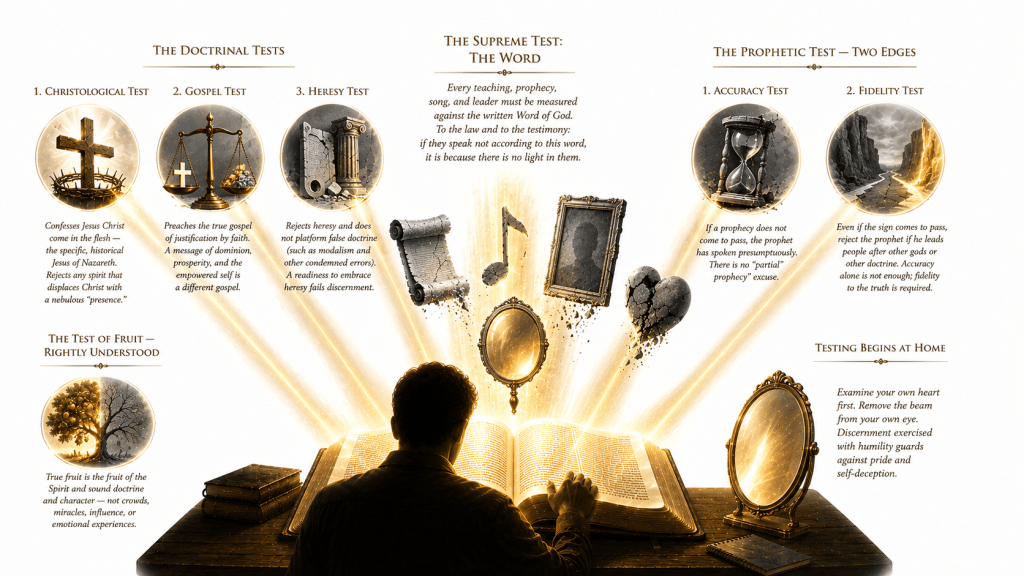
Yesterday’s six diagnostics rest on a deeper foundation, and today we lay it bare: the biblical command to test. Because before any believer can detect the influence in his own church, he must first recover a conviction the movement quietly erodes, that discernment is not a spiritual gift reserved for a specialized few, nor an unloving intrusion upon the work of God, but a standing command laid upon every Christian. “Believe not every spirit, but try the spirits whether they are of God: because many false prophets are gone out into the world” (1 John 4:1). That command assumes what the movement denies: that not every spiritual thing is from the Spirit of God, that false prophets are numerous rather than rare, and that the ordinary Christian is both able and obligated to tell the difference. Today we take up the tests Scripture itself provides.
“These were more noble than those in Thessalonica, in that they received the word with all readiness of mind, and searched the scriptures daily, whether those things were so” (Acts 17:11).
Here is the discerning believer, drawn in a single sentence, and the Holy Spirit calls him noble for it. Notice what the Bereans did, and what they did not do. They received the word with all readiness of mind, they were not cynics, not fault-finders, not closed to the message; they came eager and open. And yet they searched the Scriptures daily, whether those things were so, they tested even the preaching of the apostle Paul himself against the written Word, before they believed it. Hold both halves together, because they are the whole art of discernment. The Bereans were open and they tested; receptive and rigorous; teachable and unwilling to accept anything, from anyone, that did not square with Scripture. And here is the liberating part: Paul did not rebuke them for auditing his sermons against the Book. He commended them as more noble for it. If the greatest apostle who ever lived welcomed being tested by Scripture, no living “apostle” or “prophet” stands above it. That is the posture the movement cannot abide, because its entire structure depends on revelation that supplements and overrides the text. But for the believer it is pure freedom.
The Supreme Test: The Word
The first and final test is the written Word of God, against which every other claim is measured. To the law and to the testimony, Isaiah declares: if they speak not according to this word, it is because there is no light in them. This is what makes the Berean posture so freeing. The believer is not left to weigh one charismatic personality against another, or to guess which prophet feels most authentic, or to be swept along by whichever voice is loudest and most confident. He has a fixed and sufficient standard, and he is authorized, commanded, to bring every teaching, every prophecy, every song, and every leader to it. Discernment, rightly understood, is not the anxious business of trusting your instincts about people. It is the calm business of searching the Scriptures daily, whether those things be so. The standard does not change, does not flatter, and cannot be charmed.
The Doctrinal Tests
Scripture supplies specific doctrinal tests, and they probe the vital organs of the faith. The first and deepest is Christological. John makes the confession of Jesus Christ come in the flesh, the specific, historical Jesus of Nazareth, in His words, His cross, and His resurrection, the very dividing line between the Spirit of God and the spirit of antichrist. And this is the test the movement most often fails, for its characteristic spirituality does not deny Christ outright; it displaces Him, moving Him from the center to the periphery and putting in His place a nebulous “presence” to be soaked in, imparted, and felt. Any spirit that offers an experience detached from the words of the specific Christ, however warm, however powerful, is not the Holy Spirit, whatever it calls itself. The second is the gospel itself: Paul pronounces anathema on anyone who preaches another gospel than the one delivered (Day 19), which is why a message that replaces justification by faith with dominion, prosperity, and the empowered self is not a variation but a different gospel. The third is a movement’s readiness to embrace and platform heresy the church long ago examined and condemned, modalism among them, treating grave and settled error as no barrier to fellowship or celebration. A movement so untroubled by heresy has failed a basic test of discernment, whatever its zeal. Fail at any of these three points, and you have failed the test that matters most, whatever signs accompany it.
The Prophetic Test — Two Edges
For the movement’s prophetic claims, Scripture provides a test of brutal simplicity, and then sharpens it with a second edge. The first is accuracy: “when a prophet speaketh in the name of the LORD, if the thing follow not, nor come to pass… the prophet hath spoken it presumptuously” (Day 6, Deuteronomy 18:22). It admits no theology of “partial” prophecy to excuse the misses. But Scripture adds a second and even sharper test: even a prophet whose sign does come to pass is to be rejected if he leads the people after other gods or other doctrine, for God sometimes permits a false wonder to prove where His people’s loyalty truly lies. Accuracy alone is not enough; fidelity to the truth is required as well. So the test of a prophet is never whether he is sincere, gifted, or beloved. It is whether the word came to pass, and whether it led toward the God of Scripture or away from Him. By both tests together, the movement’s prophetic culture, with its long record of confident failures and its unbroken survival of them, is weighed and found wanting.
The Test of Fruit — Rightly Understood
The Lord Jesus gave the test of fruit, ye shall know them by their fruits, but this test is constantly misapplied, and the misapplication is one of the movement’s chief defenses. “Fruit,” in the movement’s mouth, means crowds, growth, miracles, influence, and changed feelings, the very things Jesus warned would accompany false prophets who cry “Lord, Lord” and work wonders in His name, and to whom He will say, I never knew you. That is the trap: the spectacle is offered as the fruit, precisely to short-circuit the real test.
But the fruit Scripture means is the fruit of the Spirit, love, joy, peace, longsuffering, gentleness, faithfulness, self-control, and the fruit of sound doctrine and holy character in the teacher’s own life. Numerical success is not fruit; a healed body is not proof; an emotional experience is not vindication. To test the fruit rightly is to look past the spectacle to the character and the doctrine, which is exactly what the spectacle is designed to prevent. A movement that answers every doctrinal question by pointing at its crowds and its miracles has not passed the fruit test. It has changed the subject.
The Errors That Defeat Discernment
Discernment fails most often not for lack of tests but because the tester substitutes a counterfeit standard for the biblical one. Sincerity is mistaken for truth, as though a man’s earnestness could sanctify his error. Charisma is mistaken for anointing, results for divine approval, love for doctrinal soundness, and the warmth of an experience for the presence of God. And over all of it hangs the great modern shield, “Judge not”, torn from its context and turned into a prohibition on the very testing Scripture commands. But the same Lord who said “judge not” by hypocritical standards also said, in the very next breath elsewhere, “judge righteous judgment.” The command was never against judging; it was against judging hypocritically and by a false measure. The believer who would discern truly must first refuse all these counterfeits, sincerity, charisma, results, warmth, and the misquoted “judge not”, and hold to the one standard that cannot deceive him.
Testing Begins at Home
And here is the safeguard that keeps discernment from becoming the very thing the movement loves to caricature: the testing must begin at home, with the tester himself. The believer who takes up these tests to examine others is under obligation to turn them first upon his own heart, for the same pride that deceives a false prophet can corrupt a discerner into a fault-finder who loves the hunt more than the truth. Scripture commands us to examine ourselves whether we be in the faith, and to remove the beam from our own eye before we presume to address the mote in another’s.
This self-suspicion is not a weakness in discernment; it is its safeguard. The one who fears his own capacity for self-deception will test gently, weigh carefully, and hold his conclusions with the humility of a man who knows he too could be wrong. Discernment exercised without self-examination curdles into censoriousness. Exercised with it, discernment becomes what it was meant to be, an act of love that guards the flock, oneself included. This is the difference between a Berean and a heresy-hunter: both test everything, but the Berean tests himself first, and tests others with a “readiness of mind” that wants to receive the truth, not merely to catch someone out.
The Spirit and the Word Together
One final word guards against turning discernment into a cold, merely intellectual hunt for errors. True discernment is the work of the Spirit and the Word together, the same Spirit who inspired the Scriptures illuminating them to the humble, prayerful, teachable heart. And it is a capacity that grows with use. As the writer to the Hebrews says, strong meat belongs to those who by reason of use have their senses exercised to discern both good and evil. Discernment is a muscle, not a gift dropped fully formed on a select few, cultivated not by cynicism but by saturation in the Word, by prayer for wisdom, and by the humility that fears its own capacity for self-deception as much as anyone else’s.
So the goal is never the pride of always being right. It is the protection of Christ’s sheep, oneself among them, by the God-given ability to know the Shepherd’s voice from the stranger’s. That is what the Bereans were really doing when they searched the Scriptures daily, not scoring points against Paul, but making sure the voice they followed was the true one. And that is the invitation this blog holds out to every believer: not the anxious, exhausting work of suspecting everyone, but the noble work of receiving eagerly and testing faithfully, until your senses are so exercised in the Word that the stranger’s voice, however beautiful, no longer fools you. The sheep who knows the Shepherd’s voice is not afraid of the stranger’s. He simply does not follow it.
Tomorrow, where all this testing is meant to lead: not merely away from the counterfeit, but home, to a solid church and the faithful voices worth trusting.
“These were more noble than those in Thessalonica, in that they received the word with all readiness of mind, and searched the scriptures daily, whether those things were so.” — Acts 17:11 KJV
📖 This post is adapted from NAR Connections: Connecting The Dots. If it helped you, the full book is available on Amazon — or you can support this ministry directly.
thefinalconvergence.com | Follow on Instagram, Facebook, X, and YouTube
If you like to be updated on new blogs, sign up to our newsletter!


Leave a Reply