
Published: November 13, 2026 | narconnections.com
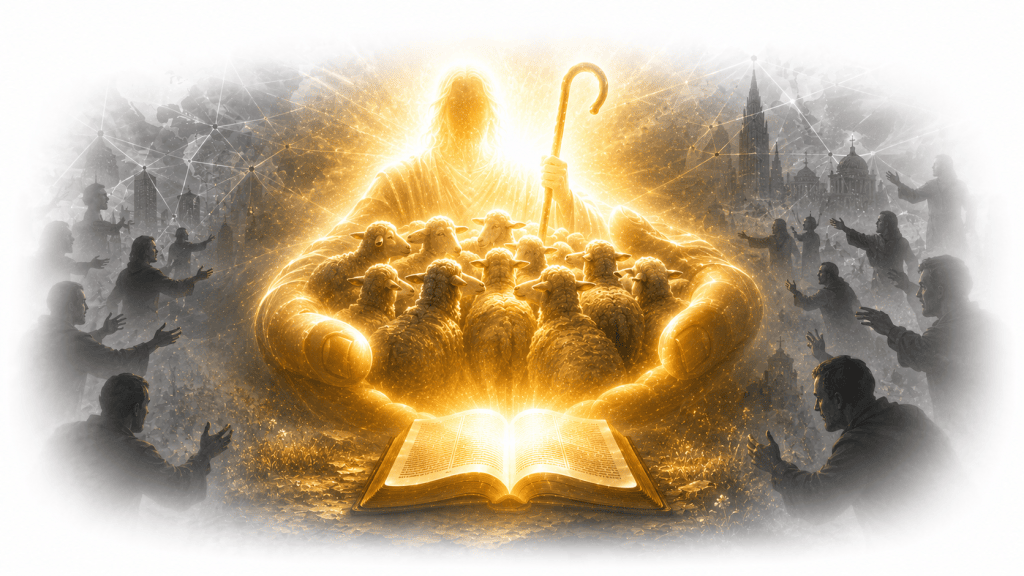
We have come a long way together, and it is worth pausing at the end of the road to see the whole of it at once. We began with a movement that denies its own existence and we end with the tools to detect it in your own sanctuary. Between those two points we traced the architects who built it, the institutions that credential it, the celebrity pastors who carry it mainstream, the worship pipeline that pipes it into every church, the mechanisms by which its connections are documented, the biblical principle that makes those connections matter, and the way of discernment that leads back to solid ground. It is a great deal to hold in the mind. But if you retain nothing else from these twenty-eight days, retain the two threads that ran through every blog, and, beneath them, the one voice that is the whole point of learning to hear.
“My sheep hear my voice, and I know them, and they follow me: And I give unto them eternal life; and they shall never perish, neither shall any man pluck them out of my hand” (John 10:27-28).
Here is where the entire journey was always leading. All the diagnostics, all the documented connections, all the tests, they exist to serve one thing: the ability of Christ’s sheep to know His voice. Jesus says His sheep hear His voice, they follow Him, and, the promise that steadies everything, they shall never perish, for no man can pluck them out of His hand. Notice the order. The sheep are not kept safe because they became expert wolf-spotters; they are kept safe because they know the Shepherd, and He knows them, and holds them. Discernment is not, finally, about mastering the stranger’s voice. It is about knowing the Shepherd’s so well that the stranger’s, however beautiful, however confident, simply is not His, and the sheep will not follow it. Hold that as the sum of everything: the goal was never suspicion. It was to know the one voice that leads home.
The Two Threads, in Miniature
If you forget the thousand names, keep the two threads, for they are the whole picture. The first is the web that crosses every continent. This is no American eccentricity to be safely ignored elsewhere, it is a single, interlocking, worldwide network: a California church whose fire came through Canada from a South African evangelist; a Korean-born apostle in Pasadena covering a church in Amsterdam; a school drawing students from fifty nations and returning them to every one; apostolic hands reaching toward the governments of nations on multiple continents at once. Wherever you live, the web is already there.
The second is the blur that dissolves every denominational wall. The movement does not ask anyone to leave his denomination; it simply operates above them all, until the historic body that once condemned a doctrine sits in council with the doctrine’s heirs, and a denominational label can no longer tell a believer where his church truly stands. The web and the blur, hold those two, and the thousand names in this blog series resolve into one coordinated picture.
Why None of This Is Academic
It would be possible to read a blog series like this as an exercise in religious cartography, an interesting map of who knows whom, filed away and forgotten. That would be a grave mistake, because nothing documented here is academic. Real congregations are being formed, in a theology their shepherds have never examined. Real believers are being taught to trust teachers no one vetted, to sing a spirituality no one weighed, to read a rewritten Bible no scholar endorsed, and to reach endlessly for an experience the finished work of Christ was supposed to have settled.
And beneath it all, quietly, the gospel itself is being exchanged. The good news that God justifies the ungodly freely by grace through faith in the finished work of His Son is being displaced by another message, a gospel of dominion, of prosperity, of the empowered and limitless self, and it is being displaced not by open assault, which the church might resist, but by a worship song, a trusted endorsement, and a warm and beloved platform. The gospel is not being argued away. It is being sung away, endorsed away, and platformed away, quietly, beautifully, and by trusted hands. That is why this is not academic. When the gospel is at stake, everything is at stake.
A Word From Inside
I have not written any of this as a detached observer, and you deserve to be reminded of that as we close. I write as one who was inside, who spent four decades within the charismatic and NAR-influenced world, from the churches of my native Netherlands to the megachurches of America, without ever being given the tools to name what was forming me. I spoke in tongues and fell under the power and received the prophetic decrees. I sang the songs documented in these pages, gave to the ministries, submitted to the covering. I was not a critic peering in from the outside; I was a captive who did not know he was captive, and who might have died in that condition had God not sent faithful men with open Bibles to show me, patiently and over many months, what I had never been shown before. Everything in this blog series, I first had to learn about myself. Every warning here is one I needed. I write, in the end, not as an accuser but as a man who was rescued, and who cannot keep silent while others remain where he once was.
The Eternal Weight — and the Hope That Outweighs It
Why call the stakes eternal? Because the things the movement quietly alters are not peripheral matters on which sincere Christians may simply differ. They touch the person of Christ, whom the movement reimagines as a man who set aside His deity so we might imitate His miracles. They touch the gospel, which it exchanges for dominion and gain. They touch the very Word of God, which it supplements with fresh revelation and, in its boldest stroke, rewrites. A false christ cannot save. A false gospel cannot justify. A false word cannot sanctify. These are not the small errors of otherwise sound teachers; at the root they are another Jesus, another spirit, and another gospel, and the eternal destiny of souls is not a matter on which the church can afford to be gracious about the truth. This is why the discernment this blog series calls for is not unkindness. It is the deepest kindness there is, because it concerns where a soul will spend forever.
But I will not end on the darkness, because the darkness is not the last word. For all the reach of the web and the completeness of the blur, the true church of Jesus Christ has never for one moment been in danger. The gates of hell shall not prevail against it. In every age the Lord has kept for Himself a faithful remnant, and He keeps one now, in small and plain congregations where the Word is still opened and the gospel still preached, in pastors who labor without platforms, in believers who quietly refused the fashionable error and held the old paths. Christ is enough. He was always enough. The finished work the movement teaches you to reach beyond is complete; the Scripture it teaches you to supplement is sufficient; the Spirit it teaches you to chase already indwells every one who is in Christ. You do not need a new apostle, a fresh word, or a further encounter. You need the Christ of Scripture, and in the gospel you already have Him whole.
What To Do Now
A blog series like this hands you something useful and something dangerous, and everything depends on which you take up. The useful thing is knowledge you did not have: you can now trace a song to its source, recognize the wolf in sheep’s clothing, and know to whom the man on the platform answers. Use it. Know the names, watch the platforms, weigh the songs on your own lips, for no one can beware of what he cannot recognize.
But here is the dangerous thing, and it is dangerous precisely because it grows out of the useful one: the knowledge can become the point. A person can spend himself hunting tainted names and forbidden songs until suspicion is the only spiritual muscle he has left, until he has appointed himself the inquisitor of every believer around him, until the joy of the Lord has drained out of him and discernment has quietly become his gospel. That is not what these pages were for. The movement they examine could ask for no better advertisement than a reader made bitter, paranoid, and loveless by reading them. So hold the two things in their right order. Recognizing the counterfeit matters, but only ever as the servant of something greater, which is holding faster to what is true. The single most important thing you can do now is not to master the network but to be in the Word. For the surest protection against every false teacher is not a catalogue of their names but a heart so filled with the true Word that the counterfeit rings false the moment it is struck. Know the names, and be free of them. Be in the Word, and be safe.
Know Who Is Leading You
This blog series began with a few words on its cover, and it ends with them, because they are its whole burden: know who is leading you. Know whose songs you sing, whose books you trust, whose voice you follow, whose hands were laid on the man in your pulpit, and whose theology is being poured into your children with every repeated chorus. Do not follow a voice merely because it is beautiful, or because the crowd follows it, or because the one who speaks it is gracious and beloved and respected. Follow the voice that speaks according to the Word, and no other.
For in the end there is only one Shepherd whose voice leads home, and He has told us how His sheep may be known: they hear His voice, they know it from the stranger’s, and the stranger they will not follow. Learn that voice by saturating yourself in the Scriptures where it is heard, and you will never be led astray, not by the most gifted apostle, the most anointed prophet, or the most beautiful song the movement can produce. My sheep hear my voice… and they shall never perish, neither shall any man pluck them out of my hand. That is the promise beneath the whole warning. The stakes are eternal, but the Shepherd is faithful, and He has never lost one of His own.
The blog series’ argument is complete. But the network reaches the church through many doors, the conference, the song, the apostle, the prophet, and there is one door it enters more quietly than any of these, and perhaps more effectively. We have watched the movement reach the church through its leaders. Over the final two days, we turn to how it reaches the believer through something closer still: the picture on the screen.
“My sheep hear my voice, and I know them, and they follow me: And I give unto them eternal life; and they shall never perish, neither shall any man pluck them out of my hand.” — John 10:27-28 KJV
📖 This post is adapted from NAR Connections: Connecting The Dots. If it helped you, the full book is available on Amazon — or you can support this ministry directly.
thefinalconvergence.com | Follow on Instagram, Facebook, X, and YouTube
If you like to be updated on new blogs, sign up to our newsletter!


Leave a Reply