
Published: November 15, 2026 | narconnections.com
Thirty days ago we began with a strange claim: that there is a movement in the church so vast it spans every continent, so woven into the mainstream that its songs are sung in your own sanctuary, and yet so quiet that its most prominent participants sincerely insist it does not exist. Today we finish. Over these thirty days we have traced the whole of it: the architects who built it, the institutions that credential it, the celebrity pastors who carry it mainstream, the worship pipeline that pipes it into every church, the mechanisms that document it, the biblical principle that makes it matter, and the way of discernment that leads home. And now, at the end, it is time to name what all of it was really for, because it was never merely to expose a movement. It was to summon a response.
“Beloved, when I gave all diligence to write unto you of the common salvation, it was needful for me to write unto you, and exhort you that ye should earnestly contend for the faith which was once delivered unto the saints” (Jude 3).
Here is the whole burden of these thirty days, in a single verse the church has too often forgotten. Notice, first, what Jude wanted to write, of the common salvation, the shared joy of the gospel, and what he found it needful to write instead: an urgent exhortation to contend. That is exactly the turn this whole campaign represents. No one who loves the gospel would choose to spend thirty days mapping a network of error; we would far rather dwell on the sweetness of the common salvation. But there are seasons when it becomes needful, when the faith is under such quiet, pervasive assault that love itself demands the church rise to its defense. And note what Jude tells us to contend for: not our preferences, not our traditions, not our platforms, but the faith which was once delivered unto the saints, the completed, sufficient, unchangeable deposit of truth, delivered once, not repeatedly revised by fresh apostles and new revelations. That single phrase, once delivered, is the answer to the entire movement in four words. And earnestly contend is the charge that these thirty days were written to place in your hands.
What We Have Seen Together
Look back over the ground we covered, because seeing it whole is itself an act of discernment. We began by establishing the foundations (Days 1-4): a movement that denies its own existence, that claims to have no history, that rebuilds the government of the church around a restored apostolic office, and that quietly moves the one measuring rod Scripture will not permit to be moved. We met the architects (Days 5-11): C. Peter Wagner, who named it; Bill Hamon, who carried its theology across seventy years; Bill Johnson and Bethel at the center of the web; Ché Ahn, its operational heir; Brian Simmons, who rewrote its Bible; Cindy Jacobs, whose council replaced the Book; Andrew Wommack and the prophetic guild, where money and manufactured revelation converge.
We toured the institutions (Days 12-14): the credentialing machine that manufactures apostles by dues, the networks that carry them into the mainstream, and Empowered21, the headquarters of the blur. We watched the movement wear the faces the church actually knows (Days 15-19): Hillsong, Elevation, Chris Hodges, Beth Moore the bridge, and the dominion doctrine reaching the seat of power. We traced the worship pipeline (Days 20-21) that reaches your church without a sermon. We answered the great objection (Days 22-24): the conference, the paper trail, the endorsement economy, and the principle that governs it all, if they endorse, they empower. And we turned, at last, from diagnosis to cure (Days 25-28): how to detect the influence, how to test the spirits, how to find a solid church, and the eternal weight of it all, crowned by the book’s whole burden, know who is leading you. Then yesterday we opened the door to what comes next: from the leaders, to the screen.
That is a great deal to have carried. But if you have walked all thirty days, you are no longer a believer who cannot recognize what is forming him. You have been handed the tools. Jude’s charge is what you do with them.
The Charge — and Its Guardrail
Earnestly contend. But hear how Jude frames it, because the same short letter that commands the contending also guards it. To contend earnestly is not to become contentious. The faith is worth fighting for, but it must be fought for in the character of the faith itself, and Jude, a few verses later, tells us exactly how: have compassion, making a difference; others save with fear, pulling them out of the fire; and keep yourselves in the love of God. Contending and compassion are not opposites; they are commanded in the same breath. The believer who contends without compassion has misread the letter as badly as the believer who keeps silent out of a false peace.
So this is the balance these thirty days have pressed at every turn, and it is worth carrying out the door: know the names, and be free of them; test everything, beginning with yourself; recognize the counterfeit only ever as the servant of holding faster to what is true. Earnestly contend, but do it as one pulling others out of the fire, not as one who loves the fight. The goal was never to win arguments or to make you suspicious of every chorus and every friend. The goal was to guard the faith once delivered, and to guard the people for whom it was delivered, including, always, yourself.
What Comes Next: Binge-Watching the Beast
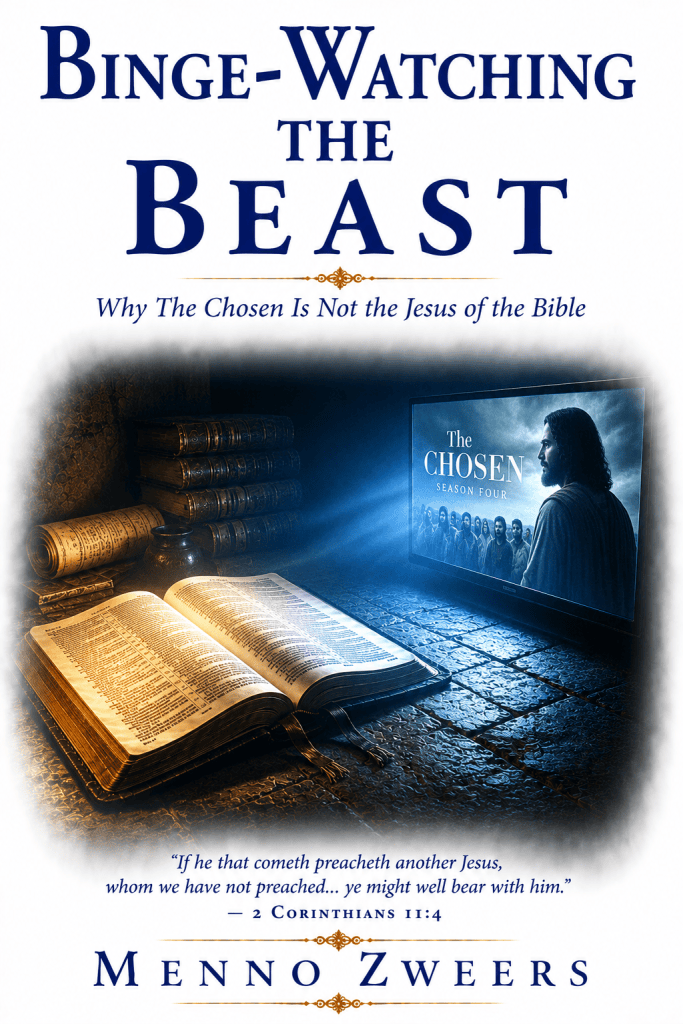
The faith once delivered is contended for on many fronts, and yesterday we saw the next one open. The network reaches the church through the conference, the song, the apostle, the prophet, and through one door quieter than any of these: the screen. The next volume in The Final Convergence Series takes up that front directly. It is called Binge-Watching the Beast — Why The Chosen Is Not the Jesus of the Bible, and it applies the exact method you have learned over these thirty days to the most successful single instrument of spiritual formation in the contemporary church: a beloved, beautifully produced, world-embraced dramatization of the life of Christ that has reshaped how millions picture Jesus, not by argument, but by image; not by doctrine, but by emotion; not by the authority of Scripture, but by the authority of a screen.
It asks the questions this series has trained you to ask, now turned toward the picture itself. Who made it, and what do they believe? What theology is embedded in the scripts? Why does the world, every denomination, and even the world’s false religions, agree on this Jesus, when the real Jesus divided men? And most critically of all, the one question on which everything turns: is the Jesus of The Chosen, produced by Dallas Jenkins, the Jesus of the Bible? It is the same Sola Scriptura standard, the same documented rigor, the same refusal to accept anything, however moving, however beloved, that does not accord with the once-delivered faith. If NAR Connections traced how the movement reaches the church through its leaders, Binge-Watching the Beast traces how it reaches the believer through the picture on the screen, and calls the church, one more time, back to the one safeguard that has never failed: the Word of God, written, sufficient, and alive.
Know Who Is Leading You
So we end where we began, with the words on the cover of my book, because they were always the whole point: know who is leading you. Know whose songs you sing, whose books you trust, whose voice you follow, whose hands were laid on the man in your pulpit, whose theology is poured into your children with every repeated chorus, and, now, whose picture of Jesus is settling into your imagination with every hour of beautiful, immersive story. Do not follow a voice, or an image, merely because it is beautiful, or because the crowd follows it, or because the one who offers it is gracious and beloved. Follow the voice that speaks according to the Word, and no other.
Thank you for walking these thirty days. Thank you for testing every one of them against the Scripture, as the Bereans tested even Paul, for that testing was the whole aim, and if you have learned to do it, the campaign has done its work. The movement is vast, and the web is real, and the blur is nearly complete. But the faith was once delivered, whole and sufficient, and it has never needed a supplement, a fresh word, or a further encounter. It needs only to be contended for, earnestly, and in love, by a church that has recovered the courage to know the Shepherd’s voice from the stranger’s, and to follow it home. Earnestly contend for the faith once delivered. Guard the good deposit. And keep yourselves in the love of God.
To Him be the glory. Amen.
“Beloved… it was needful for me to write unto you, and exhort you that ye should earnestly contend for the faith which was once delivered unto the saints.” — Jude 3 KJV
📖 This post is adapted from NAR Connections: Connecting The Dots. If it helped you, the full book is available on Amazon — or you can support this ministry directly.
📖 Now available in The Final Convergence Series: Binge-Watching the Beast — Why The Chosen Is Not the Jesus of the Bible. The investigation continues. Full book is available on Amazon.
thefinalconvergence.com | Follow on Instagram, Facebook, X, and YouTube
If you like to be updated on new blogs, sign up to our newsletter!


Leave a Reply