
Published: November 18, 2026 | thefinalconvergence.com
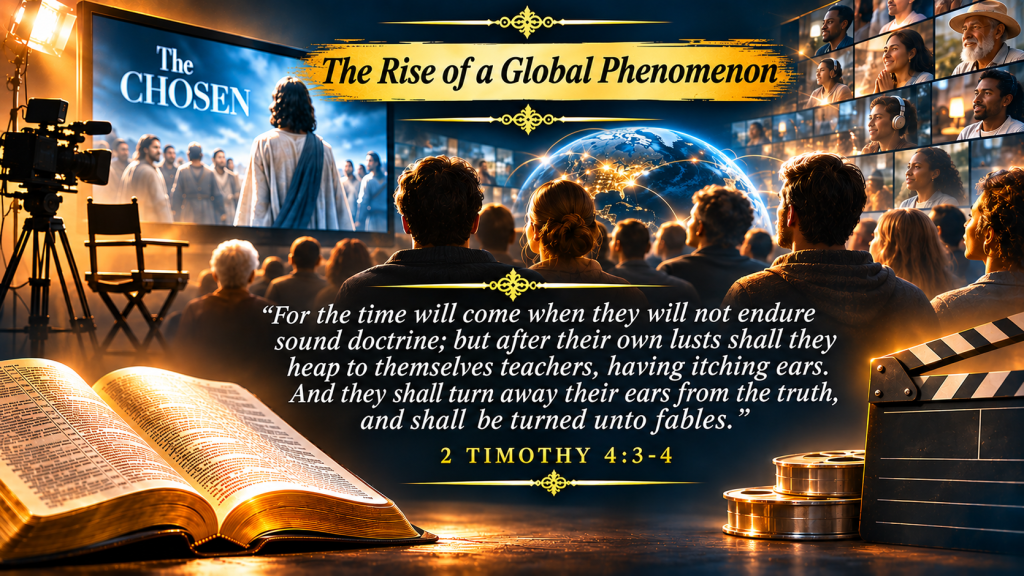
Yesterday we examined the mechanism, what a screen does to the mind that sits before it. Today we turn to the phenomenon itself, because the scale of this thing is part of the argument. The Chosen did not arrive quietly. It arrived as the most-watched depiction of Jesus Christ in the history of human media, and it got there through a route no studio had ever attempted. Understanding how it was built, and how its own creator’s careful caveat has been overrun in practice, tells us a great deal about what is actually happening in the hearts of the hundreds of millions who watch it.
“For the time will come when they will not endure sound doctrine; but after their own lusts shall they heap to themselves teachers, having itching ears. And they shall turn away their ears from the truth, and shall be turned unto fables” (2 Timothy 4:3-4, KJV).
Paul is describing a predictable drift, and the last word in the passage is the key to today’s chapter. People do not simply stop believing; they trade one thing for another. First they will not endure sound doctrine, because sound doctrine makes demands and corrects the heart. Then, having lost their appetite for it, they do not fall silent; they actively “heap to themselves teachers,” gathering voices that tell them what their “itching ears” want to hear. And the final exchange is the most precise warning in all of Scripture for the age of Christian entertainment: they “turn away their ears from the truth,” and are “turned unto fables.” The word rendered “fables” means invented stories, dramatized tales, narratives crafted by men. Paul foresaw a church that would turn from the plain truth of the Word to the warm pull of a well-told story. That is not a vague prophecy about the last days. It is a precise description of what a hundred million people are doing on their couches tonight.
It Began With a Barn
The origin is almost absurdly humble. A short nativity film, a barn, a manger scene, directed by an unknown filmmaker named Dallas Jenkins for a small Illinois church on Christmas Eve, 2017. The church posted it online. It went viral. And from that spark came a proposal no individual or studio had ever attempted: a multi-season television drama about the life of Jesus, funded not by a network or by Hollywood but by a direct appeal to ordinary people. The crowdfunding campaign raised millions. The first season launched in 2019. By 2024 the show had been viewed more than seven hundred million times, a figure that surpasses the total audience of many Hollywood blockbusters.
By any metric, it is the most-watched portrayal of Jesus Christ ever produced. And here we must say the hard thing gently but plainly: that is not, by itself, a reason to celebrate. Popularity does not equal purity. A hundred million views does not make a false Christ into the true one. The broad road has always been the crowded one; Jesus Himself said that wide is the gate and broad is the way, and many there be that go in by it. Scale is not a theological argument. It is only a measure of reach, and reach cuts both ways: the wider a thing travels, the more it matters whether what it carries is true.
“It’s Not Scripture,” and Why That Caveat Collapsed
To his credit, Dallas Jenkins says plainly, and often, that the show is “not Scripture.” He repeats it almost defensively. But a caveat is only as strong as the practice that honors it, and in practice the caveat has collapsed. Surveys and testimony from viewers reveal that a significant portion of regular watchers report that the show has changed how they picture Jesus, how they pray to Him, how they understand His personality. For many, the Jesus of The Chosen has not supplemented the Jesus of the Gospels; he has overlaid him. The show’s invented dialogue and backstories have become, functionally, canonical in the minds of millions.
This is not hypothetical. In online communities devoted to the show, fans routinely quote invented lines as though they were Scripture. They share fictional scenes as devotional moments. They say things like, “This scene helped me understand Jesus better than any sermon I have ever heard.” Churches have accelerated the confusion by folding the show into formal discipleship: episode screenings replacing Bible studies, the creator’s commentary treated with the weight of theology, the actor’s emotional performance becoming the standard by which the real Jesus is measured. Sit with that inversion, because it is the heart of the whole book. Scripture is supposed to be the measuring rod by which every portrayal of Jesus is judged. When the portrayal becomes the measuring rod by which Scripture is felt, we have turned the whole order of authority upside down. When the image judges the Word, we have entered the territory of idolatry, no matter how sincerely the caveat was spoken.
And this is exactly the “fables” of 2 Timothy 4. A dramatization is, by definition, an invented story; that is not an insult, it is simply what a dramatization is. There is nothing wrong with a well-made story in its place. But when a well-made story about Jesus shapes your theology more than the Gospels do, it has ceased to be art and become doctrine. The caveat “it’s not Scripture” cannot hold back a tide that treats it as better than Scripture, more vivid than Scripture, more moving than Scripture. The ears have turned from the truth, and been turned unto a fable; a beautiful one, scored and filmed and beloved, but a fable still.
The Ecosystem That Makes Criticism Feel Like Betrayal
There is a further reason the caveat fails to protect, and it is structural. The Chosen is not simply a show; it is a brand ecosystem engineered for total engagement. A free streaming app with tens of millions of downloads keeps viewers in daily contact. A merchandise line keeps the actor’s face, as Jesus, on clothing and in homes. Live touring events gather tens of thousands in what function as emotional pilgrimages. Tie-in Bible studies and church kits normalize the show as a legitimate discipleship resource. And a direct-giving model invites fans to fund future seasons, which quietly turns viewers into stakeholders.
That last piece is the most important, because it explains the defensiveness. When you have given money to make something, criticism of that thing feels like criticism of you. Emotional ownership produces psychological resistance to correction. This is not an accusation of conspiracy; it is simply how total institutional ecosystems work, and it mirrors the way movements make it emotionally and practically difficult for people to question or leave. The Chosen has not merely produced a popular show. It has built a community of belonging organized around a Jesus figure who exists only on a screen. To question the Jesus is to feel that you are betraying the community, and few are willing to pay that price.
The Global Stakes
Finally, the scale carries a weight that makes this urgent rather than academic. When a theologically compromised Jesus is watched by hundreds of millions, many of them in the Global South, where biblical literacy is often lower and sound theological resources are harder to find, the stakes are eternal. In nations across Africa, Latin America, and Asia, The Chosen has become, for many, their first and primary introduction to Jesus. They are not receiving it as a supplement to years of faithful preaching. They are meeting Christ through it for the first time.
And for many of them there may be no corrective. No pastor to watch alongside them and point out the invented dialogue; no teacher to follow the screening with a chapter-by-chapter study of the Gospels. The Chosen’s Jesus simply becomes the only Jesus they know; gentle, relatable, non-confrontational, and theologically incomplete. I say this with no contempt for a single one of those viewers, many of whom are sincere and hungry and precious to God. I say it because they deserve the real Christ, whole and undiminished, and the question every one of us must bring to this show is the same: does it honestly and completely present the Jesus of Scripture, or a version shaped by the beliefs, agendas, and commercial interests of those who made it? That is not a question popularity can answer. Only Scripture can. And the evidence of the chapters ahead will answer it.
Tomorrow we meet the man whose face has become, for millions, the face of Christ: the actor behind the Messiah, and the spiritual world he represents when the cameras stop.
“For the time will come when they will not endure sound doctrine… And they shall turn away their ears from the truth, and shall be turned unto fables” (2 Timothy 4:3-4, KJV).
📖 This post is adapted from Binge-Watching the Beast: Why The Chosen Is Not the Jesus of the Bible. If it helped you, the full book is available on Amazon — or you can support this ministry directly.
thefinalconvergence.com | Follow on Instagram, Facebook, X, and YouTube
If you like to be updated on new blogs, sign up to our newsletter!

