
Published: November 20, 2026 | thefinalconvergence.com
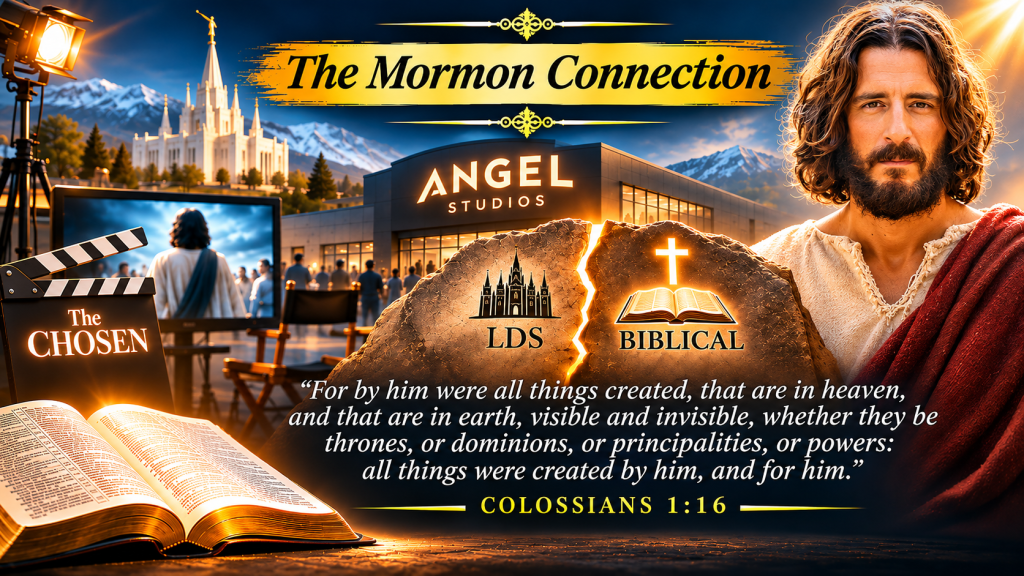
Yesterday we examined the man whose face has become the face of Christ. Today we step further back still, behind the actor, to the studio and the religious tradition that helped build this phenomenon from the ground up. This is not a rumor and not a theological insinuation; it is documented fact, traceable in corporate records, production histories, and the public statements of the show’s own creator. And it raises a question that the show’s creator has answered out loud, in words that deserve careful, unhurried examination: do Latter-day Saints and biblical Christians worship the same Jesus?
“For by him were all things created, that are in heaven, and that are in earth, visible and invisible, whether they be thrones, or dominions, or principalities, or powers: all things were created by him, and for him” (Colossians 1:16, KJV).
Before we touch a single production detail, fix this verse in place, because it settles the deepest question in the chapter. Paul says that absolutely everything that exists was created by Christ and for Christ. He piles up the categories deliberately so that nothing can slip through: things in heaven and things in earth, things visible and things invisible, every rank of the unseen world, thrones, dominions, principalities, and powers. Every angelic being that has ever existed is on the created side of that line, and Christ is on the other. He is not the eldest of the creatures; He is the Creator of the creatures. That single truth, held firmly, dismantles one of the most startling claims we will meet today. Whatever else may be said about the partnership behind The Chosen, the Jesus of Colossians 1 has no brothers among the angels. He made them all.
A Documented Partnership, Not a Rumor
The practical facts are not in serious dispute. The show’s early distribution ran through Angel Studios, co-founded by brothers Neal and Jeffrey Harmon, both practicing Latter-day Saints, based in Provo, Utah, and built within Utah’s media landscape and promoted through LDS social networks. This was not a neutral distributor that happened to carry the show; it was a values-driven enterprise shaped by its founders’ worldview. When the project needed early viewership to establish itself, the organized and highly motivated LDS community helped provide that foundation.
The first two seasons were filmed on a set in Goshen, Utah, on property owned by the LDS Church, land that had previously been used to film Mormon-produced biblical dramas. The show’s creator has confirmed this arrangement in interviews and expressed warm gratitude for the LDS community’s support. I state all of this plainly and without outrage, because partnership and gratitude are not crimes, and Latter-day Saints are not villains for making and backing a film. The significance is not the logistics. It is the theology that came through the door with them, and the claim the creator went on to make about it.
“The Same Jesus”?
The creator did not stop at practical collaboration. In a widely viewed conversation he said of his LDS friends, “The Mormons that I’ve gotten to know love the same Jesus I do, and I’m going to die on that hill.” When evangelical scholars and discernment ministries pointed out the irreconcilable differences between LDS and biblical teaching, he treated the objection as divisive rather than answering it.
I want to be fair to the warmth behind that statement. It is, on its surface, a generous instinct, and the men and women he has in mind are real people he has grown to love. But generosity cannot rewrite doctrine, and this is where sentiment and truth part ways. The question is not whether Latter-day Saints are kind, sincere, or devoted; many plainly are. The question is strictly this: when the LDS Church uses the name “Jesus,” does it mean the same person Scripture means? That is not a matter of tone or charity. It is a matter of definition, and it is answerable from published LDS sources, which is where we now turn.
What Latter-day Saint Doctrine Actually Teaches
These are not peripheral or obscure teachings; they are the core published claims of the tradition about God, Christ, salvation, and Scripture, and each one can be read in its own authoritative sources.
On God: Mormonism teaches that the Father is an exalted man who once lived as a mortal and progressed to godhood. Joseph Smith stated it directly in the King Follett Discourse of 1844: “God himself was once as we are now, and is an exalted man.” Scripture answers that God is “from everlasting to everlasting” (Psalm 90:2), that He is Spirit (John 4:24), and that before Him no god was formed, nor shall be after Him (Isaiah 43:10).
On Jesus: Mormonism teaches that Christ is the firstborn spirit child of Heavenly Father, and that His spirit brother, born into the same spiritual family, is Lucifer. The LDS theologian Bruce R. McConkie wrote in Mormon Doctrine that “Christ and Lucifer are brothers.” Here is where our anchor speaks with finality. The biblical Christ is the eternal Word who was God before the world began (John 1:1-2), and “by him were all things created… visible and invisible” (Colossians 1:16). Lucifer is a creature. Christ is his Maker. They are not brothers; they are Creator and created, and no warmth of feeling can collapse that distance.
On salvation: Mormonism teaches a tiered system whose highest aim is to become gods, presiding over one’s own world. Scripture declares salvation “by grace… through faith; and that not of yourselves” (Ephesians 2:8-9). There is no godhood to attain; there is only the mercy of Christ, and eternal life as a child of God forever dependent on the Savior, never as a god.
On Scripture: Mormonism teaches that the Bible is reliable only “as far as it is translated correctly” (Eighth Article of Faith) and must be supplemented by later revelations given through Joseph Smith. This is the same lie that runs beneath this entire series in a new costume: that the Bible, by itself, is not enough.
Read side by side, these are not two dialects of one faith. They are two different accounts of God, of Christ, of how a sinner is saved. The name is shared. The person is not.
Why a Doctrine-Neutral Jesus Serves the Purpose
Now the uncomfortable logic comes into focus. Why would LDS producers and promoters be so enthusiastic about this particular show? The answer lies in what the show does not do. It does not preach grace alone through faith alone. It does not press the exclusivity of Christ in a way that would confront an LDS viewer. It offers a warm, relatable, emotionally compelling Jesus who is essentially doctrine-neutral, a figure who can be inhabited by almost any theological framework a viewer already holds, or is about to be offered.
That is precisely what makes it so useful as a bridge. It introduces a generic, non-specific Jesus to whom distinctly Mormon content can later be attached in evangelistic conversation; LDS missionaries have been documented using the Chosen app as exactly such a shared entry point. The show does the emotional groundwork. The missionaries supply the doctrine. A Jesus with no clear teaching of His own is not a safe Jesus; he is an empty vessel, and someone will always step forward to fill him.
The Stakes, and the Charity This Requires
Let me close with the same care I have tried to keep throughout. None of this is contempt for Latter-day Saints, who are our neighbors, often our friends, and sincere in their devotion. It is not a call to coldness toward a single one of them. It is the opposite: it is love refusing to lie about the thing that matters most. To tell millions that the difference does not matter is not kindness; it undoes the labor of the Reformation, empties the courage of the martyrs who died over precisely these questions, and leaves eternal souls comforted by a sameness that is not real. The most loving thing truth can do is name the difference clearly, so that the real Christ, the uncreated Creator of Colossians 1, can be known and trusted as He actually is.
Tomorrow we move from the studio to the storyteller, and examine the theology of the man who writes and shapes this Jesus: the gospel according to Dallas Jenkins.
“For by him were all things created, that are in heaven, and that are in earth, visible and invisible… all things were created by him, and for him” (Colossians 1:16, KJV).
📖 This post is adapted from Binge-Watching the Beast: Why The Chosen Is Not the Jesus of the Bible. If it helped you, the full book is available on Amazon — or you can support this ministry directly.
thefinalconvergence.com | Follow on Instagram, Facebook, X, and YouTube
If you like to be updated on new blogs, sign up to our newsletter!
thefinalconvergence.com | @tfconvergence on Instagram, Facebook, X, YouTube, and TikTok

