
Published: November 21, 2026 | thefinalconvergence.com
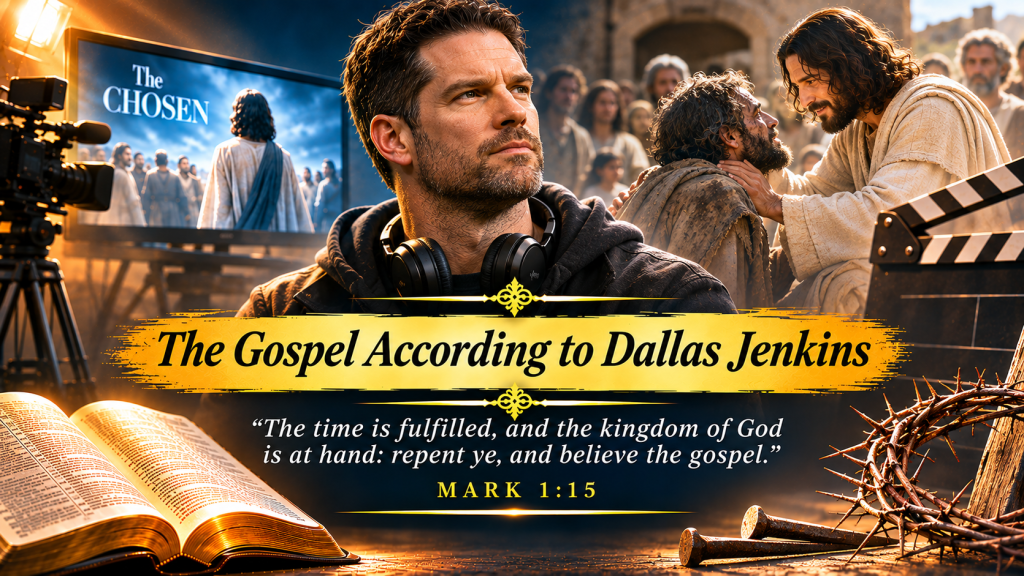
Yesterday we examined the studio behind the show. Today we turn to the storyteller, and to a quiet truth that every honest writer knows: every story carries a theology, whether its maker intends it or not. The stories we tell about Jesus reveal what we believe about sin, salvation, repentance, and the nature of God. So the fair question is not what Dallas Jenkins says his show proclaims; it is what the show’s content, his public statements, and his partnerships actually proclaim when you watch them closely. And when you do, a particular gospel comes into focus, one that is warm, welcoming, and missing the very word Jesus spoke first.
“The time is fulfilled, and the kingdom of God is at hand: repent ye, and believe the gospel” (Mark 1:15, KJV).
Mark records the opening of Jesus’ public ministry, and the first imperative off His lips is not “come,” not “belong,” not “be healed.” It is “repent.” Weigh how deliberately Mark frames it. The time is fulfilled; the kingdom has arrived; and the doorway into it is a turning. Repentance here is not one theme among many, and it is not a harsh add-on to an otherwise gentle message. It is the ground the gospel stands on. “Repent ye, and believe” are not two separate offers; they are one motion, because you cannot truly believe the gospel without turning from what the gospel exposes. Hold that word in mind, because the gospel we will examine today has quietly set it down.
A Jesus Who Rarely Says “Repent”
Watch the show across its seasons and perform a simple test: count how often repentance is clearly, unmistakably called for. The honest answer is that it happens rarely, and when it does, it passes briefly and gently. The screen’s Jesus is overwhelmingly a Jesus of healing, inclusion, understanding, and relationship. Let me say plainly that these are real and beautiful parts of His ministry; He did heal, He did welcome, He did understand. The problem is not that these things are present. The problem is that they have become the whole picture, and the rest has been quietly cropped out of frame.
For the Jesus of Scripture combined compassion with confrontation, welcome with warning, healing with a command. To the woman spared from stoning He showed tender mercy, and then He said, “go, and sin no more” (John 8:11). The mercy and the command were one act of love. A portrayal that keeps the mercy and omits the command has not simplified Jesus; it has edited Him, and the edit changes who He is.
Inclusion Without Transformation
The dominant emotional note of the show is belonging. The outcast, the broken, the misunderstood find in Jesus’ community a place of acceptance. There is a true gospel thread here, and I will not pretend otherwise; Jesus genuinely welcomed sinners, and that welcome is grace. But Scripture is equally clear about what happened after the welcome. Zacchaeus gave back fourfold what he had taken (Luke 19:8). Matthew rose and left his tax table. Mary left her former life entirely. The welcome was the beginning of a transformation, not the end of the story.
That is exactly where the show’s arc tends to stop: at the warmth. The belonging is dwelt upon; the cost of discipleship, the dying to self, the taking up of the cross, is largely absent. Yet Jesus made that cost explicit: “If any man will come after me, let him deny himself, and take up his cross, and follow me” (Matthew 16:24). When a story keeps the embrace and drops the cross, it produces something subtly dangerous: viewers who feel deeply close to a Jesus who has never once challenged them, members of a community that has never asked them to change. That is a gospel that soothes. It is not a gospel that saves.
The Hill That Is Not Calvary
In a widely circulated interview Jenkins explained his approach: “We’re not trying to preach a particular denomination’s theology. We’re trying to show the humanity of Jesus and let people connect with Him.” I take him at his word, and I believe he means it sincerely. But that single choice, humanity over theology, connection over fidelity, has consequences that are not neutral, and it quietly sets the terms for everything the show can and cannot say.
Consider what ecumenical breadth actually requires once you commit to offending no partner. To keep Mormon producers comfortable, you cannot portray a Jesus who plainly declares His own eternal, uncreated nature, the great “Before Abraham was, I am” of John 8:58, or the glory He shared with the Father before the world existed (John 17:5), because that self-existence contradicts the teaching that He is a created being. To keep sacramental viewers content, you cannot press salvation by faith alone in a way that confronts them. To keep every charismatic viewer in their seat, you cannot show a Jesus who tests experience against Scripture rather than validating it. The accumulated result is a Jesus who can be all things to all men, not in Paul’s sense of carrying the unchanged gospel to every audience, but in the opposite sense of changing the gospel to fit each one. A Jesus who offends no denomination is a Jesus who saves none, because the offense of the cross is not a flaw to be smoothed away. It is the very mechanism of redemption.
What Is Left Out Is the Gospel
Here is the hardest point, and it must be said precisely. A gospel that leaves out repentance is not a smaller gospel; it is a different one. Paul defined the gospel by its specific content: “that Christ died for our sins according to the scriptures; and that he was buried, and that he rose again the third day” (1 Corinthians 15:3-4). Died for our sins. Minimize that single phrase and the gospel itself is altered.
The show does tend to minimize the “for sins” dimension. Sin is present, but largely as backdrop, as personal struggle, as psychological pain, rather than as the fundamental offense against a holy God that demands both atonement and repentance. The cross is coming in the narrative, but it is framed mostly in terms of emotional sacrifice and relational anguish rather than substitutionary payment for the guilt of sinners. That is not an artistic interpretation of the gospel. It is a theological revision of it, and it leaves viewers in warm fellowship with a Jesus who has never told them the most important thing He came to say: “except ye repent, ye shall all likewise perish” (Luke 13:3).
The Charity This Requires
Let me guard the tone, as I have tried to all along. I do not doubt that Dallas Jenkins loves Jesus as he understands Him, nor that countless viewers have felt real comfort through this show. The welcome it portrays is not fabricated; Jesus truly is that welcoming. The concern is not that the show says something false so much as that it stops saying, right before the word that matters most. And a half-gospel is the most disarming kind, because it is true enough to be trusted and incomplete enough to mislead. The loving thing is not to despise the show or the people who love it, but to finish the sentence it leaves unfinished, and to point every warmed heart on toward the Jesus who still says, first and tenderly and unavoidably, “repent, and believe the gospel.”
Tomorrow we cross into Part Two of our investigation, the Jesus on screen himself, beginning with the mystical currents that run quietly beneath the production.
“The time is fulfilled, and the kingdom of God is at hand: repent ye, and believe the gospel” (Mark 1:15, KJV).
📖 This post is adapted from Binge-Watching the Beast: Why The Chosen Is Not the Jesus of the Bible. If it helped you, the full book is available on Amazon — or you can support this ministry directly.
thefinalconvergence.com | Follow on Instagram, Facebook, X, and YouTube
If you like to be updated on new blogs, sign up to our newsletter!
thefinalconvergence.com | @tfconvergence on Instagram, Facebook, X, YouTube, and TikTok

