
Published: November 19, 2026 | thefinalconvergence.com
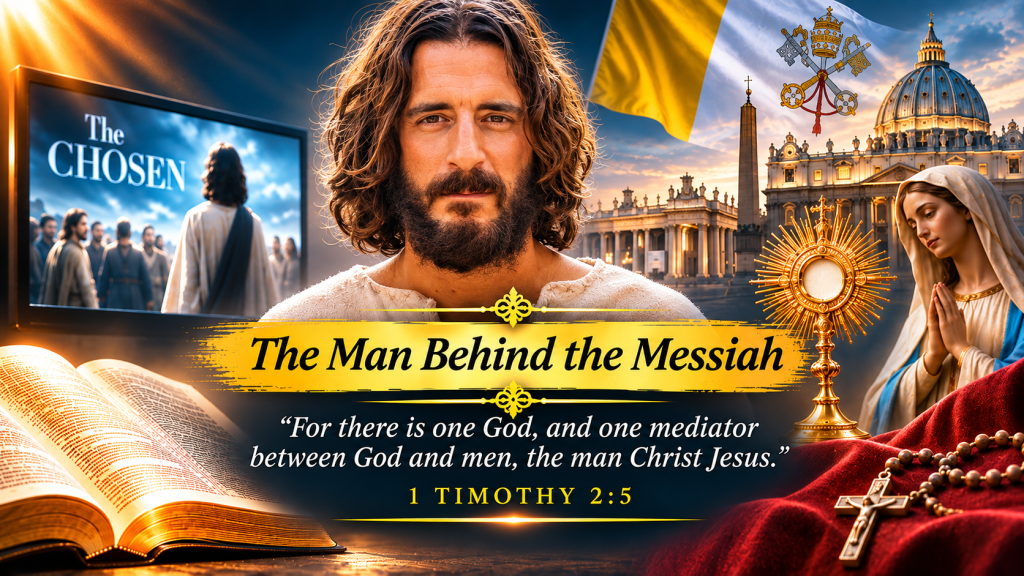
Yesterday we saw how a dramatization quietly became doctrine in the minds of millions. Today we ask a question that follows naturally from it: if hundreds of millions of people now picture Jesus as a particular face, a particular voice, a particular manner, then whose face is it? Who is the man behind the Messiah, and what does he actually believe about the Christ he portrays? This is not idle curiosity. When one man’s performance becomes the mental image of Jesus for a generation, his own convictions about God, salvation, and mediation are no longer a private matter. They are part of what the world is absorbing.
“For there is one God, and one mediator between God and men, the man Christ Jesus” (1 Timothy 2:5, KJV).
This short verse carries the whole weight of today’s chapter, so weigh each phrase. “One God,” against every rival claim. “One mediator,” not many; not a hierarchy of intercessors, not a mother who distributes grace, not a priesthood that re-administers the sacrifice, not a wafer lifted up for worship. One. And then Paul names Him with deliberate precision: “the man Christ Jesus.” The single bridge between a holy God and sinful men is the incarnate Son, and Him alone. Everything that adds a second mediator, however reverent, however beloved, however ancient, does not supplement this verse; it contradicts it. Hold that standard, because the man whose face has become the face of Christ for a generation is a sincere and public servant of a system that teaches a different answer to the question this verse settles.
The Face Became the Man
Jonathan Roumie is not simply an actor who happens to play Jesus. By his own repeated public testimony, he regards the role as a spiritual vocation, a calling he believes God gave him, and his off-screen ministry as an extension of that calling. That is an important admission, because it means he himself refuses to separate his theology from his portrayal. We should take him at his word. His influence off the screen now rivals his influence on it; he leads public prayer events online, attended by hundreds of thousands, and his following numbers in the millions. For a vast audience, his is now the definitive face of Jesus, and his is a voice they trust on spiritual matters generally, not only when the cameras are rolling.
So the ordinary journalistic question is fair, and it is not unkind: who is this man, and what does he believe? Character and commitment are evidence. They tell us what spirit a thing is born from and what it serves. This chapter is not an attack on Roumie as a person; by every account he is sincere, devout, and warm. It is an examination of publicly stated beliefs that he himself has chosen to make public, and that bear directly on the Jesus a generation is receiving through him.
A Devout Catholic, Openly and Gladly
Roumie does not conceal his Roman Catholicism; he celebrates it, publicly and enthusiastically, and that candor is to his credit. He hosts and promotes Rosary prayer events built on repetitive Marian prayer and the intercession of the Virgin. He promotes Eucharistic adoration, the veneration of the consecrated host as the literal body, blood, soul, and divinity of Christ; in 2023 he walked in a Eucharistic procession behind the monstrance at the March for Life. He is a prominent promoter of the Divine Mercy devotion, with its graces tied to an image and a chaplet. He has urged his followers toward Marian consecration, dedicating themselves to the Immaculate Heart of Mary.
None of this is hidden, and none of it is in dispute; it is his own public witness. And every item on that list runs directly into the verse that anchors this chapter. The Rosary and Marian consecration place a second mediator beside the one mediator of 1 Timothy 2:5. Eucharistic adoration directs worship toward an object. These are not stylistic preferences or cultural flavor. They are a specific theology of how grace reaches a sinner, and it is a theology Scripture does not teach.
Rome’s Jesus and Scripture’s Jesus Are Not the Same Jesus
This is the heart of the matter, and it must be said plainly but without malice. The gospel Rome confesses and the gospel Scripture proclaims diverge at the points that matter most for salvation.
Rome teaches that grace is ordinarily dispensed through seven sacraments; Scripture declares salvation by grace through faith, “not of works, lest any man should boast” (Ephesians 2:8-9). Rome teaches that the Mass re-presents the sacrifice of Christ, truly offering Him to the Father again and again; Scripture declares that He was offered “once for all,” that “by one offering he hath perfected for ever them that are sanctified” (Hebrews 10:10-14). The cross was not a recurring event; it was finished. Rome teaches that Mary is the Mediatrix of all grace; Scripture names exactly one mediator, “the man Christ Jesus.” One gospel ends at a cross where the Lamb said, “It is finished.” The other continues at an altar where the sacrifice never ends. These are not two accents of one faith. They are two different answers to the only question that finally matters.
That is why the identity of the man behind the Messiah is not trivial. When the most influential portrayal of Jesus in human history is embodied by a sincere and formal representative of a gospel that Scripture refutes at these exact points, the warmth of the performance does not neutralize the theology beneath it. It carries it. The face teaches even when the script is silent.
The Honors, Reported Plainly
The book documents more, and I will report it carefully rather than sensationally. Roumie has been associated with Vatican and Catholic institutional orders, including the Order of the Holy Sepulchre, a papal chivalric order, and the Knights of Columbus. And in his own words, on his own channel, wearing the insignia, he has described being knighted some years ago into the modern Sovereign Military Order of the Temple of Jerusalem, which claims the legacy of the medieval Knights Templar. That is his own cheerful, public testimony, not an accusation from a hostile source.
Here I will be as fair as the book itself is at this point: joining an order that claims the Templar legacy does not make a man a Freemason, an occultist, or anything of the kind, and I will not pretend otherwise. The author says as much directly. What the pattern does show, without any need to speculate about secret motives, is a life systematically and formally woven into overlapping institutional allegiances, all of them centered on Rome and its authority. Three orders, three sets of oaths, three loyalties beyond simple personal piety. You do not need a conspiracy to see the plain significance of that. The man whose face is the world’s Jesus has sworn his formal allegiance to a system whose gospel is not the gospel of the Book.
Why This Matters, and What It Does Not Mean
Let me guard this carefully, because it is easy to hear as cruelty, and it is not meant as cruelty. This is not a claim that Jonathan Roumie is a wicked man, or insincere, or consciously deceptive. It is not a license to despise Catholics, many of whom love Christ as they understand Him. It is simply the recognition that the question this whole series serves, “which Jesus?”, now has a human face attached to it, and that face belongs to a man who publicly serves a different answer than Scripture gives. You cannot separate the portrayal from the theology when the portrayer himself refuses to separate them.
So the application is not suspicion of a person; it is the recovery of a standard. Measure the Jesus on the screen, and the Jesus behind every tender performance, against the Jesus of the written Word. Let 1 Timothy 2:5 do its work. If there is one mediator, then any Jesus who shares the office with another is not the Jesus of the Bible, however beautifully he is played.
Tomorrow we go one layer deeper, behind the actor to the studio itself, and to the religious tradition that helped build this phenomenon from the ground up.
“For there is one God, and one mediator between God and men, the man Christ Jesus” (1 Timothy 2:5, KJV).
📖 This post is adapted from Binge-Watching the Beast: Why The Chosen Is Not the Jesus of the Bible. If it helped you, the full book is available on Amazon — or you can support this ministry directly.
thefinalconvergence.com | Follow on Instagram, Facebook, X, and YouTube
If you like to be updated on new blogs, sign up to our newsletter!
thefinalconvergence.com | @tfconvergence on Instagram, Facebook, X, YouTube, and TikTok

