
Published: November 17, 2026 | thefinalconvergence.com
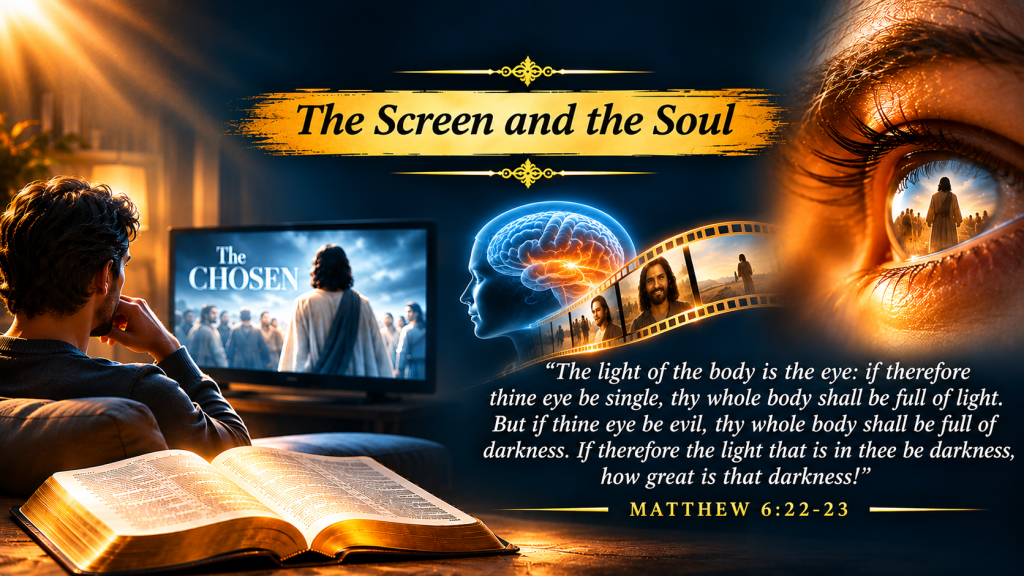
Yesterday we met the thesis: that The Chosen offers another Jesus, a counterfeit so warm and beautiful that the heart embraces it before the mind is ever asked to test it. But before we examine what the show teaches, we have to understand something more basic, and more unsettling. We have to understand what a screen does to the person who sits before it. Because the danger of this show is not only in its content. It is in its delivery. A false idea in a book can be weighed, argued with, and set down. A false image absorbed through a glowing screen, scored with music, in a state of relaxed attention, is not weighed at all. It is simply received. And what is received that way does not stay in the mind as information. It settles into the heart as formation.
“The light of the body is the eye: if therefore thine eye be single, thy whole body shall be full of light. But if thine eye be evil, thy whole body shall be full of darkness. If therefore the light that is in thee be darkness, how great is that darkness!” (Matthew 6:22-23, KJV).
The Lord Jesus is teaching that the eye is a gateway. What a man takes in through his eye does not stay at the eye; it fills the whole body, with light or with darkness. The eye that is “single,” fixed on what is true, floods the whole person with light. But the eye drawn to what is false fills the whole body with darkness. And then He adds the most sobering line in the passage, the one that should make every modern Christian stop: “If therefore the light that is in thee be darkness, how great is that darkness.” There is a darkness that comes disguised as light; a false radiance that feels like illumination while it is actually blinding you. That is the exact danger of a beautiful counterfeit Christ. It enters through the eye, it feels like light, and it fills the whole person with a darkness so convincing that the viewer calls it an encounter with God. Guard the gateway, Jesus says, because everything downstream of the eye depends on it.
The Thirty-Second Shift
Consider, first, a fact about the technology itself that most believers have never been told. Researchers in media psychology have long documented that within roughly thirty seconds of a screen being activated, the viewer’s brain shifts out of the alert, critically engaged state of normal waking attention into a slower, relaxed, passively receptive state. Extended viewing can carry the mind further still, into the state of highest suggestibility, in which new beliefs are formed most easily and with the least conscious evaluation. This is not a fringe claim; it is one of the most robustly replicated findings in the field.
The implication is profound. The emotional response to the show’s Jesus is not happening in the part of the brain that asks, “Is this the Jesus of Scripture?” It is happening in the part that forms emotional memory, that builds attachment, that generates the felt sense of intimacy and presence. In other words, the very faculty Scripture commands us to use, the faculty that tests the spirits and searches the Scriptures to see whether these things are so, has been quietly switched off by the medium itself before the content ever arrives. You are not evaluating the show. You are being shaped by it.
Formation, Not Information
This is why I keep drawing the distinction between information and formation, because it is the hinge of the whole matter. A sermon offers you information; you hear a claim, you weigh it, you accept or reject it. But a screen, engaged in that relaxed and receptive state, offers you formation; it does not argue, it molds. You do not come away from The Chosen thinking differently about Jesus. You come away feeling differently about Him. And a feeling, unlike a claim, is almost impossible to fact-check after the fact, because it did not arrive as a proposition you could examine. It arrived as an experience you simply absorbed.
The modern streaming model makes this worse by design. Autoplay removes the pause between episodes; narrative momentum pulls you forward before reflection can occur; investment in the characters creates a psychological resistance to analyzing them. By the time a believer has binged a full season, he has spent more hours with the show’s Jesus than he has spent reading the four Gospels combined. And the Gospels, on a page, cannot compete on those terms. They have no soundtrack, no cinematography, no swelling strings and filtered light framing every encounter with Christ. For a generation formed on screens, the show’s Jesus is simply more vivid, more present, and more emotionally compelling than the written text. That is precisely the danger. “Faith cometh by hearing, and hearing by the word of God” (Romans 10:17); not by seeing a dramatization of it. The power of the gospel is in the truth it contains, not the feelings it produces.
The Altar in the Living Room
Now consider the architecture of the room itself, because Scripture gives us a category for what has happened there. For most of human history the furniture of a home faced the hearth, the fire, the gathering point of the family. In the last century, that orientation quietly shifted. The furniture was turned to face the screen. And in the language of the Old Testament, an altar is simply the place toward which a household orients itself in worship; the fixed point where attention and devotion are directed, where the exchange between the human and the transcendent is meant to occur.
Read in that light, a sobering truth comes into focus. Every home that has organized its seating around a glowing screen has, in the most literal architectural sense, an altar in its living room. And The Chosen is being delivered, night after night, to the worshipper who sits before it. This is the inversion the whole book is written to expose. Scripture is meant to be the measuring rod by which every portrayal of Jesus is judged. But when a believer evaluates the real Jesus by whether He matches the emotional resonance of a television performance, the image has begun to judge the Word. When the image judges the Word, we have entered the territory of idolatry, however sincere the worshipper, however beautiful the screen.
The Answer Is Not Fear of Pictures. It Is a Single Eye.
Let me be clear about what this chapter is not saying, because the point is easily mistaken. This is not a call to fear all images, to smash your television, or to treat every screen as the devil’s work. The problem is not that images exist; the problem is what we do with them, and what we let them do to us. The warning of Matthew 6 is not “have no eye.” It is “let thine eye be single.” The remedy for an eye drawn to a counterfeit is not blindness; it is an eye fixed so firmly on the true light of the Word that the counterfeit, however lovely, can no longer pass for the original.
That is the recoverable discipline this series keeps pressing. A believer saturated in the Gospels, who knows the real Christ from the page before he ever meets a portrayal of Him on a screen, watches with his critical faculty intact. He can enjoy a well-made film and still refuse to let it overwrite his Bible. He receives the image as what it is, a man’s interpretation, and never mistakes it for the thing itself. But a believer who meets Jesus first and mostly through the screen has no such defense, because the counterfeit arrived before the original, and the formation happened before the testing could begin. The safeguard, now as always, is the sufficiency of the written Word, held up before the eye until the eye is single, and the whole body is full of light.
Tomorrow we turn from the mechanism to the phenomenon itself: how a short nativity film made for one small church on a Christmas Eve became the most-watched depiction of Jesus in human history, and why its own creator’s insistence that it is “not Scripture” has not stopped millions from treating it exactly as if it were.
“The light of the body is the eye: if therefore thine eye be single, thy whole body shall be full of light. But if thine eye be evil, thy whole body shall be full of darkness. If therefore the light that is in thee be darkness, how great is that darkness!” (Matthew 6:22-23, KJV).
📖 This post is adapted from Binge-Watching the Beast: Why The Chosen Is Not the Jesus of the Bible. If it helped you, the full book is available on Amazon — or you can support this ministry directly.
thefinalconvergence.com | Follow on Instagram, Facebook, X, and YouTube
If you like to be updated on new blogs, sign up to our newsletter!

