
Published: June 20, 2026 | thefinalconvergence.com
I did not come to the charismatic world as an adult seeker. I was born into it. Not metaphorically. The framework within which I first understood what Christianity was, what God was, what the Spirit’s work looked like, and how divine truth was accessed and confirmed, all of it was formed by communities that operated within the broad stream of charismatic and NAR-influenced Christianity before I was old enough to have chosen anything for myself.
This matters for the question this series is asking — why do you believe the Bible? — because the answer to that question for most believers has been shaped by the communities that formed them before they were capable of critically examining those communities. The charismatic movement has a specific and profoundly important answer to the question of biblical authority. And it is an answer that I absorbed before I had the tools to evaluate it.
Understanding that answer, and understanding why it is inadequate, is where the testimony begins.
What the Charismatic World Believes About the Bible
The charismatic and NAR traditions do not deny the Bible’s authority. They affirm it, loudly, consistently, and with genuine conviction. Scripture is honored. Quoted. Preached. Memorized. The Bible is described as the Word of God. But alongside that formal affirmation runs a structural assumption that fundamentally alters the nature of the authority being claimed.
The assumption is this: that the Spirit who inspired the Bible continues to speak with equivalent authority through contemporary prophets, apostles, and Spirit-anointed leaders, and that the interpretation of the written Word requires the guidance of these living voices to be fully understood and correctly applied.
This assumption is rarely stated as bluntly as I have just stated it. It is embedded in the culture rather than declared in a doctrinal statement. It shows up in the way prophetic words are received, with the same deference, sometimes greater deference, than biblical texts. It shows up in the way apostolic declarations function, as authoritative pronouncements about what God is doing that interpret the Scripture for the community. It shows up in the way the specific stream’s theological conclusions are assumed to represent the Spirit’s current understanding of biblical truth, and in the way departure from those conclusions is treated not as a different interpretation of the same authoritative Scripture but as a spiritual deficiency, a lack of revelation, a failure to be sufficiently Spirit-led.
In this framework, the Bible is the foundation, but the voices are the active agents of interpretation. To truly understand Scripture, you need the right voices. And the right voices are the recognized apostles and prophets of the movement.
The Communities That Formed Me
The communities I was formed by were not identical in their theology or their practice. They were diverse, Dutch Pentecostal-Charismatic-adjacent at Berea, more explicitly WoF and NAR-influenced at Living Word and The Belonging Co, softer and more experientially-driven at Substance Church. But across all of them ran the same structural assumption: that the Spirit’s active voice through recognized leaders was the interpretive guide to the written Word.
Berea Haarlem and Berea Amsterdam — The Berea communities under the leadership of figures like Rob Allart, Jan Pool, Jan-Sjoerd Pasterkamp, and Dick and Arleen Westerhof were shaped by the charismatic renewal that swept through Dutch Christianity in the late twentieth century. The culture was warm, serious about Scripture in one sense, and genuinely devoted. But the prophetic culture was present from the beginning. Directional words were received and acted on. The leadership’s spiritual authority shaped the interpretation of every biblical text that touched on the community’s direction and theology.
Lighthouse Rilland under Tineke Bouwman — A period I left due to what I can only describe as spiritual abuse, the misuse of spiritual authority to control rather than serve. I name this specifically because it illustrates the most dangerous consequence of a system in which leadership voices carry interpretive authority over Scripture: when the leadership is unaccountable, the misuse of that authority has no external check. Scripture cannot correct a leader who claims to interpret Scripture. Only a higher authority can, and in a system where the leader is the highest human interpretive authority, there is no correction mechanism.
Shelter Haarlem under Jan Pool — The same pentecostal-charismatic and prophetic culture, the same assumption of apostolic authority, the same framework in which the written Word was honored while living voices shaped its meaning.
Substance Church in Minneapolis under Peter Haas — An ARC-affiliated church that represents the softer, more culturally accessible edge of the charismatic world. The ARC (Association of Related Churches) network is less explicitly NAR but participates in the same experiential framework. The culture of expectation, that the genuine Spirit-filled community would be characterized by ongoing supernatural encounter, was present and formative.
Living Word Christian Center in Brooklyn Park under Mac Hammond — Word of Faith theology, which represents perhaps the most fully developed form of the assumption I described above. In Word of Faith teaching, the believer’s confession, the words they speak over their lives in alignment with what God has declared, carries genuine creative power. The Bible becomes not primarily a source of understanding God’s nature and the gospel but a repository of declarable promises that the Spirit-empowered believer activates through faith-filled speech. The interpretive lens through which every text is read is the Word of Faith theological framework, and departure from that framework is understood as departure from genuine faith.
The Belonging Co in Nashville under Alex and Henry Seeley — Connected to the Hillsong and Planetshakers world, The Belonging Co represents the most worship-culture-saturated version of the charismatic tradition. The Spirit’s presence was measured primarily by the atmosphere of corporate worship. The theological formation was lighter but the experiential assumption was total: that genuine Christianity was characterized by ongoing supernatural encounter, and that the community’s experience of the Spirit validated its theological direction.
What I Was Told the Bible Meant
Across all of these communities, with their significant differences in style and theological emphasis, certain interpretations of Scripture were simply assumed. Not arrived at through careful exegesis. Assumed, as the theological air the community breathed.
That tongues was the initial evidence of Spirit baptism, or at least a primary marker of genuine Spirit fullness. That healing was included in the atonement, that by his stripes we are healed (Isaiah 53:5) referred not only to spiritual redemption but to physical healing available to every believer with sufficient faith. That the gifts of apostle and prophet were being restored to the church in preparation for a final end-times harvest. That the confines of the canon were not absolute, that God continued to speak through recognized voices with the same authority as the Scripture those voices claimed to expound. That the believer’s experience of the Spirit, specifically, their emotional and physical responses in worship environments, was a reliable indicator of genuine spiritual vitality.
I did not choose these interpretations. I received them. In the way that every child receives the framework of their formation, before the critical faculty is developed, before the tools of independent evaluation are available, before the question “but what does the text actually say?” can be asked with the naivety that genuine inquiry requires.
The Problem With Receiving Without Examining
Here is the specific problem this created for my relationship with the Bible. I read the Bible through the lens of the interpretive tradition before I read the Bible itself. Every text that I encountered was pre-interpreted, pre-filtered through the theological assumptions of the community before I had access to the plain meaning of the words on the page.
When I read Acts 2, I read it as a Pentecostal narrative confirming the tongues theology I had already received. When I read Ephesians 2:20, I did not read it as a statement about the completed foundation, I read it through the apostolic restoration theology that told me the verse described the ongoing work of restored apostles. When I read 1 Corinthians 12, I read it through the assumption that tongues was the normative gift and that Paul’s rhetorical questions in verse 30 were not actually expecting negative answers.
I was not reading the Bible. I was reading the tradition’s interpretation of the Bible, and calling it the Bible. This is not unique to the charismatic and NAR world. It happens in every tradition that places an interpretive framework between the reader and the text. The Catholic who reads every biblical text through the lens of Magisterial interpretation. The confessionalist who reads every text through the Westminster Confession. The prosperity preacher who reads every text through the covenant-blessing framework.
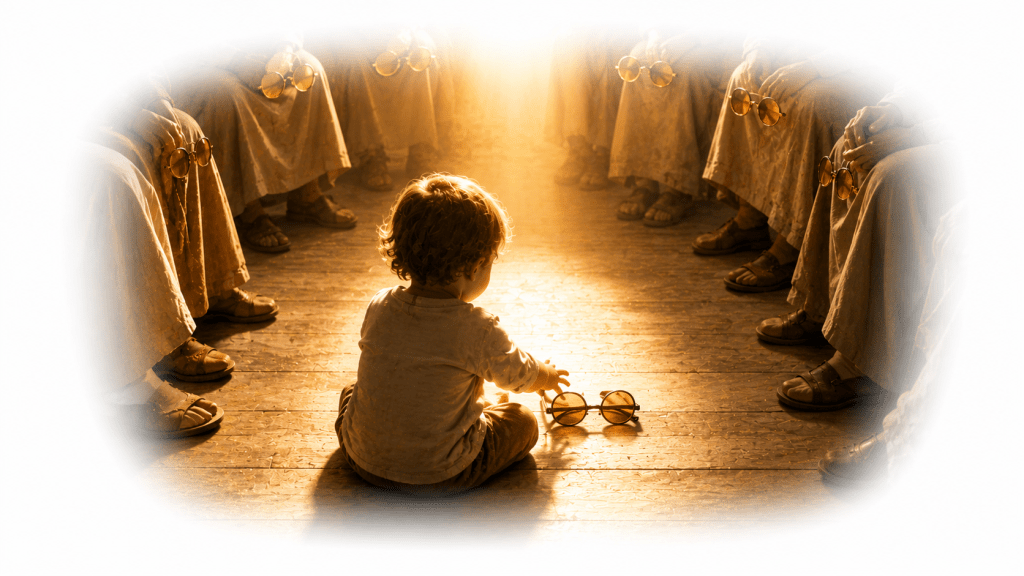
The tradition becomes the glasses through which the text is read. And the glasses are so familiar, so transparent, so much a part of how vision itself works, that the wearer does not know they have glasses on. I did not know I had glasses on. The process of finding out, and what it cost, and what it gave, is what the next three days will describe.
“Wherewithal shall a young man cleanse his way? by taking heed thereto according to thy word.” — Psalm 119:9 KJV
Tomorrow, Day 3, when the cracks began to appear.
📖 This post is adapted from Why I Believe the Bible: A Personal Defense of Sola Scriptura. If it helped you, the full book is available on Amazon — or you can support this ministry directly.
thefinalconvergence.com | Follow on Instagram, Facebook, X, and YouTube
If you like to be updated on new blogs, sign up to our newsletter!


Leave a comment