
Published: June 30, 2026 | thefinalconvergence.com
In Day 10 of this series we established the basic distinction that answers the canon argument: the Church recognized the canon, it did not create it. Recognition is not the same as creation. The measuring rod does not create the object it measures.
Today we go deeper, because the Catholic version of this argument is more sophisticated than the summary treatment Day 10 provided. It deserves its fullest and strongest form before it is answered. And when it is answered at that level, the answer is more decisive than the introductory treatment suggested. The argument in its fullest form runs like this:
You did not arrive at your canon independently. You received it from a tradition. That tradition, through councils, through the consent of the church across generations, through the guidance of the Holy Spirit working through the institutional Church, identified which books were canonical. Without the Church’s work of identification, you would have no Bible to appeal to. Therefore your appeal to the Bible against the Church’s authority is self-defeating: you are using the Church’s gift against the Church that gave it. The child cannot disown the parent who gave it life.
This is a rhetorically powerful argument. It has persuaded many. And it fails, but the failure requires careful exposure.
The Argument Assumes What It Must Prove
The first problem with the argument is that it assumes the specific ecclesiological claim that is precisely what is in dispute. The argument assumes that the Church which recognized the canon is the Roman Catholic Church as it presently exists, with its current magisterial structure, its current claims to papal infallibility, its current sacramental theology. If that assumption is granted, the argument has considerable force: the institution that produced the Bible stands over the Bible.
But the assumption is not granted. And it cannot simply be asserted. The communities that recognized the books of the New Testament were diverse, geographically scattered, organizationally varied, and in many cases quite different from the institutional Church that Rome claims to be the legitimate heir of. The churches of Alexandria, Antioch, Rome, Jerusalem, Ephesus, and Carthage were not organized under a single unified magisterial structure in the second and third centuries. The recognition of the New Testament canon was not the act of a single centralized authority but the gradual convergence of many independent communities that had been using these texts as authoritative Scripture from their reception.
To say “the Church gave you the Bible” and then identify that Church with the specific institutional claims of contemporary Roman Catholicism is to smuggle a contested historical-theological claim into what presents itself as a historical observation.
Peter Called Paul’s Letters Scripture — Before Any Council
The most decisive single piece of evidence against the “Church gave you the Bible” argument is found within the New Testament itself.
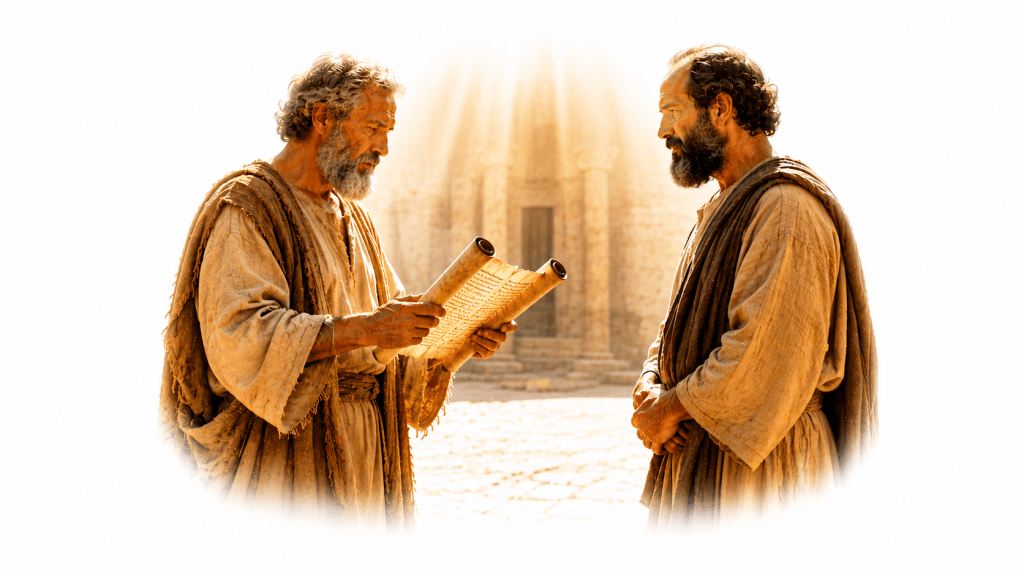
“As also in all his epistles, speaking in them of these things; in which are some things hard to be understood, which they that are unlearned and unstable wrest, as they do also the other scriptures, unto their own destruction” (2 Peter 3:16). Peter calls Paul’s epistles the other scriptures, placing them in the same category as the recognized Old Testament scriptures. He does this within the New Testament itself, within the generation of the apostles, decades before any council would formally recognize the canon.
This is not a council recognizing apostolic authority. This is apostolic authority recognizing apostolic authority. Peter does not need a later council to tell him that Paul’s letters are Scripture. He already knows. Because the authority is intrinsic, visible to those who have the Spirit and know the Scriptures, not conferred by institutional recognition.
The canon was not created by the Council of Carthage in 397 AD. It was already functioning as the recognized authority of the apostolic church before the generation that wrote it had passed away. The councils formally codified what the Spirit had already testified to across the church’s experience of the canonical books.
The Self-Referential Problem
The Catholic argument faces a devastating self-referential difficulty that it has never fully resolved.
The specific biblical texts used to establish the Catholic Church’s authority, Matthew 16:18 (“upon this rock I will build my church”), John 21:15-17 (“feed my sheep”), Ephesians 2:20 (“built upon the foundation of the apostles”), are biblical texts. They derive their authority from being in the Bible.
But if the Bible’s authority derives from the Church’s recognition, if the Church gave the Bible its authority, then the biblical texts used to establish the Church’s authority derive their authority from the Church’s authority. The argument is circular in a way that the Sola Scriptura position is not.
The Reformers noticed this. Their argument was not: we prefer the Bible to the Church. Their argument was: we are appealing to the common authority that both we and Rome acknowledge, the text, against Rome’s specific interpretive tradition. The Bible is the agreed common ground. If the Catholic argument about canon is correct, there is no common ground, the Church stands above the agreed text and the agreed text cannot be used to evaluate the Church.
That is a position Rome is willing to hold. But it is not a position that can claim to be grounded in the Bible, because the grounding of anything in the Bible requires that the Bible have authority independent of the institution claiming that grounding.
The Argument Proves Too Much
The deepest problem with the “Church gave you the Bible” argument is that it proves considerably more than its proponents intend. If institutional recognition confers canonical authority, if the Church’s act of recognizing the books is what makes them authoritative, then the following would also be true:
The books the Council of Trent formally declared canonical in 1546, including the Apocrypha, are as authoritative as the books recognized at Carthage in 397 AD. On the canon-creation argument, both councils were doing the same thing: conferring authority. The Protestant rejection of the deuterocanonical books is therefore the rejection of conciliar authority, which, on the Catholic argument, is itself conciliar authority rejecting conciliar authority.
Furthermore: if institutional recognition creates canonical authority, then a council that added to the canon tomorrow could create new Scripture. The argument has no principled stopping point. The canon-creation claim, consistently applied, produces an open canon, which is precisely what the charismatic and NAR traditions want and what Rome officially denies.
The Catholic argument wants to use institutional recognition to establish a specific and closed canon. But the logic of “the Church creates the canon” cannot be limited to one specific council’s decision. It opens the door it was intended to close.
What the History Actually Shows
The historical record, examined without the overlay of later institutional claims, shows the following:
The communities that became the church received the apostolic letters as authoritative Scripture from the moment they received them. Paul’s letter to the Galatians was read in the Galatian churches as an authoritative apostolic declaration from its first circulation. John’s Gospel was treated as canonical authority in the Johannine communities from its composition. The authority was recognized immediately, because it was intrinsic, because it was the authority of the apostle whose direct commission from the risen Christ was known.
Disputed books; Hebrews, James, Revelation, 2 Peter, 2 and 3 John, Jude, were disputed because of uncertainty about apostolic authorship, not because any council was withholding its conferral of authority. The debate was about whether the intrinsic authority was present, not about whether the council would create it.
The councils closed a debate about what was already inherently canonical. They did not confer authority on what was previously ordinary. The authority predated the recognition. The recognition identified what was already there. That is not the Catholic argument. That is the Reformation argument. And it is the argument that the historical evidence supports.
The Freedom This Gives
Understanding the self-authenticating authority of the Scripture, the authority that the text carries by virtue of its divine origin, independent of any institution’s recognition of it, gives the believer something that the canon-creation argument cannot provide. It gives the freedom to read the text. Directly. Without mandatory institutional mediation. Without the requirement that before the text can be authoritative for you, an institution must have declared it so.
The text is authoritative because God breathed it. Not because Rome recognized it. Not because the Council of Carthage listed it. Not because the Westminster Assembly included it in the Confession’s list of canonical books. By the God who breathed it. Before any council. Before any institution. Before any tradition.
And that self-authenticating authority is available to every believer who opens the Book, simple or sophisticated, institutionally connected or not, because the Spirit who inspired it is also the Spirit who illuminates it. Direct. Personal. Without a gate.
Tomorrow, Day 13, Attack #3: “Tradition Is Co-Equal With Scripture.”
“As also in all his epistles…which they that are unlearned and unstable wrest, as they do also the other scriptures.” — 2 Peter 3:16 KJV
📖 This post is adapted from Why I Believe the Bible: A Personal Defense of Sola Scriptura. If it helped you, the full book is available on Amazon — or you can support this ministry directly.
thefinalconvergence.com | Follow on Instagram, Facebook, X, and YouTube
If you like to be updated on new blogs, sign up to our newsletter!


Leave a Reply