
Published: July 1, 2026 | thefinalconvergence.com
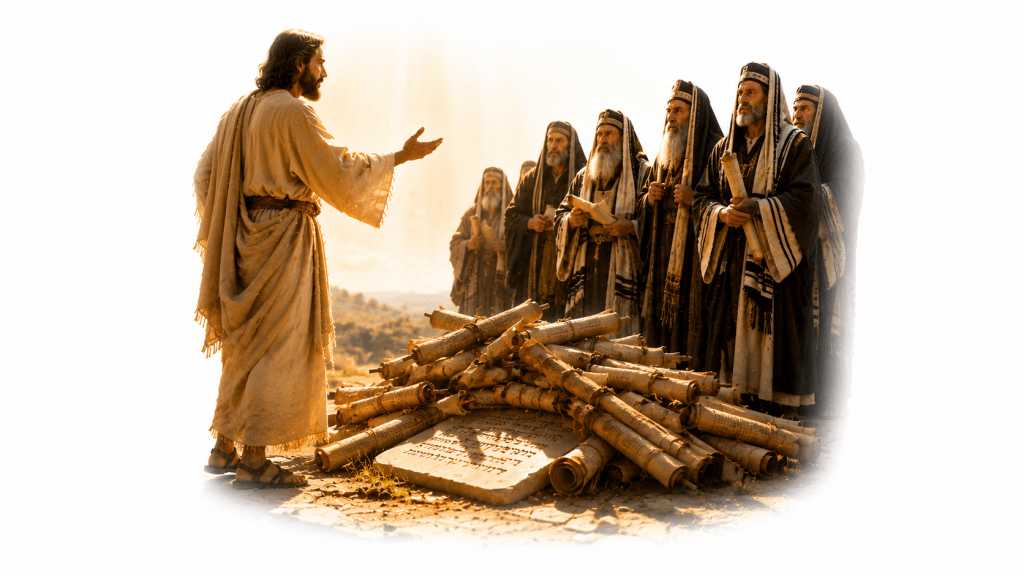
This attack comes from the same direction as the last one, but it is a different argument. Yesterday we examined the claim that the Church gave the Bible its authority. Today we examine the claim that alongside the Bible there is a co-equal source of divine revelation: the tradition of the Church.
In Roman Catholic theology, the formal position, articulated at the Council of Trent and clarified at Vatican II, is that divine revelation comes to us through two streams: Sacred Scripture and Sacred Tradition. These are not independent sources, they flow from the same divine source. But they are co-equal channels through which the deposit of apostolic faith is transmitted to the church. Scripture alone is not sufficient to convey the whole of what Christ and the apostles delivered. Tradition carries the rest.
This is not merely a Catholic position. In various forms, the tradition-as-necessary-supplement argument appears in Eastern Orthodox theology, in certain strands of Anglican theology, and, more quietly but no less significantly, in some expressions of Reformed confessionalism where the confession functions as a co-equal interpretive authority alongside Scripture even when it is not formally described as such.
We will examine both the formal Catholic version and the more subtle Protestant version. Because this is the one attack in this series where the problem is not only outside the Sola Scriptura camp but, in certain forms, inside it.
The Catholic Version at Its Strongest
The Catholic argument for Tradition as co-equal with Scripture is most precisely stated in the documents of Vatican II: “Sacred Tradition and Sacred Scripture form one sacred deposit of the word of God, committed to the Church. Holding fast to this deposit the entire holy people united with their shepherds remain always steadfast in the teaching of the Apostles.” (Dei Verbum, 10)
The argument proceeds: The apostles received from Christ, and the Holy Spirit revealed to them, more than was written down in the New Testament. The unwritten apostolic teaching, the liturgical practices, the doctrinal traditions, the interpretive frameworks, was transmitted through the living tradition of the Church under the Spirit’s guidance. Scripture and Tradition together constitute the single apostolic deposit that the Magisterium is charged with guarding and interpreting.
Therefore: to understand Christian doctrine correctly, you need both the written Word and the living Tradition. Scripture read outside the Tradition is Scripture misread. This is the formal position. It is coherent as an internal system. And it collapses for three reasons.
Jesus’s Own Verdict on Tradition as Co-Equal Authority
The most significant single piece of evidence against the tradition-as-co-equal-source argument is not a Reformation argument. It is Jesus’s own argument, addressed not to pagans but to the most tradition-respecting religious community of His time.
“Full well ye reject the commandment of God, that ye may keep your own tradition…making the word of God of none effect through your tradition, which ye have delivered: and many such like things do ye” (Mark 7:9-13). The Pharisees were not casual tradition-followers. They had elevated the oral tradition, the accumulated interpretive framework of the rabbis, claiming direct descent from Moses through an unbroken chain of authorized interpreters, to the status of co-equal authority with the written Torah. The tradition interpreted the Torah. The tradition supplemented the Torah. The tradition filled in what the Torah had left unspecified.
And Jesus said: you are making the word of God of none effect through your tradition. The specific example was the Corban ruling, a tradition that allowed a man to declare his property dedicated to God and thereby exempt himself from using it to support his elderly parents, in direct violation of the written commandment to honour father and mother. The tradition claimed equal authority with the commandment. The tradition, in this specific case, nullified the commandment.
Jesus identified this as the mechanism by which tradition consistently displaces Scripture: not by openly denying it but by claiming the authority to supplement and interpret it, until the supplement and the interpretation have displaced the original. The Pharisees had Tradition and Scripture. The tradition claimed co-equal authority. And the word of God was made of none effect.
The Problem of Identifying Authentic Tradition
The Catholic Tradition-as-co-equal argument faces a practical difficulty it has never fully resolved: how does anyone identify what constitutes genuine apostolic Tradition? The claim is that the unwritten apostolic teaching has been faithfully transmitted through the living tradition of the Church. But the Catholic Church did not formally define the Immaculate Conception of Mary as dogma until 1854. It did not formally define papal infallibility until 1870. It did not formally define the Assumption of Mary until 1950.
If these are genuinely part of the apostolic deposit, if they are part of what Christ revealed to the apostles — why did it take eighteen to nineteen centuries for the Church to formally define them? The Immaculate Conception was not universally held in the medieval period. Thomas Aquinas denied it. Duns Scotus defended it. The debate was unresolved for centuries. How is something disputed among the greatest Catholic theologians of the medieval period to be identified as part of the faithfully transmitted apostolic Tradition?
The Catholic response, Newman’s theory of doctrinal development, holds that the deposit of faith “develops” over time as the Church reflects more deeply on what it was given. Seeds of doctrine, implicit in the apostolic deposit, develop into explicit formulations over centuries.
But this is precisely the problem. Development is indistinguishable from addition. A seed that produces a plant is not the same thing as the plant being present in the seed. If the Immaculate Conception was truly implicit in the apostolic deposit, the apostolic deposit contained it in a form that its own most careful students spent centuries failing to identify. How is this distinguishable from a later addition presented as ancient tradition?
The Reformers’ question has never received a satisfying answer: show me where in the apostolic deposit, in the Scripture and in the demonstrable practices of the first-century church, the specific doctrines of purgatory, Marian intercession, and papal infallibility are actually present. Not where they can be read back after the fact. Where they are present in the apostolic deposit as given.
What Tradition Is Supposed To Do
Tradition, properly understood, has a legitimate and valuable function. It transmits the interpretation of Scripture across generations. It preserves the liturgical practices and theological formulations that the Spirit has been producing in the church’s reflection on the Word. It gives the individual believer access to twenty centuries of careful biblical exposition that prevents each generation from having to start from scratch.
The Reformers did not reject this function. Calvin’s Institutes is saturated with patristic citation. Luther read the Fathers voraciously. The Reformation confessions drew on the rich tradition of conciliar theology where it accurately reflected Scripture.
The specific Reformation objection was not to tradition’s existence but to its claim of co-equal authority with Scripture. Not to tradition’s value as a servant but to its position as a second master alongside the first. And here is where the problem goes beyond Rome.
The Subtle Protestant Version
In certain Reformed and confessional communities, and this is the claim that will be developed more fully in a later part of this series, a version of the tradition-as-co-equal problem operates more quietly but just as significantly.
The Westminster Confession of Faith, the Heidelberg Catechism, the Belgic Confession, the Three Forms of Unity, these are held in high regard within their traditions. Rightly so. They are careful, largely faithful systematizations of biblical teaching, produced by learned men who were genuinely trying to be faithful to Scripture.
But in some expressions of confessional Christianity, the confession functions as the lens through which every biblical text is read, and the confession’s reading of a text is given co-equal or effectively superior authority to the plain text itself. The person who reads Romans 9 and arrives at a conclusion that differs from the Westminster Confession’s formulation is not told: let us examine the text together and see which reading is more faithful. They are told: the confession has settled this question. Your reading is to be measured against the confession, not the confession against your reading.
This is Mark 7:13. Not in the full sense of Rome, the confession is not formally declared co-equal with Scripture. But functionally, operationally, in the lived experience of those communities, the tradition has been elevated to a position that the sufficient Word never authorized.
The test of Sola Scriptura is simple and demanding: when the confession and the plain text of Scripture conflict, which one has the final authority? If the answer is the confession, the confession is functioning as a co-equal tradition. However accurate it usually is. However careful its framers were. The Word alone. That is the standard. Every tradition, however valuable, evaluated by it.
Tomorrow, Day 14, Attack #4: “The Spirit Speaks Beyond the Canon.”
“Making the word of God of none effect through your tradition, which ye have delivered.” — Mark 7:13 KJV
📖 This post is adapted from Why I Believe the Bible: A Personal Defense of Sola Scriptura. If it helped you, the full book is available on Amazon — or you can support this ministry directly.
thefinalconvergence.com | Follow on Instagram, Facebook, X, and YouTube
If you like to be updated on new blogs, sign up to our newsletter!


Leave a Reply