
Published: July 3, 2026 | thefinalconvergence.com
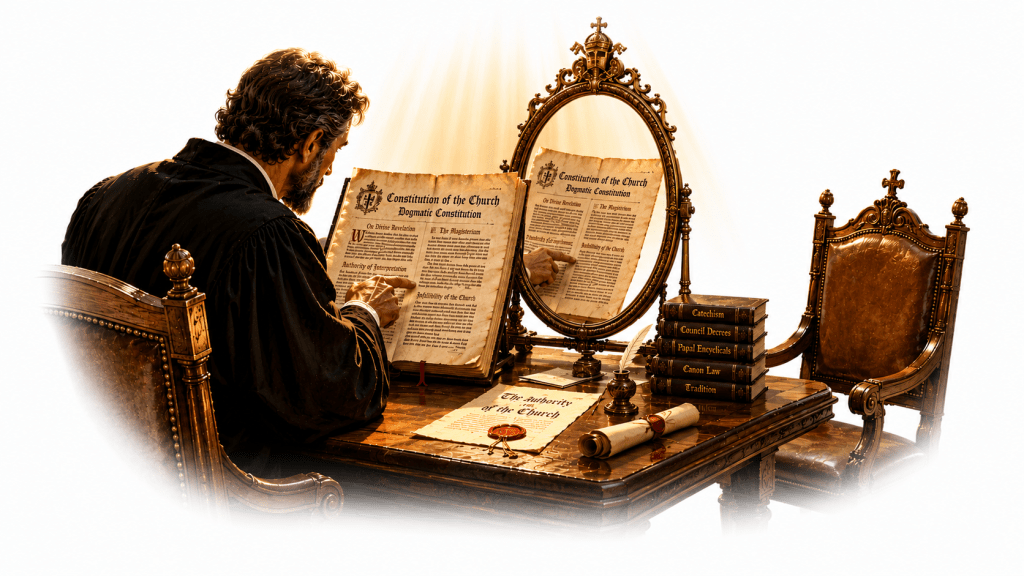
This is the cleverest objection in the series. It does not attack the Bible’s historical reliability, its textual transmission, or its claimed miracles. It attacks the logical structure of the Sola Scriptura position itself, and claims to show that Sola Scriptura is self-defeating by its own standard.
The argument, in its cleanest form: Sola Scriptura says that Scripture alone is the final authority for all matters of faith and practice. But the specific doctrine of Sola Scriptura, the claim that Scripture alone is the final authority, is not itself found in Scripture. You cannot find a verse that says “Scripture alone is the final and supreme authority for all matters of faith and practice.” Therefore, if Sola Scriptura is true, we cannot know from Scripture alone that Sola Scriptura is true. The doctrine is self-defeating, it requires something outside Scripture (the tradition, the church, the council) to establish it.
This argument has been deployed with great effectiveness by Roman Catholic apologists, Patrick Madrid’s famous “Scripture Alone” challenge, Scott Hahn’s conversion arguments, the entire apparatus of Catholic apologetics that targets evangelical converts. It sounds devastating. And it has persuaded a significant number of people who were not equipped to answer it. But the argument has three decisive problems, and identifying them turns the tables on every system that deploys it.
Problem One: Every System Has a First Principle
The self-refutation charge assumes that a self-grounding claim is a disqualifying one. But every coherent system of knowledge has a first principle that cannot be proven from within the system, because every system must stand on something, and whatever it stands on is not derivable from something further below it.
Science cannot prove by scientific method that the scientific method is reliable. The proof of the scientific method requires stepping outside science and appealing to something; reason, pragmatic success, coherentism, that science itself does not produce. Logic cannot prove by logic that logic is reliable. Mathematics cannot prove from within mathematics that mathematical axioms are true, as Gödel famously demonstrated, a sufficiently complex formal system cannot prove its own consistency. Every system has a starting point that functions as foundational precisely because it is not derivable from anything more foundational.
Sola Scriptura is not uniquely vulnerable to the self-refutation charge. Every epistemological system has its own version of the same structure. The Catholic who deploys the self-refutation argument against Sola Scriptura has a Catholic version of the same problem: why should you trust the Magisterium? Because the Magisterium tells you to. Is that self-grounding? The Catholic answer, the Magisterium was established by Christ, as shown in Matthew 16, appeals to a biblical text whose authority is, on the Catholic argument, derived from the Magisterium’s recognition. The circularity is present in every system. It is not a uniquely Protestant problem.
The question is not whether a system has a self-grounding first principle. Every system does. The question is whether the first principle is the right one, whether it is coherent, whether it is corroborated by external evidence, whether it produces the kind of knowledge it claims to produce.
Problem Two: The Bible Does Claim Authority for Itself
The self-refutation argument claims that the Bible does not assert its own ultimate authority. But this is only true if you define “Sola Scriptura” in the specific polemical phrase sola scriptura and then demand that the Bible use precisely that phrase.
The Bible makes extensive claims about its own nature and authority. It claims to be God-breathed (2 Timothy 3:16). It claims to be pure and perfect (Psalm 12:6, Psalm 19:7). It claims to stand for ever (Isaiah 40:8). It claims to be unbreakable (John 10:35). It claims to be the standard against which all prophetic claims are tested (Isaiah 8:20, Deuteronomy 18:22). It commands the testing of all teaching against Scripture (Acts 17:11, the Berean standard, itself in Scripture). It warns against adding to or taking away from its words (Revelation 22:18).
Taken together, these claims constitute a robust self-testimony to the Bible’s own supreme and final authority, not in the single sentence the Catholic apologist demands, but across the consistent testimony of the whole.
The demand for a specific proof text that says “Sola Scriptura is true” is the demand that the Bible provide a meta-statement about itself in precisely the form the critic requires. But the Bible is not a systematic theology textbook organized to pre-answer its critics’ preferred formulations. The teaching of Sola Scriptura is found across the whole of Scripture’s self-testimony.
Problem Three: The Alternative Is Not Less Self-Grounding
The self-refutation argument is typically deployed as if the Catholic alternative, the Magisterium as final interpretive authority, is not equally self-grounding. But it is. Why should you trust the Magisterium? The Catholic answer: because Christ established it, as evidenced by Matthew 16:18 (“upon this rock I will build my church”). But who interprets Matthew 16:18? The Magisterium. Who decides that Matthew 16:18 refers to Peter and the papacy rather than to Peter’s confession of faith? The Magisterium. The Magisterium interprets the text that establishes its own authority. The circularity is complete.
The Reformers’ challenge remains unanswered: if you appeal to the Magisterium to interpret Scripture, and the Magisterium appeals to Scripture to establish its authority, you have a circle. If the Magisterium’s interpretation of Matthew 16:18 is correct, the Magisterium has authority. If the Magisterium has authority, its interpretation of Matthew 16:18 is binding. No position outside the circle evaluates the circle’s validity.
At least the Sola Scriptura position appeals to a common external standard that both parties claim as authoritative, the text, and invites the examination of what the text actually says. The Magisterial position appeals to the institution’s own interpretation of the institution’s own founding document. That is not less circular than the position it accuses of self-refutation.
The Self-Authenticating Witness of the Spirit
The Reformers had a deeper answer to the self-refutation charge than the purely logical arguments above, and it is the one that carries the most weight for the genuine believer. The authority of Scripture is not established by a logical argument that Scripture is authoritative. It is recognized, through the Spirit’s direct testimony to the heart of the genuine believer, as the Word of the God who cannot lie, speaking with the authority of the one who breathed it.
Calvin called this the testimonium internum Spiritus Sancti, the internal testimony of the Holy Spirit. The Spirit who inspired the Word also witnesses, directly and personally, to the genuine believer’s heart that the Word is what it claims to be. Not as an additional revelation supplementing the Scripture. As the Spirit’s own confirmation of His own Word’s authority in the heart of the one who receives it.
This is not a logical argument from within the system. It is the Spirit’s own self-authentication of His own Word, the same Spirit who breathed out the text now bearing witness to the authority of what He breathed. The believer who has experienced this testimony knows it is not circular. It is the authority of the Author bearing witness to His own work.
“Thy word is true from the beginning: and every one of thy righteous judgments endureth for ever” (Psalm 119:160). True from the beginning. Not true because a council declared it true. Not true because an institution recognized its truthfulness. True, from the beginning, before any recognition, before any institutional endorsement.
The Practical Outcome
The self-refutation argument, when pressed, produces an absurdity. If Sola Scriptura is defeated because the specific phrase “Scripture alone is the final authority” is not in the Bible, then every doctrine that cannot be expressed in a single biblical sentence is equally defeated.
The specific Canon of 66 books is not a single biblical sentence. The specific list of popes is not a single biblical sentence. The specific doctrine of ex cathedra infallibility is not a single biblical sentence.
Either the demand for a single self-referential sentence is applied consistently, in which case it defeats every theological position including the Catholic one, or it is applied selectively, in which case it is not a logical argument but a debating tactic.
Applied consistently, the argument defeats itself. Applied selectively, it is dishonest. Either way, it does not succeed against Sola Scriptura. The Bible’s authority is intrinsic. Its self-testimony is extensive. Its authentication by the Spirit is personal and direct. And no logical demand for a self-referential proof text changes what the Spirit testifies to the heart of every person who comes honestly to the sufficient, authoritative, self-authenticating Word.
Tomorrow, Day 16, Attack #6: “The Bible Was Written by Fallible Men.”
“Thy word is true from the beginning: and every one of thy righteous judgments endureth for ever.” — Psalm 119:160 KJV
📖 This post is adapted from Why I Believe the Bible: A Personal Defense of Sola Scriptura. If it helped you, the full book is available on Amazon — or you can support this ministry directly.
thefinalconvergence.com | Follow on Instagram, Facebook, X, and YouTube
If you like to be updated on new blogs, sign up to our newsletter!


Leave a Reply