
Published: July 5, 2026 | thefinalconvergence.com
This attack comes from two very different directions, but both versions share the same foundational claim. The Roman Catholic version: the apostolic office has continued through the papacy. Peter was given the keys of the kingdom, a authority that was transmitted through apostolic succession to every subsequent Bishop of Rome. The living teaching authority of the Church, the Magisterium, is the continuation of that apostolic authority, providing the living interpretive voice the church needs to understand and apply Scripture correctly.
The New Apostolic Reformation version: God is restoring the office of apostle in these last days. The five-fold ministry of Ephesians 4:11; apostles, prophets, evangelists, pastors and teachers, was given to the church until the church comes to maturity. Since the church has not yet reached that maturity, the gifts have not ceased. God is raising up a new generation of recognized apostles who carry the governing authority the church needs for the end-times harvest.
Both versions claim that Scripture alone is insufficient without a living apostolic voice to govern its interpretation and application. Both versions claim that the plain text of the New Testament, read without apostolic mediation, is inadequate for the church’s needs. Both versions claim that something beyond the closed canon is necessary. Both are wrong. And the Bible explains why with a precision that leaves no room for either version.
Paul Identified Himself as the Last
The most significant single verse for this question is not Ephesians 2:20, though we will examine it. It is Paul’s own self-identification in 1 Corinthians 15:8-9: “And last of all he was seen of me also, as of one born out of due time. For I am the least of the apostles, that am not meet to be called an apostle, because I persecuted the church of God.” Last of all. Not penultimate. Not second-to-last. Last. Paul identifies himself as the final apostle, the last person to whom the risen Christ appeared in the specific, direct, commissioning encounter that constituted genuine apostolic appointment.
As of one born out of due time. The Greek is ektroma, an untimely birth, a premature delivery, someone born out of the normal sequence. Paul’s apostleship was anomalous, granted outside the normal pattern of the original Twelve, by the specific sovereign act of the risen Christ on the Damascus road. But it was still within the apostolic generation, still within the period of the foundational revelation that the apostolic office was given to provide.
Paul does not say: “and eventually, when the church needs it, more apostles will be raised up.” He says: last of all, he was seen of me. The apostolic witness to the resurrection, the specific, historical, commissioning encounter that the apostolic office required, ended with Paul. The NAR’s “restored apostles” are not the next chapter of what Paul ended. They are a claim that a chapter Paul marked as closed can be reopened.
The Foundation Is Laid Once
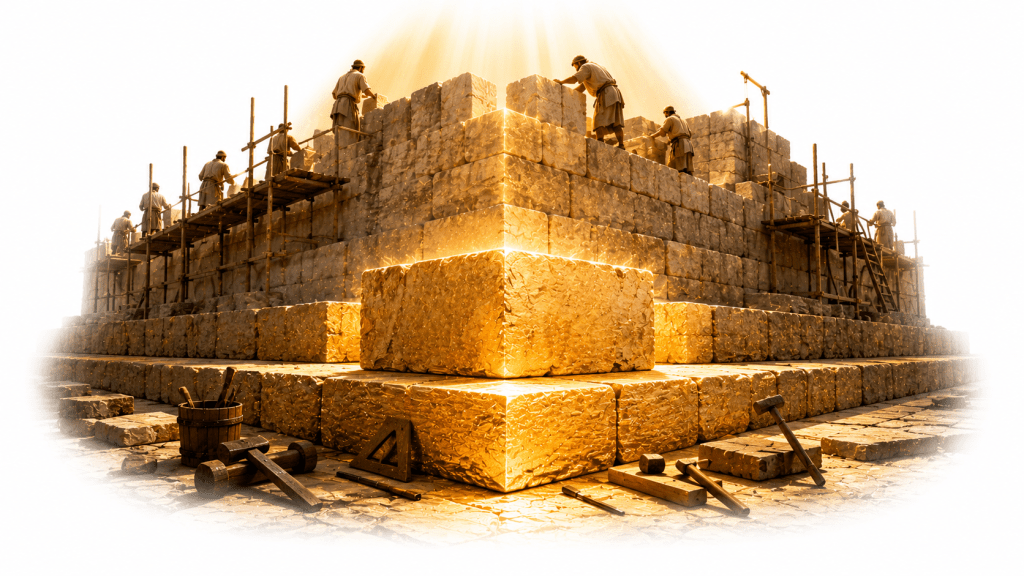
Ephesians 2:20 establishes the architectural principle that explains why the apostolic office was foundational and not continuous: “And are built upon the foundation of the apostles and prophets, Jesus Christ himself being the chief corner stone.” We have examined this verse in earlier posts of this series. But its relevance to the living-apostles argument requires specific attention here.
A foundation serves a specific and temporal function. It is laid at the beginning of a construction project, before any other work is done. It establishes the level, stable base on which everything else is built. And then the rest of the building rises upon it. The foundation does not continue to be laid as the building progresses. It is laid once, completely, and then its work is done in the sense that it now supports everything built upon it.
The apostles and prophets are the foundation of the church, not its ongoing governing structure, not its continuous interpretive voice, not its perpetual living authority. They laid the foundation through the original proclamation of the gospel, the planting of the churches, and, crucially, the production of the New Testament documents that constitute the permanent, inscripturated form of the apostolic teaching.
Once the foundation is laid, you do not need the foundation-layers to come back. You need builders who are building on what was laid. The pastors, teachers, and evangelists of Ephesians 4:11 continue the work of building on the foundation the apostles laid. They do not continue the apostolic office itself.
The Criteria Paul Himself Established
Acts 1:21-22 preserves the specific criteria that the early church, under apostolic guidance, identified for the apostolic office: “Wherefore of these men which have companied with us all the time that the Lord Jesus went in and out among us, beginning from the baptism of John, unto that same day that he was taken up from us, must one be ordained to be a witness with us of his resurrection.”
Two criteria: having companied with Jesus from John’s baptism to the ascension, and being a witness of the resurrection. No person alive today meets either criterion. Not the most gifted, most Spirit-filled, most fruitful Christian leader in the world. Not the pope. Not C. Peter Wagner. Not any recognized apostle of any NAR network. The criteria are historical and specific, tied to a specific historical period and a specific historical encounter with the risen Christ that has not recurred.
The Catholic response, that Peter’s authority was transmitted through apostolic succession, faces the problem that the transmission of apostolic authority requires someone qualified to transmit what was transmitted. If the authority of the original apostles derived from their specific historical commissioning and their eyewitness of the resurrection, what exactly is being transmitted to successors who have neither? The specific authority that grounded the original apostleship cannot be transmitted precisely because it was grounded in a specific historical relationship with the incarnate Christ that cannot be repeated.
Ephesians 4:11-13 — What “Till” Actually Means
The NAR’s primary proof text for ongoing apostolic authority is Ephesians 4:11-13: “And he gave some, apostles; and some, prophets; and some, evangelists; and some, pastors and teachers; for the perfecting of the saints, for the work of the ministry, for the edifying of the body of Christ: till we all come in the unity of the faith, and of the knowledge of the Son of God, unto a perfect man, unto the measure of the stature of the fulness of Christ.”
The NAR reads this as: the five-fold gifts continue until the church reaches perfect unity and maturity, which it has not yet reached, therefore all five gifts, including apostles and prophets, continue. But this reading conflates the purpose of the gifts with the gifts themselves. The passage does not say that all five offices continue until maturity. It says that Christ gave these gifts for the edifying of the body until maturity. The purpose of the gifts, building the body toward maturity, continues. The specific foundational offices that were given at the beginning of that process are not required to continue for the process to continue.
The pastors, teachers, and evangelists do the ongoing work of building toward the maturity the passage describes. They do this work on the foundation the apostles and prophets laid, using the apostolic deposit the apostles entrusted to the church in the form of the New Testament. The apostolic office accomplished its foundational work. The ongoing offices accomplish the building work on that foundation.
Furthermore, the maturity the passage describes is not ecclesiastical or organizational. It is the maturity of individuals and communities coming to the full knowledge of the Son of God through the Word. That process happens through preaching, teaching, pastoral care, and evangelism, not through fresh apostolic revelation supplementing the sufficient Word.
What We Actually Need — and Have
The underlying concern behind both versions of the living-apostles argument is legitimate: the church needs authoritative guidance for interpreting Scripture, resolving disputes, and maintaining doctrinal integrity across generations. How does the church, without living apostles, maintain that guidance? The answer is not an authority structure that supplements the Word. It is the Word itself.
The sufficient Word, rightly divided by trained and accountable teachers, tested by the Berean standard of Acts 17:11, interpreted in community across the centuries of faithful exposition, accountable to the plain text in every generation, provides everything the church needs for doctrinal integrity, dispute resolution, and ongoing formation.
The disputes that the church has resolved across twenty centuries were not resolved by living apostolic pronouncements overriding the text. They were resolved by the careful, sustained, community-tested engagement with the text itself. The council that formulated Nicaea was not creating new revelation. It was clarifying what the text already said about the nature of Christ, and was accountable to the text in that clarification. The living apostle is not needed. The living Word is sufficient.
“And last of all he was seen of me also, as of one born out of due time.” — 1 Corinthians 15:8 KJV
Tomorrow, Day 18, Attack #8: “Everyone Interprets It Differently.”
📖 This post is adapted from Why I Believe the Bible: A Personal Defense of Sola Scriptura. If it helped you, the full book is available on Amazon — or you can support this ministry directly.
thefinalconvergence.com | Follow on Instagram, Facebook, X, and YouTube
If you like to be updated on new blogs, sign up to our newsletter!


Leave a Reply