
Published: July 7, 2026 | thefinalconvergence.com
The eight attacks are answered. Today the series shifts. For eight days we have been on defense, responding to objections, clearing away the challenges that have been brought against the Bible’s authority and reliability. Today and for the next several days we go on offense, building the positive case. The evidence that is not merely the absence of disproof but the presence of confirmation.
And we begin with the evidence that God Himself explicitly points to as the distinctive mark of His unique divinity. “Remember the former things of old: for I am God, and there is none else; I am God, and there is none like me. Declaring the end from the beginning, and from ancient times the things that are not yet done, saying, My counsel shall stand, and I will do all my pleasure” (Isaiah 46:9-10).
God does not point to impressive architecture. He does not point to the complexity of the natural world (though that evidence is real). He does not point to the subjective religious experience of His people. He points to this: declaring the end from the beginning. The ability to announce specific future events before they happen, with the specificity and accuracy that only the God who governs history could produce, is the evidence God Himself offers as proof that He is God and there is none like Him.
If that claim is false, if the Bible’s prophecies are vague, general, retroactively fitted to events they did not specifically predict, or fraudulently written after the fact, the entire structure collapses. But if the claim is true, if the Bible contains specific, verifiable, historically confirmed prophecies that could not have been produced by human foresight, then we are dealing with the word of the God who governs the end from the beginning.
The evidence is strong. Much stronger than most believers know, and much stronger than the objections against it can account for.
The Cyrus Prophecy — Named 150 Years Early
One of the most remarkable prophecies in the entire Old Testament is found in Isaiah 44:28 and 45:1: “That saith of Cyrus, He is my shepherd, and shall perform all my pleasure: even saying to Jerusalem, Thou shalt be built; and to the temple, Thy foundation shall be laid. Thus saith the LORD to his anointed, to Cyrus, whose right hand I have holden, to subdue nations before him.”
Isaiah wrote these words in the eighth century BC, approximately 700 years before the birth of Jesus, and approximately 150 years before Cyrus the Great became king of Persia and issued the decree that allowed the Jewish exiles to return from Babylon and rebuild the temple.
The prophecy names Cyrus, by name. Not a vague reference to a future deliverer. The specific name of the specific man who would accomplish the specific act of releasing the exiles. Isaiah declares this while the Assyrian Empire is at its height, while Babylon has not yet risen to dominance, while the temple that would be destroyed has not yet been destroyed, and while the people who would be exiled have not yet been exiled.
The critical response is to date the relevant portions of Isaiah to the post-Exilic period, to argue that the prophecy was written after Cyrus had already acted. This is the foundation of the “Deutero-Isaiah” hypothesis, that the book of Isaiah was written by at least two different authors, the second writing in the sixth century BC to address the exile.
But the Dead Sea Scrolls, discovered at Qumran in 1947, include a complete copy of the book of Isaiah, dated to approximately 125 BC, long before any alleged later composition could have been introduced. The Dead Sea Scrolls Isaiah shows no textual break between the sections the critical hypothesis attributes to different authors. It is a continuous document, and it predates the supposed composition of “Deutero-Isaiah” by centuries.
The prophecy names Cyrus by name. The manuscript evidence places the text before the fulfillment. The critical hypothesis that would explain it away is not supported by the manuscript record.
Psalm 22 — The Crucifixion Described Before Crucifixion Existed
David wrote Psalm 22 approximately 1,000 years before the crucifixion of Jesus. The Psalm describes an experience of suffering with specific details that match the crucifixion with remarkable precision: “I am a worm, and no man; a reproach of men, and despised of the people. All they that see me laugh me to scorn: they shoot out the lip, they shake the head, saying, He trusted on the LORD that he would deliver him: let him deliver him, seeing he delighted in him” (vv. 6-8).
“I am poured out like water, and all my bones are out of joint: my heart is like wax; it is melted in the midst of my bowels. My strength is dried up like a potsherd; and my tongue cleaveth to my jaws; and thou hast brought me into the dust of death. For dogs have compassed me: the assembly of the wicked have inclosed me: they pierced my hands and my feet. I may tell all my bones: they look and stare upon me. They part my garments among them, and cast lots upon my vesture” (vv. 14-18).
The specific elements: mocking spectators, the physical description of crucifixion (bones out of joint, heart melted, extreme thirst, the piercings), the dividing of garments by casting lots. Every one of these specific details is confirmed in the Gospel accounts of the crucifixion (Matthew 27, John 19).
The most significant detail: Psalm 22 was written before crucifixion existed as a method of execution. Crucifixion was developed by the Persians and adopted by the Romans, but the specific physical details of Psalm 22 describe with accuracy what happens to a person crucified on a cross. David did not have crucifixion as a conceptual framework. He described what the Spirit was revealing, an event 1,000 years in the future, in terms that precisely match its actual occurrence.
Isaiah 53 — The Suffering Servant
Written approximately 700 years before the birth of Jesus, Isaiah 53 describes the suffering and death of the Servant of the LORD with a specificity that has caused Jewish scholars across the centuries to wrestle with its meaning:
“But he was wounded for our transgressions, he was bruised for our iniquities: the chastisement of our peace was upon him; and with his stripes we are healed. All we like sheep have gone astray; we have turned every one to his own way; and the LORD hath laid on him the iniquity of us all” (vv. 5-6).
“He was oppressed, and he was afflicted, yet he opened not his mouth: he is brought as a lamb to the slaughter, and as a sheep before her shearers is silent, so he openeth not his mouth” (v. 7).
“For he was cut off out of the land of the living: for the transgression of my people was he stricken. And he made his grave with the wicked, and with the rich in his death; because he had done no violence, neither was any deceit in his mouth” (vv. 8-9).
Seven hundred years before the crucifixion: the substitutionary nature of the suffering (wounded for our transgressions), the silence before His accusers, the death by stoning or execution implied in being cut off, the burial with the rich (Joseph of Arimathea’s tomb). The passage is so specific in its correspondence with the Gospel accounts of Jesus’s death that early Jewish interpretation had to work hard to redirect it toward a collective interpretation of Israel’s suffering rather than acknowledge its fulfillment in the Nazarene.
The Destruction of Jerusalem — Matthew 24
In approximately 30 AD, Jesus predicted the destruction of Jerusalem and the temple with specific details: “And Jesus said unto them, See ye not all these things? verily I say unto you, There shall not be left here one stone upon another, that shall not be thrown down” (Matthew 24:2).
Forty years later, in 70 AD, the Roman general Titus destroyed Jerusalem and demolished the temple. Contemporary historians, including Josephus, who was present, describe the destruction in terms that precisely match Jesus’s prediction. The temple was so thoroughly demolished that soldiers tore out the stones to recover the gold that had melted into the cracks during the temple’s burning.
The critical response is to date Matthew’s Gospel after 70 AD, to argue that the prediction was written after the event. But the manuscript tradition for Matthew, including early citations by the Apostolic Fathers who wrote before 100 AD, strongly supports a first-century dating that precedes the destruction. And the prophecy contains specific elements, such as the instruction to pray that the flight not occur in winter or on the Sabbath (v. 20), that reflect the specific concerns of a Jewish community writing before the destruction, not a community recording a prediction after the fact.
The Tyre Prophecy — Ezekiel 26
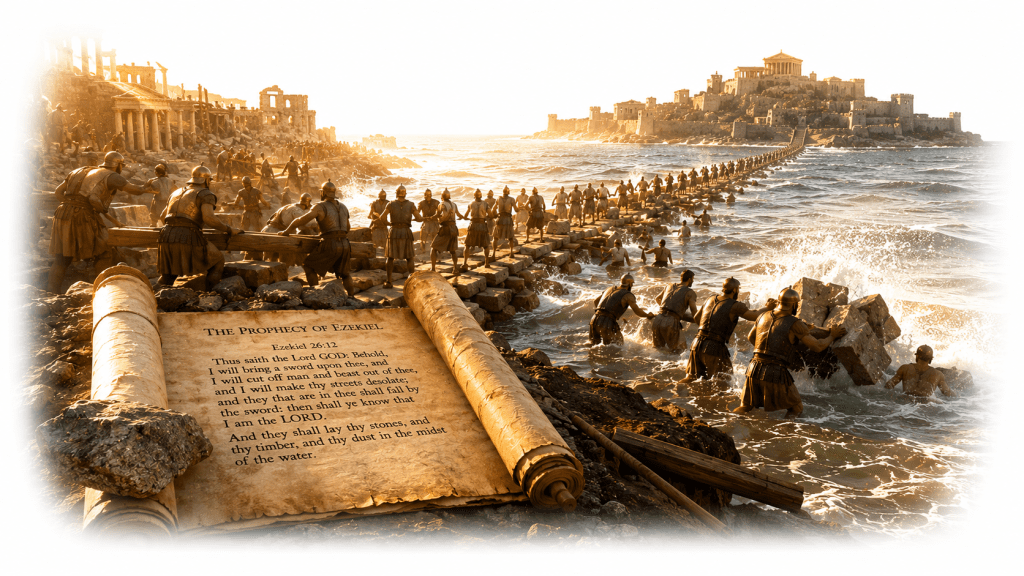
In approximately 587 BC, Ezekiel prophesied against the city of Tyre with specific predictions: “They shall destroy the walls of Tyrus, and break down her towers: I will also scrape her dust from her, and make her like the top of a rock. It shall be a place for the spreading of nets in the midst of the sea…And they shall lay thy stones and thy timber and thy dust in the midst of the water” (Ezekiel 26:4-5, 12).
The prophecy predicted: that Nebuchadnezzar would destroy the mainland city, that the stones and timber would be thrown into the sea, that the site would become a bare rock used for spreading fishing nets, and that the ancient city would never be rebuilt.
The historical fulfillment: Nebuchadnezzar destroyed the mainland city in 573 BC. The island city survived. Two centuries later, Alexander the Great besieged the island city, and to build his siege causeway, he literally scraped the rubble of the mainland city and threw it into the sea. The site became the bare rock the prophecy described, still visible today as the peninsula that Alexander’s causeway created, used for fishing as the prophecy said.
The multiple-stage, centuries-spanning fulfillment, across two different conquerors separated by 250 years, is precisely the kind of evidence that human foresight cannot produce.
Declaring the End From the Beginning
The fulfilled prophecy evidence is not primarily an apologetic tool. It is the confirmation of the God who claims this ability as His own identifying mark.
No human author can declare the end from the beginning. No religious tradition can produce verified, specific, historically confirmed predictions of events centuries and millennia in the future. The fulfilled prophecies of the Scripture are not the product of lucky guessing, vague generality, or post-facto composition. They are the signature of the God who governs history, the specific, particular evidence that the text we are reading is not merely human.
God pointed to this evidence Himself: “Declaring the end from the beginning, and from ancient times the things that are not yet done.” The evidence He claimed is the evidence we find.
Tomorrow, Day 20, archaeology. Where the spade confirms what the text declared.
“Declaring the end from the beginning, and from ancient times the things that are not yet done, saying, My counsel shall stand, and I will do all my pleasure.” — Isaiah 46:10 KJV
📖 This post is adapted from Why I Believe the Bible: A Personal Defense of Sola Scriptura. If it helped you, the full book is available on Amazon — or you can support this ministry directly.
thefinalconvergence.com | Follow on Instagram, Facebook, X, and YouTube
If you like to be updated on new blogs, sign up to our newsletter!


Leave a comment