
Published: July 8, 2026 | thefinalconvergence.com
In the nineteenth century, biblical archaeology did not yet exist as a discipline. What existed was a confident academic consensus, built on the rationalist assumptions of the Enlightenment and the rising methodologies of historical-critical scholarship, that the Bible was an unreliable historical document. Its genealogies were legendary. Its city lists were invented. Its characters were mythological constructions. Its historical claims were the pious embellishments of a community constructing a national identity from tribal stories.
The cities it named could not be found. The empires it described were unconfirmed. The kings it mentioned were unattested. The events it recorded left no trace in the archaeological record. And then the spades went into the ground.
What followed, across one hundred and fifty years of systematic excavation across the ancient Near East, Israel, Egypt, Mesopotamia, Asia Minor, and the Mediterranean world, is one of the most remarkable reversals in the history of academic scholarship. The cities that could not be found were found. The empires that were unconfirmed were confirmed. The kings that were unattested appeared in inscriptions, administrative records, and royal seals. The events that left no trace produced layer after layer of physical evidence.
The pattern has been consistent and it has run in one direction: the text is declared unreliable, and then the evidence vindicates the text This is not nothing. It is the most sustained external confirmation of a historical document’s reliability that any ancient text has ever received.
The Hittites — From Legend to Capital City
Through much of the nineteenth century, the Hittites were cited as a classic example of biblical invention. The Old Testament mentions the Hittites more than fifty times, as a major people-group in Canaan, as a military power, as neighbors and trading partners of Israel. But no external record of the Hittites existed in the ancient Near Eastern sources known to nineteenth-century scholars. The confident conclusion: the Hittites were legendary, invented by the biblical authors to populate their narrative.
In 1906, excavations at Hattusa in modern Turkey uncovered the capital city of the Hittite Empire, along with tens of thousands of clay tablets in Hittite cuneiform, royal archives, treaties, administrative records, and diplomatic correspondence that established the Hittites as one of the dominant powers of the ancient world for centuries. The empire that the nineteenth century called legendary left a capital city, a royal archive, and a documented history that has been studied for over a century since. Not a legend. An empire. Confirmed by the spade exactly where the text placed them.
Belshazzar — The King Who Could Not Have Existed
The fifth chapter of Daniel names Belshazzar as the king of Babylon on the night of the city’s fall to the Persians. For centuries, critics pointed to Belshazzar as a historical error, because the known Babylonian king lists showed that the last king of Babylon was Nabonidus, not Belshazzar. Belshazzar appeared to be a fictional character inserted into a historical narrative by an author who did not know the actual history.
In 1854, the Nabonidus Cylinder was discovered at Ur. Among its contents was a prayer by Nabonidus for the life of his firstborn son, Belshazzar, who was serving as co-regent, administering Babylon while Nabonidus was away on an extended campaign in Arabia. The co-regency explains precisely why Daniel records that Belshazzar offered to make Daniel the third ruler of the kingdom (Daniel 5:16), the specific number that puzzled readers, now explained by the two-tiered co-regency. Nabonidus was the first. Belshazzar was the second. Daniel’s reward would make him the third.
The character the critics called fictional was the co-regent of Babylon, documented in the king’s own prayer cylinder. The specific detail that seemed like an error confirmed the narrative’s precision.
The Tel Dan Stele — The House of David
In the late twentieth century, minimalist scholars argued that David was a legendary figure, that the biblical account of the Davidic monarchy was a later construction with no historical basis. There was no external evidence, they argued, for the existence of David as an actual historical king.
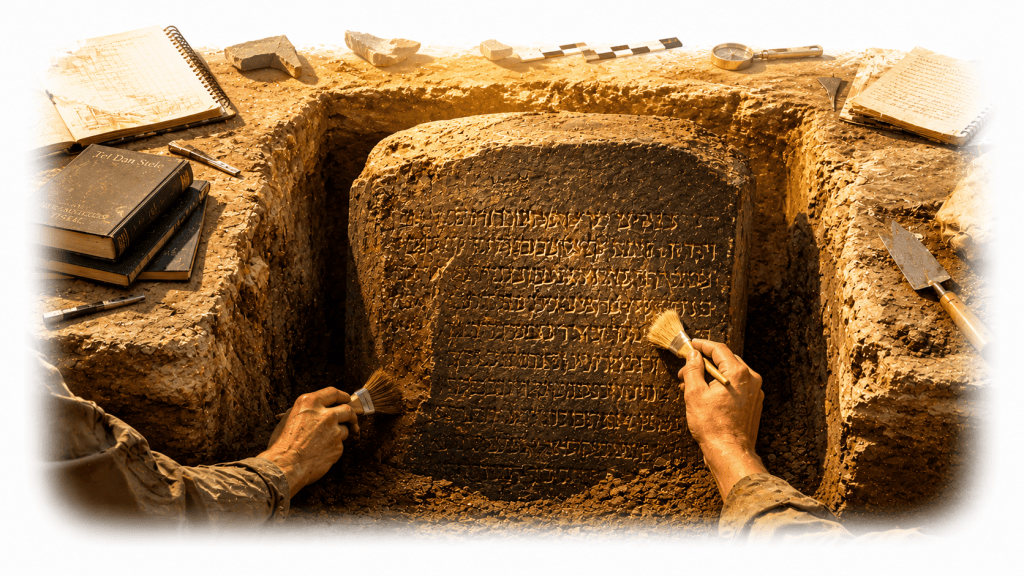
In 1993, archaeologists excavating the site of Tel Dan in northern Israel discovered a basalt stele, a victory inscription, written in Aramaic by an Aramaean king of Damascus, celebrating his military victories against Israel. The inscription explicitly mentions the “House of David” (byt dwd in the Aramaic), the royal dynasty of David, as the ruling house of Judah.
This was the first extra-biblical reference to David ever discovered. It was written within approximately a century of David’s reign, far too close to the events to be a fabrication, and in a foreign inscription with no stake in promoting Israelite religious claims. The minimalist argument collapsed. David was real. His dynasty was real. And a neighboring king’s victory inscription confirmed both.
Pontius Pilate — The Governor Who Condemned Jesus
For centuries, the only references to Pontius Pilate as governor of Judea were found in the New Testament and in the writings of Josephus and Tacitus. Some historians treated even these references with varying degrees of skepticism.
In 1961, Italian archaeologists excavating the ancient theater at Caesarea Maritima discovered a limestone dedication stone, the Pilate Stone, inscribed with the Latin text identifying Pontius Pilate as the Prefect of Judea during the reign of Tiberius Caesar. The man who condemned Jesus to crucifixion appears in a dedication inscription in the city where he governed, exactly the title and the time period the Gospels record.
The Pool of Bethesda — From Theological Symbol to Excavated Site
The Gospel of John describes the Pool of Bethesda, a pool in Jerusalem with five porticoes, where Jesus healed a lame man (John 5:2). For centuries, some scholars treated the five porticoes as a theological symbol rather than an architectural description, as part of John’s symbolic numerical patterns rather than a description of an actual location.
Excavations in the nineteenth century in the northeastern section of Jerusalem uncovered the pool, with its five porticoes. The specific architectural detail that had been treated as symbolic was an accurate description of a real first-century site.
The Pattern and Its Direction
William Foxwell Albright, one of the greatest biblical archaeologists of the twentieth century, began his career with significant skepticism about the historical reliability of the biblical text. By the end of his career, he wrote: “Discovery after discovery has established the accuracy of innumerable details, and has brought increased recognition to the value of the Bible as a source of history.”
The direction of the pattern matters. When a single ancient text claims historical events and those events are confirmed by independent archaeological evidence, repeatedly, specifically, in cases where the text was confidently declared wrong, the direction of the evidence is significant.
The Bible has been declared wrong about the Hittites. The Hittites were found. It has been declared wrong about Belshazzar. Belshazzar was confirmed. It has been declared wrong about David. David’s dynasty appeared in a foreign inscription. It has been declared wrong about Pilate. Pilate appeared in an inscription at Caesarea. It has been declared wrong about the pool of Bethesda. The pool was excavated with its five porticoes exactly where John placed it. The text keeps being declared in error. The spade keeps vindicating the text.
This is not the track record of a document that was fabricated, embellished, or invented to serve a religious agenda. Fabricated texts do not survive sustained archaeological scrutiny. They are exposed by it. The biblical text has survived a century and a half of the most intensive archaeological scrutiny ever applied to any ancient document, and has emerged repeatedly confirmed where it was repeatedly questioned.
What Archaeology Does and Does Not Prove
It is important to be precise about what the archaeological confirmation of the Bible’s historical reliability does and does not establish. Archaeology does not prove the Bible’s theological claims. The excavation of the Pool of Bethesda does not prove that Jesus healed a lame man there. The discovery of the Hittite capital does not prove that God spoke to Abraham. The Pilate Stone does not prove the resurrection.
What archaeology does is establish that the historical framework of the biblical narrative is reliable, that the text was written by people who knew the history they were describing, who named the right kings, the right cities, the right empires, the right administrative details, in the right periods. This is precisely the kind of reliability that you would expect from a text that is what it claims to be, the historically grounded revelation of the God who acts in history.
A text written by people who knew the history is a very different thing from a text fabricated centuries after the events it purports to describe. And the consistent archaeological confirmation keeps pointing toward the former.
“There failed not ought of any good thing which the LORD had spoken unto the house of Israel; all came to pass.” — Joshua 21:45 KJV
Tomorrow, Day 21, the unity of sixty-six books. The coherence that fifteen centuries of human writing cannot explain.
📖 This post is adapted from Why I Believe the Bible: A Personal Defense of Sola Scriptura. If it helped you, the full book is available on Amazon — or you can support this ministry directly.
thefinalconvergence.com | Follow on Instagram, Facebook, X, and YouTube
If you like to be updated on new blogs, sign up to our newsletter!


Leave a comment