
Published: July 9, 2026 | thefinalconvergence.com
Consider a thought experiment. Take sixty-six books. Write them across fifteen centuries. Use more than forty different authors. Write in three different languages; Hebrew, Aramaic, and Greek. Write on three different continents; Asia, Africa, and Europe. Use every literary genre available; poetry, law, history, prophecy, wisdom literature, personal correspondence, apocalyptic vision. Choose your authors from the full spectrum of human experience and social location: a king, a shepherd, a tax collector, a physician, a fisherman, a tent-maker, a priest, a prophet in exile, a general, a scribe.
Give these authors no means of communication with one another across the centuries. Let the early authors write without knowing what the later authors would say. Let the later authors write without knowing they were completing what the earlier authors had begun. Let no human editorial committee coordinate the whole. Now put the sixty-six books together.
By every expectation of human literary production, by everything we know about how diverse authors writing across long periods of time produce texts that reflect their specific historical moments, personal perspectives, and cultural contexts, the result should be a massive, sprawling collection of contradictions, inconsistencies, and irresolvable tensions. It should look like what every such collection of human texts actually looks like: a library that reflects the diversity of its contributors rather than the coherence of a single mind.
The Bible does not look like that. And the question of why it does not is one of the most powerful evidences for its divine origin.
The Scarlet Thread
The most fundamental unity of the sixty-six books is what theologians have called the scarlet thread of redemption, the single narrative of a God who created, whose creation fell, who immediately promised restoration, and who across four thousand years of history progressively unfolded and finally accomplished exactly what He promised.
The thread begins in Genesis 3:15, immediately after the fall, before any human being has asked for it, before any religious system has been developed, before any prophet has spoken: “And I will put enmity between thee and the woman, and between thy seed and her seed; it shall bruise thy head, and thou shalt bruise his heel.” The seed of the woman who will crush the serpent’s head while suffering injury in the act. The first promise of the entire Bible, spoken by God to the enemy of humanity in the garden, is a compressed preview of the entire redemptive narrative.
The thread ends in Revelation 22, with the tree of life restored, the curse removed, the bride presented to the Lamb, the serpent’s head finally and definitively crushed. Genesis 3:15 and Revelation 22 are written by different authors, in different languages, across more than a thousand years of time, and one is the seed and the other is the flower of the same living plant.
No human editor produced this. No conspiracy of ancient authors coordinating across millennia. The author behind the thread is the one who knew the end from the beginning, because He is the one who determined both.
The Typological System
Running beneath the scarlet thread is an elaborate system of types and antitypes, shadows and their realities, patterns and their fulfillments, that no human literary conspiracy could have constructed and that no theory of redaction explains.
The sacrificial system of Leviticus. The specific requirements: the unblemished animal, the laying on of hands, the substitutionary death, the shed blood, the high priest’s annual entry into the Holy of Holies on the Day of Atonement. These requirements were given to Israel as the law of their worship, without explanation of their ultimate significance, without any text in Leviticus that says: this is a preview of something greater.
Fifteen hundred years later, the book of Hebrews opens those requirements and explains each one:
The unblemished animal, He offered himself without spot to God (Hebrews 9:14). The laying on of hands, the transference of sin to the substitute. The substitutionary death, he bore the sins of many (Hebrews 9:28). The shed blood, without the shedding of blood there is no remission (Hebrews 9:22). The high priest’s annual entry, he entered once for all into the holy place (Hebrews 9:12). Every specific requirement of Leviticus is explained in Hebrews with the precision of a key fitting a lock.
Leviticus did not know it was pointing to Hebrews. Hebrews knew exactly what Leviticus had been pointing to. The same Spirit who encoded the shadow in Leviticus decoded it in Hebrews, fifteen hundred years and multiple translations later.
The Consistent Portrait of God
Across sixty-six books, three languages, fifteen centuries, and every conceivable literary genre, the portrait of God is consistent in a way that no committee of editors across centuries could have maintained.
Holy. The thrice-holy of Isaiah 6 (eighth century BC) is the same thrice-holy of Revelation 4 (first century AD). The absolute moral perfection of God that produces Isaiah’s “woe is me, for I am undone” is the same absolute moral perfection that prostrates John on Patmos.
Just. The God who will by no means clear the guilty (Exodus 34:7) is the same God who demonstrates His righteousness in the cross (Romans 3:25-26). The justice of Amos’s social indictment against Israel is the same justice that Paul grounds in Romans 1-3.
Merciful. The steadfast love (hesed) that runs through every Psalm is the same grace (charis) that Paul unpacks across his letters. Different words. Same character. Same God.
Patient. The God who bears with Israel through forty years of wilderness complaint is the same God who is “longsuffering to us-ward, not willing that any should perish” (2 Peter 3:9). Old Testament and New Testament. Different languages. Same patience.
Faithful. “Every word of God is pure…he is a shield unto them that put their trust in him” (Proverbs 30:5). “If we believe not, yet he abideth faithful: he cannot deny himself” (2 Timothy 2:13). One in Proverbs, one in Paul’s letter to Timothy. Same portrait. Same God.
The consistency is too precise for human authorship and too extensive for human editing. The portrait of God in Genesis is the portrait of God in Revelation. Everything in between is the progressive revelation of the same character.
What Jesus Said About the Unity
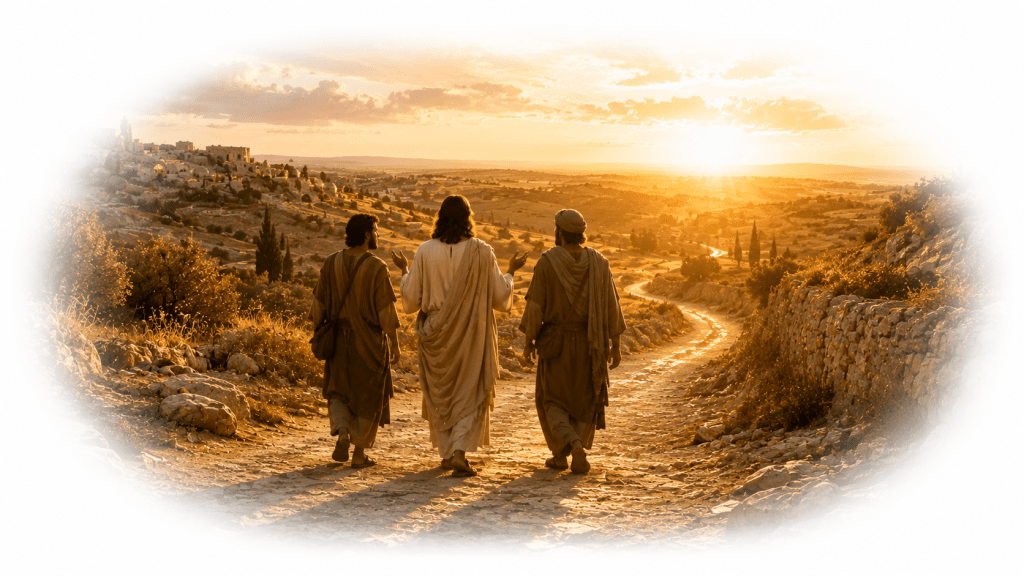
The risen Christ, on the road to Emmaus, made the unity of the whole canon explicit: “And he said unto them, These are the words which I spake unto you, while I was yet with you, that all things must be fulfilled, which were written in the law of Moses, and in the prophets, and in the psalms, concerning me. Then opened he their understanding, that they might understand the scriptures” (Luke 24:44-45).
All things written in the law, the prophets, and the psalms, the entire three-part Hebrew canon, are concerning Him. The unity of the whole is Christological. The thread that runs from Genesis to Malachi is the thread that leads to the one who is its fulfillment.
The disciples did not see this until He opened their understanding. Not because the texts were obscure, but because the unity that was always present in the texts required the author of the unity to illuminate it. The Spirit who encoded the unity in the sixty-six books is the Spirit who opens the eyes of the reader to see it.
This is the testimony of the one who knows the canon from the inside, because He is its subject and its author simultaneously. Every book, in every genre, across every century, concerning Him.
The Contrast That Makes the Unity Remarkable
The most effective way to appreciate the unity of the Bible is to compare it to any other collection of ancient religious texts.
Take the Vedas of Hinduism, composed across a comparable period, by comparable numbers of authors, in comparable conditions of geographical and cultural diversity. The result is rich and complex, but it is the richness and complexity of an evolving tradition reflecting its authors’ diverse perspectives, not the coherence of a single unfolding narrative.
Take the Homeric corpus, the Confucian classics, the Upanishads, or any other collection of ancient literature produced across centuries by diverse authors. In every case, the diversity of the collection reflects the diversity of its contributors, because that is what collections of human literature produced across long periods of time always do.
The Bible does not do what collections of human literature do. Its diversity is as genuine as any collection of human literature. But its unity, the unity of narrative, of theology, of character portrait, of typological system, of redemptive purpose, is unlike anything in the history of human literary production.
That unity does not come from human coordination. It comes from the single divine author who breathed out every one of the sixty-six books, in their genuine human diversity, through their specific historical moments, in their particular languages and genres, and who knew, from the first word of Genesis, exactly how the last word of Revelation would read.
“And he said unto them…all things must be fulfilled, which were written in the law of Moses, and in the prophets, and in the psalms, concerning me.” — Luke 24:44 KJV
Tomorrow, Day 22, the witness of transformation. The evidence that lives in twenty centuries of redeemed human beings.
📖 This post is adapted from Why I Believe the Bible: A Personal Defense of Sola Scriptura. If it helped you, the full book is available on Amazon — or you can support this ministry directly.
thefinalconvergence.com | Follow on Instagram, Facebook, X, and YouTube
If you like to be updated on new blogs, sign up to our newsletter!


Leave a comment