
Published: July 14, 2026 | thefinalconvergence.com
Yesterday’s post was about the individual practice. The person with the open Bible at the plain table in the early morning. The daily discipline of Joshua 1:8. The private familiarity, meditation, and obedience that living under the Word requires of the individual believer.
But the Word does not intend to be lived under only in private. The church, the gathered community of genuine believers, was designed to be the place where the Word dwells collectively, where believers teach and correct and build up one another from the Word, where the communal life of the body is formed and governed and corrected by the Scripture that is its authority.
“Let the word of Christ dwell in you richly in all wisdom; teaching and admonishing one another in psalms and hymns and spiritual songs, singing with grace in your hearts to the Lord” (Colossians 3:16). The word of Christ dwelling richly, not the word of the conference speaker, not the word of the apostolic network, not the word of the confessional tradition, but the word of Christ, in the community, producing mutual teaching and admonishing. The church under the Word is the community in which the Word dwells richly and produces the horizontal ministry of the Spirit through believers to believers.
What does that community look like? And what are the specific ways in which communities that claim to be under the Word fall short of what the text describes?
The Sermon as Exposition, Not Performance
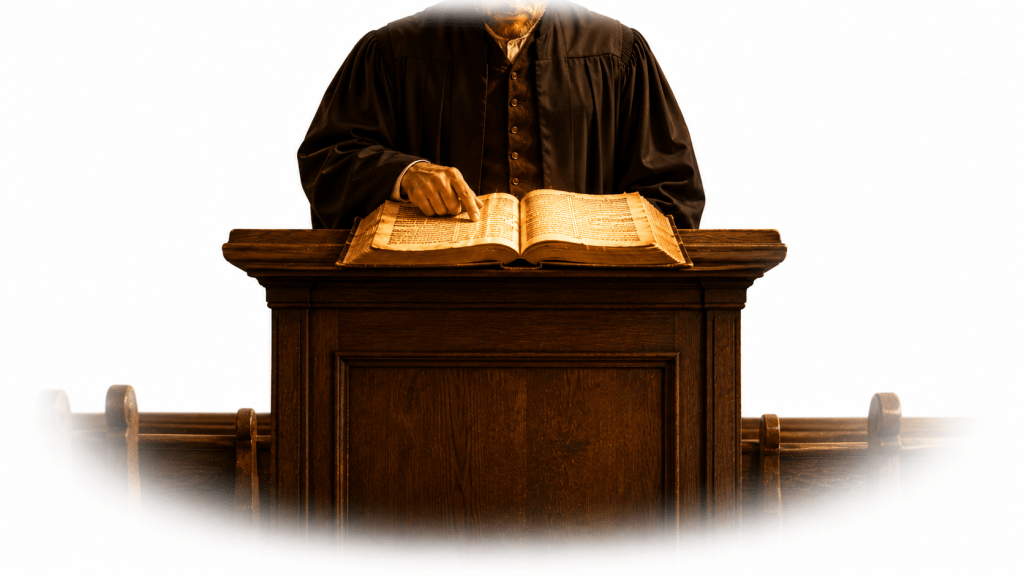
The most visible and most significant indicator of whether a church is genuinely under the Word is what happens in the pulpit on Sunday morning.
Two kinds of preaching exist in the contemporary church. The first uses Scripture as a launching pad, the preacher selects a passage, extracts from it a theme or principle, and then develops that theme according to their own agenda for the congregation. The text may be quoted. It may even be expounded. But the sermon’s agenda was determined before the text was consulted, and the text serves the sermon rather than the sermon serving the text.
The second allows the text to govern the sermon. The preacher works through a book of the Bible sequentially, passage by passage, week by week, and the text sets the agenda. What the text addresses this week is what the congregation hears. If the text confronts a comfortable assumption, the sermon confronts it. If the text demands something of the congregation that the congregation would prefer not to hear, the sermon demands it. If the text dwells on a theme that the preacher would not have chosen, the sermon dwells on it.
The second form, genuine expository preaching, is the form that corresponds to the doctrine of Sola Scriptura. Not because the first form cannot produce good sermons. But because only the second form systematically places the preacher under the text rather than over it. Only the second form guarantees that the congregation will eventually hear all of what the sufficient Word has to say, not only the portions their pastor favors, not only the themes the season of ministry calls for, not only the passages that generate the most favorable congregational response.
The preacher who works through Romans is going to reach Romans 9. The preacher who works through Matthew is going to reach Matthew 23. The preacher who works through Revelation is going to confront every comfortable assumption about the nature of the Christian life and the character of the God the congregation thinks they know. Expository preaching is the form that makes the text the authority precisely by removing the preacher’s ability to avoid the parts of the text that would challenge the congregation.
The Berean Congregation
Acts 17:11 commends the Bereans not merely for individual virtue but for a communal practice. They received the word with readiness of mind, and searched the Scriptures daily whether those things were so. Together. As a community.
The church under the Word is a Berean congregation, not merely a congregation whose individual members are encouraged to read their Bibles, but a congregation that is equipped and expected to bring what they are taught back to the text and test it. Not with suspicion toward teachers. With the same combination of readiness and accountability that the Bereans modeled.
This has specific implications for how the church conducts itself:
It means the congregation must be taught to read, not merely to be read to. The church that produces biblical illiteracy in its congregation is not a church under the Word. It is a church in which the Word’s authority has been effectively transferred to the teacher, because the congregation has no independent access to the text that could expose the teacher’s error.
It means the congregation must be encouraged to question, not divisively, not with an adversarial spirit, but with the honest question: where does the text say that? The church under the Word does not treat that question as a threat. It treats it as the Berean practice the text commends.
It means the congregation must be accountable to the text together, when the community reaches a consensus that the plain text does not support, the text corrects the consensus. The church under the Word does not mistake communal agreement for biblical faithfulness. Communities can agree on positions that the text does not authorize. The text, not the consensus, is the final word.
The Correctable Church
Perhaps the most demanding application of the Word’s authority in the communal setting is this: the church under the Word must be a correctable church. Not correctable by cultural pressure. Not correctable by the preferences of the congregation. Not correctable by the shifting standards of the surrounding society. Correctable by the Word, the specific, plain meaning of the text applied to the specific practice or teaching under examination.
The history of the church is largely the history of churches needing correction. The Galatian churches needed Paul’s urgent correction: they were adding to the simple gospel. The Corinthian church needed correction on division, on sexual ethics, on the Lord’s Supper, on the use of spiritual gifts. The seven churches of Asia Minor in Revelation 2-3 each needed specific correction, and the specific correction came not from a council or a tradition or an apostolic network but from the one who walked among the lampstands and knew the texts He had breathed out.
A church that cannot be corrected by the Word, that has placed tradition, confession, leadership authority, or communal consensus above the plain text, is not a church under the Word. However doctrinally precise. However historically rooted. However many correct positions it holds. The correctable church is not the church that changes with every cultural wind. It is the church that holds the text above every other authority, including its own established positions, and that follows the text when the text requires revision of what the community has previously taught.
The Reformers modeled this for the institutional church of their day. The church that produced them was not their enemy. It was the community they loved, the tradition they were shaped by, the institution they were calling back to the Word it claimed to steward. The reform they called for was not the abandonment of the church but the submission of the church to the authority it formally acknowledged and practically overrode.
The Word Dwelling Richly — What It Produces
When the word of Christ dwells richly in a community, when it is genuinely the organizing authority around which the community’s shared life is structured, Colossians 3:16 describes what follows: teaching and admonishing one another.
Not only the pastor teaching. Not only the elder admonishing. One another, the horizontal ministry of believers equipped by the Word to speak the Word to their brothers and sisters. The wife who knows the Scripture well enough to give her husband the specific verse that addresses his specific trial. The friend who recognizes the pattern the text warns about in the decisions his friend is making. The small group member who surfaces the passage that the discussion has been circling without landing on.
This is the Word dwelling richly in a community, not as a reference text consulted by the specialist for the benefit of the congregation, but as the common possession of every member, accessible to every believer, productive in the ministry of every person in the body to every other.
The church that has been taught to live under the Word produces this horizontal ministry naturally. Not because the members have theology degrees but because the Word has been dwelt in richly, systematically taught, consistently memorized, repeatedly returned to, and applied together in the ordinary life of the community.
The Word dwelling richly is not the Word preached well on Sunday and forgotten by Wednesday. It is the Word in the mouths and minds and hearts of the community, the Joshua 1:8 practice extended from the individual believer to the gathered body. Meditated day and night, together.
What the Church Under the Word Is Not
The church under the Word is not the church that has replaced the Word with a charismatic leader who claims apostolic authority and whose declarations function as binding as Scripture, however gifted, however Spirit-filled the community believes him to be.
It is not the church that has replaced the Word with a confessional standard that governs interpretation and that cannot itself be questioned by the plain text, however accurate the confession, however carefully its framers worked.
It is not the church that has replaced the Word with denominational tradition, a set of practices and emphases that have accumulated across generations and that are now treated as co-authoritative with the text that is supposed to govern them.
In every case, the test is simple. When the teaching, the leader, the confession, or the tradition conflicts with the plain text, which one yields? The church that can answer unhesitatingly: the text, is the church under the Word.
Tomorrow, Day 27, something this series has been building toward for twenty-six days. The question that Sola Scriptura raises not only for Rome and the NAR but for those within Protestantism who formally claim the Bible’s authority.
It is time to name it.
“Let the word of Christ dwell in you richly in all wisdom; teaching and admonishing one another.” — Colossians 3:16 KJV
📖 This post is adapted from Why I Believe the Bible: A Personal Defense of Sola Scriptura. If it helped you, the full book is available on Amazon — or you can support this ministry directly.
thefinalconvergence.com | Follow on Instagram, Facebook, X, and YouTube
If you like to be updated on new blogs, sign up to our newsletter!


Leave a comment