
Published: July 26, 2026 | thefinalconvergence.com
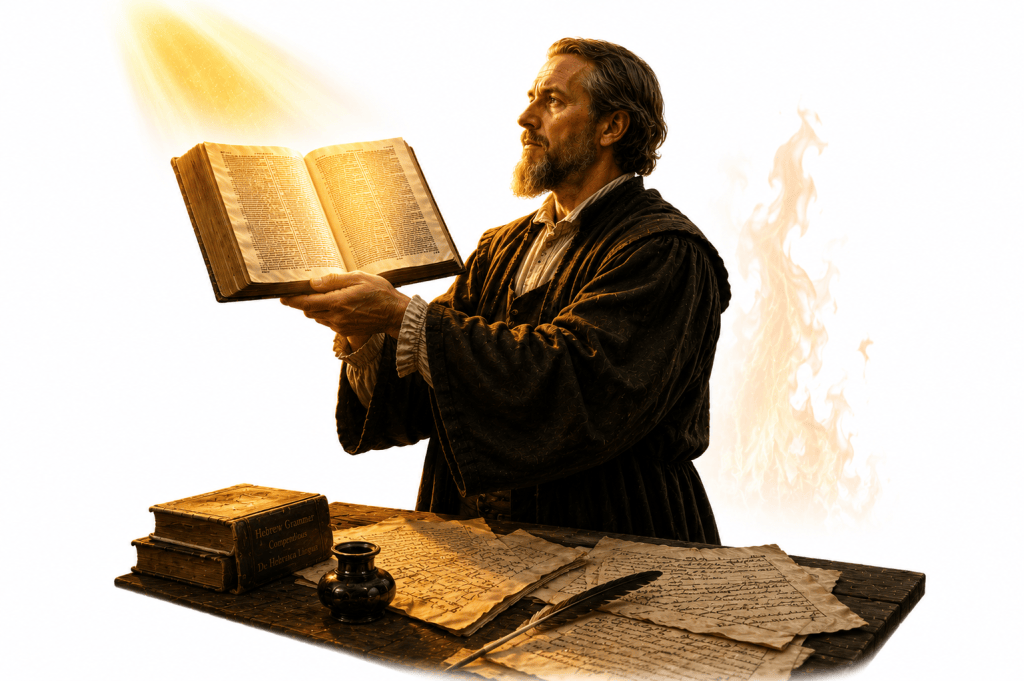
Luther stood. Calvin wrote. Tyndale translated. And when the institutional church had exhausted every other means of stopping him, it burned him.
William Tyndale’s story is the Biblicism argument not as theological proposition but as blood. Not as the declaration at a diet or the careful preface to a systematic theology, as the life and death of a man who held the position so completely, so practically, so at the cost of everything, that the only response the tradition that opposed him could find was execution.
The specific crime was not heresy in the abstract. The specific crime was making the Scripture available to ordinary people in their own language without the mediation of the institutional church.
That is the Biblicist act. And Tyndale paid the Biblicist price.
The Challenge That Defined the Reformation
In approximately 1520, Tyndale was engaged in debate with a Catholic scholar, tradition identifies him as one of the clerics in the household of Sir John Walsh, where Tyndale was serving as tutor. The exchange is recorded in Foxe’s Book of Martyrs.
The Catholic scholar, frustrated with Tyndale’s insistence on the Scripture as the governing authority, made the argument that had sustained the institutional church’s monopoly on biblical interpretation for centuries: “We were better be without God’s laws than the Pope’s.”
Tyndale’s response has echoed through the centuries of Protestant Christianity: “I defy the Pope and all his laws; if God spare my life, ere many years I will cause a boy that driveth the plough shall know more of the Scripture than thou dost.”
Parse this. It is the Biblicism thesis in one sentence.
The boy that driveth the plough, the ordinary person, without theological training, without institutional authorization, without the necessary mediation of the ordained scholar, shall know more of the Scripture. Not more of the tradition’s interpretation of the Scripture. The Scripture itself. More of it. More accurately. More directly.
This is the claim that the institutional church could not permit. It was not merely offensive to ecclesial pride. It was structurally threatening to the entire system by which the church maintained its authority. If the plowboy could know the Scripture directly, if the Word was perspicuous enough, alive enough, powerful enough to reach the ordinary believer without the priest standing between the reader and the text, then the church’s claim to be the necessary interpretive authority was exposed as self-serving rather than scriptural.
Tyndale knew exactly what he was claiming. And he was willing to die for it.
The Translation That Changed Everything
Tyndale began work on his English translation of the New Testament in 1523. When the Bishop of London refused to support the project, the institutional church was not going to authorize a translation that would make the Scripture directly accessible to ordinary English speakers, Tyndale left England and worked on the Continent, supported by English merchants in Antwerp.
The first printed edition of his New Testament appeared in 1526. It was smuggled into England in bales of cloth and distributed to ordinary English people who had never had access to the Scripture in their own language. The institutional church responded by buying up and burning as many copies as it could find.
The irony of the burning: the money the church used to buy the copies was used by Tyndale to fund a revised and improved edition. The book the church was trying to destroy was being funded by the church’s attempts to destroy it. Tyndale continued translating. He produced portions of the Old Testament; the Pentateuch, Jonah, various other books. He translated with a scholar’s rigor, from the original Hebrew and Greek, with reference to Erasmus’s Greek New Testament and Luther’s German translation, and with a pastor’s care for the ordinary English reader.
His goal was never simply to make the Scripture available in English. His goal was to make it available without mediation. He was not producing a translation that would require the trained scholar to explain it to the ordinary reader. He was producing a translation that the plowboy could read and understand on his own, guided by the Spirit who inspired the text, with no institutional gate between the reader and the Word.
“For the word of God is quick, and powerful, and sharper than any twoedged sword, piercing even to the dividing asunder of soul and spirit, and of the joints and marrow, and is a discerner of the thoughts and intents of the heart” (Hebrews 4:12). This is the verse that grounded Tyndale’s conviction. The Word is alive, quick, from the Old English for living. The Word is powerful. The Word is sharp. It reaches the human heart directly, without the priest’s mediation, without the scholar’s authorization, without the tradition’s interpretive framework.
If the Word is alive and powerful and able to discern the thoughts and intents of the heart, it does not need the confession to reach the plowboy’s heart. It reaches directly. The Spirit who breathed it illuminates it directly. Tyndale’s translation project was not a literary exercise. It was the most radical practical expression of Sola Scriptura in the entire Reformation. Every copy of his New Testament was a declaration: the Word is sufficient to reach ordinary people directly, without institutional mediation.
The Price
In May 1535, Tyndale was betrayed by an agent of the English church, arrested, and imprisoned in the castle of Vilvoorde near Brussels. He remained in prison for approximately sixteen months, during which he continued to write, reportedly asking in a letter for warm clothing and above all for his Hebrew Bible and grammar, that he might use his imprisonment to continue his work on the Old Testament.
On October 6, 1536, William Tyndale was strangled and his body burned at the stake. His last recorded words were a prayer: “Lord, open the King of England’s eyes.”
Not a recantation. Not a compromise. A prayer for the Word to do what he had spent his life arguing the Word could do: reach directly, without mediation, through the eyes of one man to the heart of another. The king whose eyes Tyndale prayed for was Henry VIII. Within three years of Tyndale’s death, Henry had authorized an English Bible, based substantially on Tyndale’s own translation, to be placed in every church in England.
The man the institutional church burned became the primary source of the translation the institutional church was forced to authorize. The Word that the church tried to stop ended up authorized in the church’s own sanctuaries, in the language Tyndale had given it, reaching the ordinary English believer directly. The Word does not need the institution. Even when the institution burns the man who insists on the point.
What Tyndale’s Death Means for the Confessionalist Argument
The confessionalist tradition that uses the word biblicist as a slur does not, and cannot, use that slur against Tyndale. No one calls Tyndale naive. No one calls him tradition-ignorant or scholarship-rejecting. He was one of the most learned men of his generation, fluent in multiple languages, engaged with the best scholarship of his era.
But Tyndale was a Biblicist, in the precise sense this series has defined. He held the conviction that the Word, translated into the language of the ordinary person, was powerful enough and perspicuous enough to reach that person directly, without requiring the institutional church’s interpretive authorization.
And the specific thing Tyndale died preventing, the institutional church’s claim that the Scripture can only be correctly understood through authorized institutional mediation, is precisely what confessionalism, in its most consistent expressions, has reproduced with Protestant materials.
Not with the same ferocity. Not with burning. But with the same structural claim: the Scripture requires the authorized interpretive framework (the confession, the tradition, the denominational standards) to be correctly understood. The reading that falls outside the confessional framework is suspect by virtue of being outside it.
Tyndale died fighting that claim. The tradition that invokes his legacy as a Reformer while reproducing the claim he died fighting has not reconciled this tension.
The Plowboy Still Has the Bible
The great irony, and the great hope, of the Tyndale story is that the plowboy still has the Bible. Five hundred years after Tyndale’s translation, the Word is available in more languages, to more ordinary people, with more direct access, than at any point in the history of the church. The translation work Tyndale began has been continued by generations of linguists, missionaries, and Bible translators who have carried the same conviction: the Word is alive and powerful and able to reach the ordinary person directly.
The institutional systems that tried to prevent that direct access are gone or weakened. The Word is here. Tyndale’s prayer was answered. Not because the institution authorized it. Because the Word is what Tyndale believed it was, and what this series is defending.
Alive. Powerful. Sharp. Reaching directly into the thoughts and intents of every heart that receives it. The plowboy’s Bible. The Biblicist’s conviction. The Reformer’s sacrifice.
The Word alone.
Tomorrow, Day 9, Zwingli and Knox. The Swiss and Scottish witnesses to the Biblicist principle that the whole Reformation shared.
“For the word of God is quick, and powerful, and sharper than any twoedged sword, piercing even to the dividing asunder of soul and spirit, and of the joints and marrow, and is a discerner of the thoughts and intents of the heart.” — Hebrews 4:12 KJV
📖 This post is adapted from Biblicism: The Faith Once Delivered. If it helped you, the full book is available on Amazon — or you can support this ministry directly.
thefinalconvergence.com | Follow on Instagram, Facebook, X, and YouTube
If you like to be updated on new blogs, sign up to our newsletter!


Leave a comment