
Published: July 27, 2026 | thefinalconvergence.com
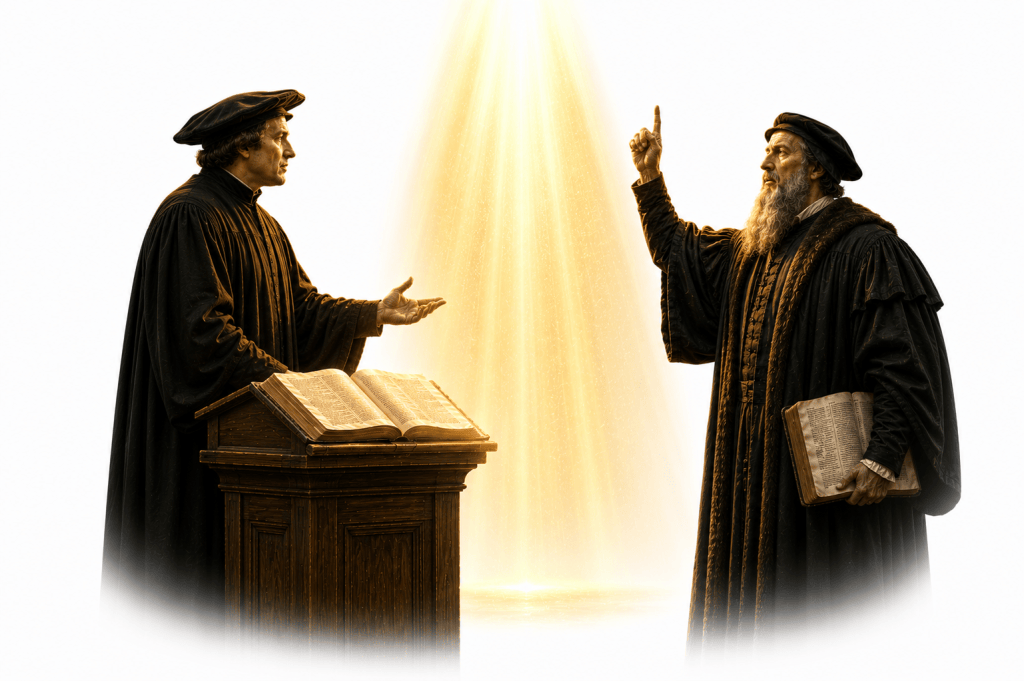
Three days. Three Reformers. Three forms of the same conviction. Luther: the conscience captive to the Word, against pope and council. Calvin: the Institutes as preparation for reading Scripture, not replacement for it. Tyndale: the plowboy’s Bible, the Word reaching ordinary people directly, without mediation.
Today, two more witnesses. Different countries, different contexts, different opponents. The same position.
Ulrich Zwingli in Zurich. John Knox in Scotland.
What they shared, with each other and with the three Reformers who preceded them this week, was the Biblicist conviction that every human institution, however ancient, however powerful, however claiming divine authorization, was accountable to the Word of God. That the Word was the standard by which every claim was measured. That no institutional authority, whether the Bishop of Constance, the Roman Curia, or the Queen of Scotland, could override the plain testimony of Scripture.
“We ought to obey God rather than men” (Acts 5:29). Peter and John before the Sanhedrin, the authorized religious institution of their day, the body charged with governing the interpretation and application of the Scripture. And the apostles declining to obey. Not in rebellion. Not in lawlessness. Because the institution was requiring something that the Word of God did not authorize. And when the institution and the Word conflict, the Word takes precedence. Over the Sanhedrin. Over the Bishop of Constance. Over Mary Queen of Scots.
Zwingli and Knox held this conviction. And the evidence of how they held it is the evidence that Week Two requires.
Zwingli — The Zurich Reformation
Ulrich Zwingli arrived in Zurich as the people’s priest at the Great Minster in 1519. His first act was decisive, and it was the Biblicist act that defined the Zurich Reformation. He announced that he would not follow the traditional lectionary, the schedule of appointed texts that the church calendar prescribed for each Sunday, but would instead lecture through the Gospel of Matthew from the beginning, chapter by chapter, week by week, in sequential exposition.
This was not merely a liturgical preference. It was a theological declaration. The lectionary was the tradition’s selection of which portions of Scripture the congregation would hear and when. By abandoning the lectionary for sequential exposition, Zwingli was saying: the text, not the tradition, sets the agenda. The Word governs what the community hears. Not the church calendar.
This is the expository preaching principle that Day 26 of the Why I Believe the Bible series named as the mark of the genuinely Word-governed community. Zwingli was practicing it in 1519, and his reason for doing so was explicitly Biblicist. He continued through Matthew, then through Acts, then through Paul’s letters, then through the rest of the New Testament. The congregation in Zurich received, over years of ministry, the whole of the New Testament, not the tradition’s selection of it.
The Zurich Disputation — Scripture Against Tradition
In January 1523, the city council of Zurich summoned Zwingli to defend his reforming work before the assembled bishops and ecclesiastical representatives. The specific charge was that he was departing from the tradition of the church. Zwingli’s response was to frame the entire disputation in Biblicist terms. His sixty-seven theses, the framework for the disputation, opened with a declaration that would define the terms of engagement: “All who say that the Gospel is invalid without the confirmation of the Church err and slander God.”
The Gospel is valid on its own terms, by virtue of its divine origin, not by virtue of the church’s authorization of it. The confirmation of the institution does not make the Word authoritative. The Word is authoritative before and regardless of the institution’s endorsement.
And at the disputation itself, Zwingli issued a challenge that placed every debate in Biblicist terms: he invited his opponents to refute him from the Scripture. Not from tradition. Not from the councils. Not from the accumulated authority of the church’s interpretive history. From the Scripture.
The Bishop of Constance’s representative, Johann Faber, declined the terms. The tradition was not going to be evaluated by the Scripture. The Scripture was going to be evaluated by the tradition. Zwingli’s Biblicist reply: “Dear brother, I don’t think much of traditions or customs; the Word of God must reign supreme over all.”
The Word must reign supreme over all. Over the council. Over the Bishop. Over the tradition. Over the accumulated interpretive history. This is the Biblicism thesis. Stated in 1523. By a man the confessionalist tradition claims as its own.
Zwingli’s Disagreement With Luther
One of the most significant pieces of historical evidence that both Zwingli and Luther were genuine Biblicists, rather than simply using the language of Sola Scriptura to advance their respective institutional agendas, is their famous disagreement over the Lord’s Supper.
At the Marburg Colloquy of 1529, Luther and Zwingli met to discuss the possibilities of Protestant unity, and failed to achieve it, primarily because of their disagreement over the interpretation of Christ’s words at the Last Supper. Luther insisted on a literal interpretation: “This is my body” means Christ is truly, physically present in the elements. Zwingli argued for a symbolic interpretation: “This is my body” means “this represents my body.” Both men appealed to the same Scripture. Both invoked Sola Scriptura as their principle. Both arrived at different conclusions.
The confessionalist critique of Biblicism often cites this kind of disagreement as evidence that Sola Scriptura produces interpretive chaos, that when two men both claim to follow Scripture and arrive at different conclusions, the Scripture cannot be functioning as the supreme authority.
But the Marburg disagreement actually demonstrates the opposite. Luther and Zwingli were genuinely engaging the text, each following where they believed the text led, neither deferring to the other’s institutional authority. This is what Biblicism produces: genuine textual engagement, honest disagreement, and the recognition that the standard for resolving the disagreement is the text, not the person claiming to represent it.
The chaos would have been if one of them had simply invoked his own institutional authority, I am Luther, therefore my reading is correct, and demanded submission. Neither did. Both argued from the text. The disagreement is the evidence of genuine Biblicist engagement, not its failure.
Knox — Every Crown Accountable to the Word
John Knox brought the Biblicist principle to its most politically charged application in the Scottish Reformation of the sixteenth century. Knox’s specific contribution to the Biblicism argument is the extension of the Word’s authority over every human institution, including the crown. In his famous confrontations with Mary Queen of Scots, Knox declined to defer to royal authority on matters where the royal authority was in conflict with the Word. He was not a revolutionary in the secular sense. He was a Biblicist, and the Biblicist conviction he held required him to say, directly to the Queen: The crown is not above the Word. The Word is above the crown.
This is Acts 5:29 applied to monarchy. We ought to obey God rather than men. When the Queen commands something that the Word prohibits, the Word takes precedence. Not because Knox had no respect for governing authority, he did. But because the Word’s authority was supreme in all matters of faith and practice, including the faith and practice of the sovereign.
Knox’s famous statement — “one man with God is a majority” — is the Biblicist conviction at its most compressed. The individual whose conscience is captive to the Word is not less authoritative than the crowd or the crown or the council that opposes him. Because the authority he is exercising is not his own. It is the Word’s.
This was not Knox’s eccentric individualism. It was the Biblicist principle he shared with Luther at Worms, with Zwingli at the Zurich Disputation, with Calvin in the Institutes’ preface, with Tyndale in his translation and his death. The Word above every institution. Every institution accountable to the Word.
The Pattern That Week Two Establishes
Five Reformers across five days. German, Swiss, English, Scottish. Systematic theologians and biblical scholars, popular preachers and martyrs. Diverse in context, in emphasis, in specific theological formulations, even in some of their specific doctrinal conclusions. One conviction held by all of them: the Word is the supreme authority. Every human institution; Pope, council, confession, crown, is evaluated by the Word it claims to serve, not the other way around.
This is Biblicism. And every one of the men whose legacy the confessionalist tradition claims held it. The confessionalist tradition that uses biblicism as a slur has used it against the founders of the tradition it is defending. Luther, Calvin, Tyndale, Zwingli, Knox — each one held the position that genuine Biblicism claims. Each one practiced the Berean virtue that confessionalism has, in its most consistent expressions, suppressed. Each one followed the text when the text conflicted with the institution.
That is the evidence of Week Two.
Tomorrow, Day 10, the pattern that unites them. What the Reformation as a movement believed about the relationship between Scripture and every human system that claims to represent it.
“Then Peter and the other apostles answered and said, We ought to obey God rather than men.” — Acts 5:29 KJV
📖 This post is adapted from Biblicism: The Faith Once Delivered. If it helped you, the full book is available on Amazon — or you can support this ministry directly.
thefinalconvergence.com | Follow on Instagram, Facebook, X, and YouTube
If you like to be updated on new blogs, sign up to our newsletter!


Leave a comment