
Published: August 8, 2026 | thefinalconvergence.com
The argument of the last ten days has been building toward a name. The mechanism of Days 11-15. The straw men of Days 16-18. The Spirit and scholarship of Days 19-20. Every post in this section has been approaching, from different angles, the single most important claim in the Biblicism argument, the claim that names what the confessional tradition has produced and why the Biblicist answer is the only consistent response to it. Today, the name.
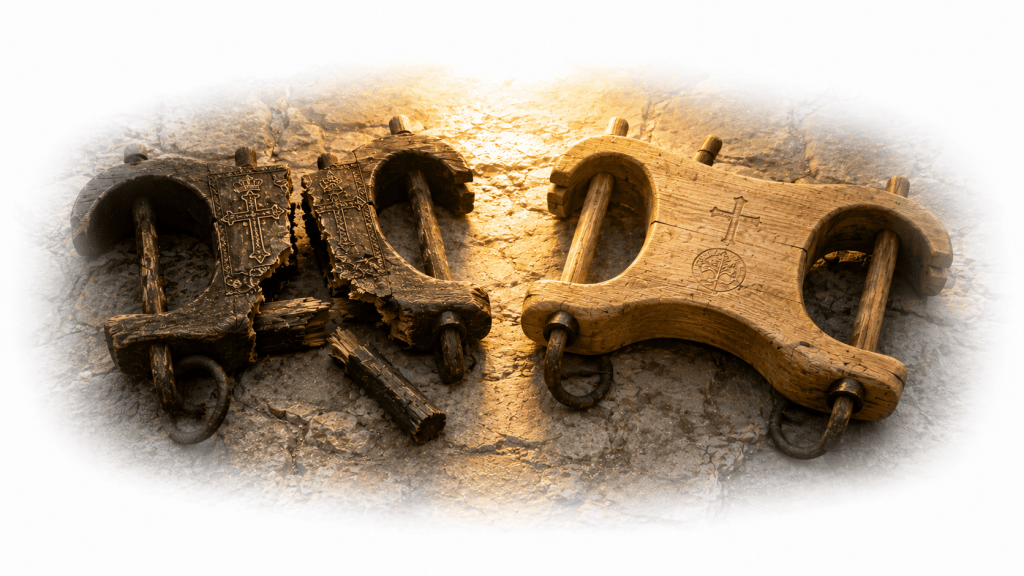
“Stand fast therefore in the liberty wherewith Christ hath made us free, and be not entangled again with the yoke of bondage” (Galatians 5:1). The yoke of bondage. Paul’s description of the specific institutional religious authority that was standing between the Galatian believers and the freedom of the gospel. Not the gospel itself. Not the Scripture. The institutional claim to govern how the gospel was received, what conditions were attached to it, whose authorization was required for the believer’s standing before God to be secure.
Confessionalism, in its most consistent expressions, has recreated a version of that yoke. It has given it a different name and different theological content. But the structure, the human institution standing between the believer and the sufficient Word, governing what the Word is permitted to say, requiring institutional authorization for interpretive conclusions, is the same structure the Reformation was a response to.
Confessionalism has rebuilt the Protestant Magisterium.
What the Magisterium Is
The word Magisterium names a specific structure, not merely a specific institution. The Roman Catholic Magisterium, the teaching authority of the Pope and the College of Bishops, is the most familiar instance of the structure. But the structure itself can be reproduced with different institutional materials. The Magisterium structure has three essential components:
One: A human institution whose interpretation of Scripture is treated as binding on the community. The institution’s reading of the text is the governing reading. When the institution has spoken, the question is settled.
Two: An authorization mechanism. The believer’s interpretive ministry, their capacity to read and teach and apply the Scripture in the community, requires the institution’s authorization. Those who interpret outside the institution’s framework are not authorized interpreters.
Three: An override function. When the plain reading of a biblical text conflicts with the institution’s settled interpretation, the institution’s interpretation overrides the plain reading. The text is read through the institution’s framework. The institution’s conclusion governs what the text is permitted to say.
These three components constitute the Magisterium structure. When all three are present, the Magisterium has been reproduced, regardless of whether the institution calls itself the Magisterium, regardless of whether it claims papal infallibility, regardless of whether its theological content differs from Rome’s.
The Protestant Magisterium Identified
In the confessional Reformed and Presbyterian tradition at Stage Four of the mechanism described in Day 11, all three components are present.
Component One — the binding institution: The Westminster Confession functions as the governing interpretation of the Scripture for the community. When the Westminster Confession has spoken, the question is settled. The confessional community does not re-open what the confession has closed.
Component Two — the authorization mechanism: The ordination examination described in Day 13 is the authorization mechanism. The candidate for ministry must be authorized by the confessional body before they can exercise an interpretive ministry in the community. The body that authorizes is the body bound by the confessional standard. The authorization requires the candidate to operate within the confessional framework.
Component Three — the override function: When careful exegetical work produces a conclusion that conflicts with the Westminster Confession’s formulation, the Westminster Confession’s formulation governs. The text is read through the confessional framework. The exegetical conclusion is rejected not because it fails the test of the text but because it fails the test of the confession.
Three components. All present. The Magisterium structure has been reproduced with Protestant materials.
The Important Differences — and Why They Do Not Change the Structural Analysis
This argument will immediately provoke a response: “The Westminster Confession is nothing like the Papal Magisterium. The Confession formally acknowledges its own fallibility. The Pope claims infallibility. The differences are fundamental.” The differences are real. They matter. They should be acknowledged precisely, not minimized.
The content differs. The Westminster Confession’s theological conclusions on justification, grace, and the gospel differ from Rome’s Magisterial conclusions on exactly these matters. The Reformation’s theological recovery was genuine and significant.
The formal status differs. The Westminster Confession formally acknowledges, in WCF 31.3, that all synods may err. The Pope’s ex cathedra pronouncements claim infallibility. This formal difference is not trivial.
The degree differs. The authority claimed for the Westminster Confession in confessional communities is, in most cases, somewhat less total and somewhat more formally accountable than the authority Rome claims for the Magisterium.
These differences are real. But they do not change the structural analysis. The structural analysis is about the functional operation, about what actually happens when a believer’s plain reading of a biblical text conflicts with the institution’s settled interpretation. And what actually happens, in the confessional community at Stage Four, is what the Magisterium structure produces: the institution’s interpretation overrides the plain reading. Formally fallible. Functionally infallible. That is the Protestant Magisterium.
Why This Matters — What the Reformation Was For
The Reformation was not primarily a theological revolution. It was a structural recovery. The specific structure the Reformation dismantled was the Magisterium, the institution standing between the believer and the sufficient Word, requiring institutional authorization for the believer’s interpretive access to the Scripture, governing what the Scripture was permitted to say through the institution’s settled interpretations.
Luther’s stand at Worms was not primarily a stand for specific theological conclusions, though those conclusions were correct and important. It was a stand against the structure. The council can err. The pope can err. My conscience is captive to the Word of God, not to the institution that claims to govern the Word’s meaning. The Reformation was the dismantling of the structure that placed the institution between the believer and the Word.
When confessionalism recreates that structure with Protestant materials, when the confession replaces the council, when the denominational standard replaces the papal decree, when the ordination examination replaces the dispensation of the Magisterium, the Reformation’s structural recovery has been reversed. Not intentionally. Not maliciously. Not in a single dramatic act of betrayal. Through the gradual, invisible, generation-by-generation mechanism described in Day 11. But reversed nonetheless.
The Consistent Application of the Reformation Principle
The Biblicist claim is not that the Reformation’s theological conclusions were wrong. They were largely right, and the Westminster Confession, for all its proper status as a fallible human document, accurately represents those theological conclusions on many of the most important questions.
The Biblicist claim is that the Reformation’s principle, Scripture alone as the supreme, final, infallible authority, must be applied consistently. To Rome. To the NAR. And to the confessional tradition that claims the Reformation’s legacy while rebuilding the structural problem the Reformation was a response to.
This consistent application is not unfair. It is the semper reformanda principle that the Reformation itself produced: the church always reforming, always accountable to the Word that governs it, never permitting any human institution; however respected, however accurate on important questions, however beloved, to take the seat that belongs to the Word.
The Protestant Magisterium must be named. Not to condemn the communities that have built it. Not to reject the genuine theological gifts those communities have produced and transmitted. But to name it honestly, so that the recovery is possible. The recovery that removes the confession from the seat that belongs to the Word. The recovery that opens the question that the institution has closed. The recovery that returns the believer to the direct access to the sufficient Word that the Spirit illuminates without mediation. The recovery that the Reformation was.
Tomorrow, Day 22, the series enters its final section. Named Critics Answered. Beginning with R.C. Sproul.
“Stand fast therefore in the liberty wherewith Christ hath made us free, and be not entangled again with the yoke of bondage.” — Galatians 5:1 KJV
📖 This post is adapted from Biblicism: The Faith Once Delivered. If it helped you, the full book is available on Amazon — or you can support this ministry directly.
thefinalconvergence.com | Follow on Instagram, Facebook, X, and YouTube
If you like to be updated on new blogs, sign up to our newsletter!


Leave a comment