
Published: August 22, 2026 | thefinalconvergence.com
Five days into the series, the foundation is laid. What the canon is, the measuring rod. How it came to be, inspired by God, recognized by the church. How that inspiration worked, men carried by the wind of the Spirit, personality intact, error absent.
Today the foundation section closes with the question that makes all of it matter: so what? If the church recognized the canon rather than creating it, what actually changes? Is this a technical point for theologians, or does it reach down into the life of the ordinary believer holding a Bible on an ordinary Tuesday?
It reaches all the way down. Because where you stand, on solid ground or shifting sand, depends entirely on this one distinction.
“The grass withereth, the flower fadeth: but the word of our God shall stand for ever” (Isaiah 40:8).
The grass withers. The flower fades. Institutions rise and fall, councils convene and dissolve, movements surge and collapse. But the Word of our God shall stand for ever, not because the church propped it up, but because God spoke it and God preserves it. That permanence is the direct consequence of recognition over creation. A Word the church created would wither with the church. A Word the church merely recognized stands forever, because its life was never in the church to begin with.
What Changes for Authority
Start with the most basic consequence. Who has the final word?
If the church created the canon, then the church has the final word, because the authority that made the Bible Scripture can also interpret it, revise it, and add to it. The Bible becomes a document the institution produced, and no document stands above the authority that produced it. On this view, when the church and the Bible seem to disagree, the church wins, because the church is the source.
If the church recognized the canon, then the Word has the final word, because the church never held the authority in the first place. It received it. The Bible is not the institution’s product but God’s, entrusted to the church’s keeping. On this view, when the church and the Bible seem to disagree, the Bible wins, because the church stands under it as servant, not over it as author.
This is not abstract. It is the exact fault line between Rome and the Reformation, and it runs through every question the church has ever fought over. Whenever a tradition, a council, a confession, or a charismatic leader claims authority to bind the conscience beyond what Scripture says, the question is always the same: by what authority? And the recognition principle gives the answer. No human institution created the Word, so no human institution stands over it. The Word measures them all.
What Changes for the Closed Canon
The recognition principle is also what makes the closed canon stay closed.
Think it through. If the church’s recognition is what made the books Scripture, then the church’s ongoing recognition could make new books Scripture too. The canon would be open in principle, a matter of continuing institutional discernment, always potentially expandable by the same authority that established it. This is precisely the logic that lets Rome add the Apocrypha and lets the NAR add prophetic words. If recognition confers authority, recognition can keep conferring it.
But if recognition merely acknowledges an authority God already conferred through inspiration, and if inspiration ran through the closed apostolic office that ended with the death of the last apostle, then there is nothing left to recognize. The inspiration stopped when the office closed. The recognition simply caught up to what God had already finished doing. And a canon closed by the end of inspiration cannot be reopened by any amount of institutional discernment, because discernment was never what closed it. God closed it. The church only noticed.
This is why recognized, not created is the lock on the canon door. Creation could always add another key. Recognition means the door was shut by a hand no institution can reach.
What Changes for the Ordinary Believer
Here the distinction comes home to the person in the pew, and it changes everything about how they hold their Bible.
If the church created the canon, the ordinary believer is dependent on the institution for access to the Word. You cannot be sure of Scripture without the church’s certification, because the church is the source of Scripture’s authority. Your confidence in the Bible runs through the institution. Cut off from it, or in conflict with it, you have no independent ground to stand on. This is, not coincidentally, exactly the position Rome has always wanted the laity in: you need us to tell you what the Bible is and what it means.
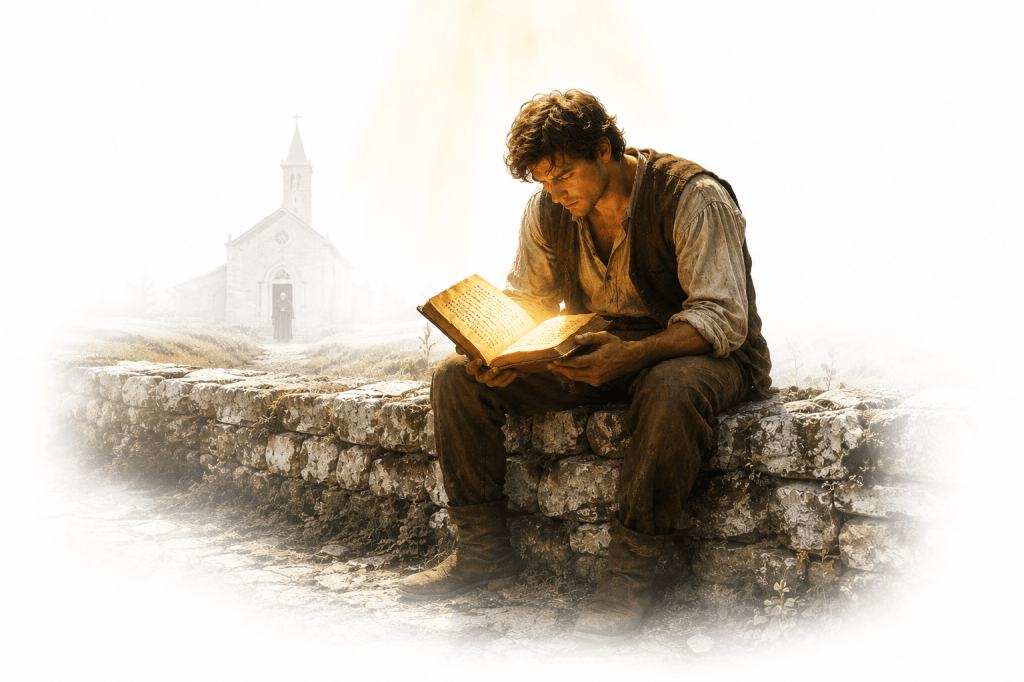
If the church recognized the canon, the ordinary believer stands on the Word directly. The same Spirit who inspired the text and led the church to recognize it bears witness in the heart of every believer who reads it. You do not need the institution’s certification to know the Shepherd’s voice, you need the Shepherd’s Spirit, which every believer has. This is the liberation the Reformation recovered: the plowboy with a Bible in his own language, reading the Word for himself, standing on it directly, answerable to God rather than mediated by an institution.
The recognition principle is what puts the Bible in your hands and keeps it there. It says: this Word is God’s, given to His people, sufficient in itself, and yours to read directly. No priest between you and the page. No Magisterium deciding what you are permitted to see. The measuring rod is in your hand, and you may measure everything, including the very institution that would claim authority over you, against it.
What Changes for Discernment
This is where the foundation section has been driving the whole time. The recognition principle is not just a doctrine about the past. It is a working tool for the present, the tool that lets you test every claim that comes at you.
Every counterfeit works the same way: it tries to smuggle in authority the Word never granted. The NAR prophet says God gave him a fresh word. The Roman apologist says the church has authority the Bible does not name. The progressive teacher says the suppressed gospels deserve a hearing. The cult leader says his new scripture completes the old. In every case, someone is claiming to add to, override, or stand above the settled Word.
And in every case, the recognition principle is the answer. Ask: by what authority? If the answer is anything other than the inspired, closed, recognized canon, the claim fails, because no new authority can be recognized where no new inspiration has occurred, and inspiration closed with the apostolic office. The counterfeit always requires the canon to be open. The recognition principle keeps it shut. That is why the enemy has attacked this single distinction, in a thousand costumes, since the garden. If he can convince you the church created the Bible, he can convince you the church can change it, and then everything is negotiable. But if you know the church only recognized what God had already settled forever, you have solid ground under your feet that no movement, no council, and no fresh revelation can move.
The Ground Beneath Your Feet
This is why the distinction changes everything. It determines who has final authority. It determines whether the canon stays closed. It determines whether you hold the Bible directly or through an institution. And it determines whether you can stand firm when the counterfeits come, as they will, in every generation.
The grass withers. The flower fades. Every institution that ever claimed to author the Word will pass away, and every movement that ever claimed to supplement it will collapse. But the Word of our God shall stand for ever, settled in heaven before any council met, recognized by the sheep who know the Shepherd’s voice, preserved by the God who promised to keep it.
That is the foundation. It is solid rock. And it is the ground the rest of this series is built on.
Tomorrow the series turns to the specifics, how the Old Testament canon was actually formed. Law, Prophets, and Writings.
“The grass withereth, the flower fadeth: but the word of our God shall stand for ever.” — Isaiah 40:8 KJV
📖 This post is adapted from Canon and Covenant: How God Preserved His Word Through History. If it helped you, the full book is available on Amazon — or you can support this ministry directly.
thefinalconvergence.com | Follow on Instagram, Facebook, X, and YouTube
If you like to be updated on new blogs, sign up to our newsletter!


Leave a Reply